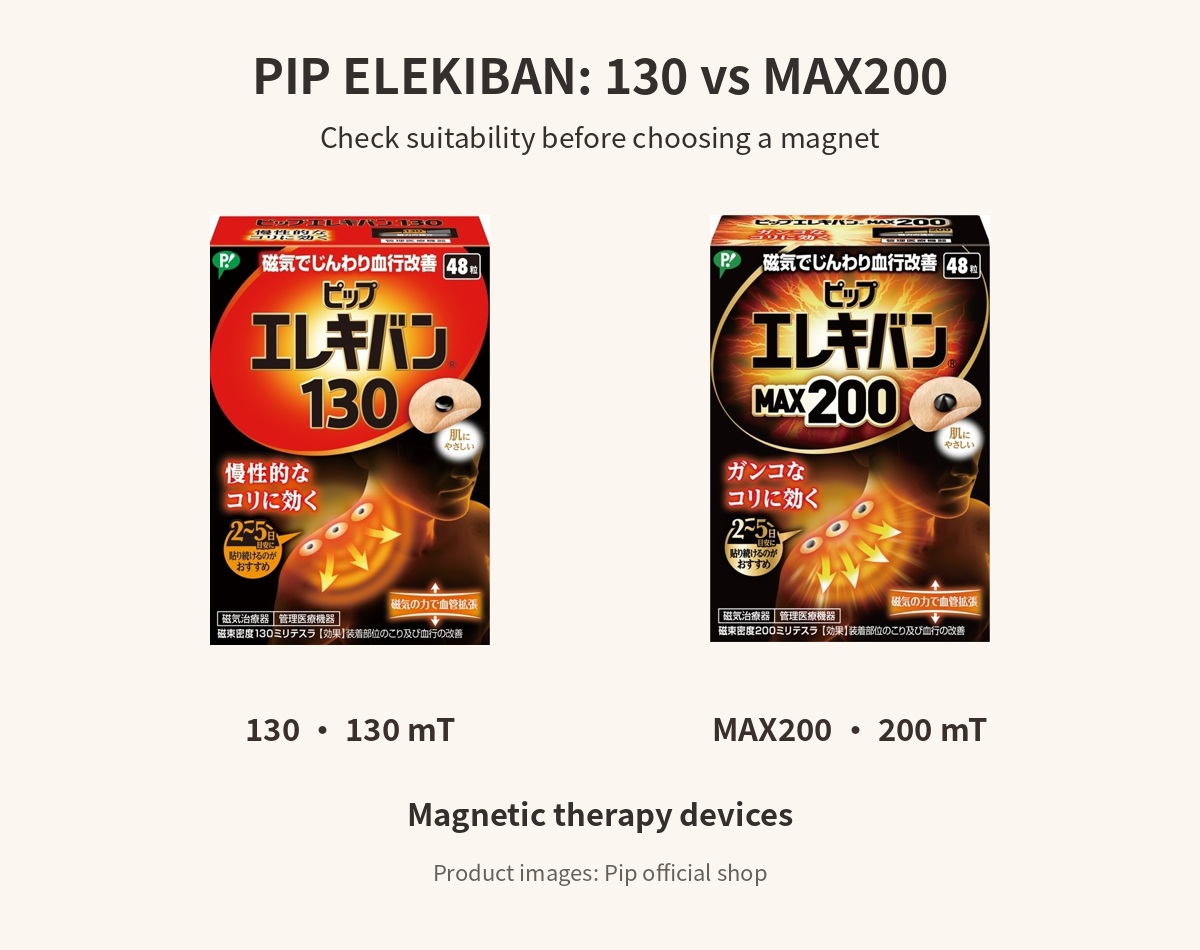
Before choosing the bigger number on a PIP ELEKIBAN box, check whether a magnetic device is suitable for the person who will use it. ELEKIBAN 130 and MAX200 are magnetic therapy devices, not medicated anti-inflammatory patches. Their magnetic specifications differ, but both have the same labelled purpose in Japan.

I’m Irene, a Taiwan-born pharmacist licensed in Japan and working in a Japanese drugstore. These little discs can look similar to medicated spot patches. When choosing them for a family member, checking for a pacemaker or other medical equipment is more important than choosing a pack size.
Checked: 19 October 2026. This guide covers the Japanese-market ピップエレキバン130 and ピップエレキバンMAX200. Instructions for products sold in other countries may differ.
- Looking for a medicated pain patch? Check the active ingredient rather than choosing by shape.
- Considering a magnetic patch? The 130 model is rated at 130mT; MAX200 is rated at 200mT and uses a larger, cone-shaped magnet.
- Using an implanted medical electronic device or medical electrical equipment such as an adjustable-pressure cerebrospinal-fluid shunt? Do not use either product.
- ELEKIBAN 130 vs MAX200: what actually differs?
- A magnetic device is a different choice from a medicine patch
- Who must avoid them, and who needs advice first?
- How to apply them, and what “2–5 days” means
- Children, loose magnets and reuse
- Packing them for travel or buying for someone else
- Official sources and complete instructions
ELEKIBAN 130 vs MAX200: what actually differs?
ELEKIBAN 130: the 130mT model
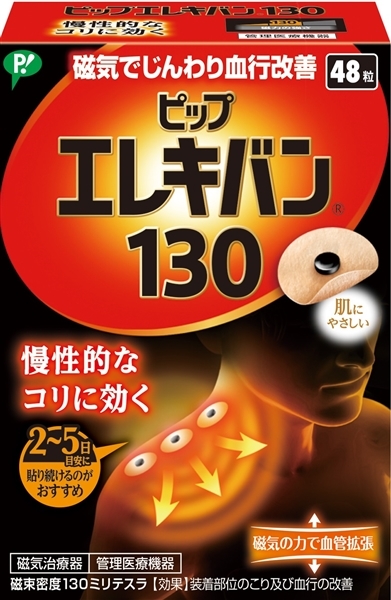
Look for ピップエレキバン130 and the large “130” on the red-and-black box. Its maximum magnetic flux density is 130 millitesla (mT); its Japanese device certification number is 225AGBZX00030000. The official shop lists packs of 12, 24, 48 and 72. These are different quantities of the same model, not different strengths.
ELEKIBAN MAX200: 200mT with a larger cone-shaped magnet
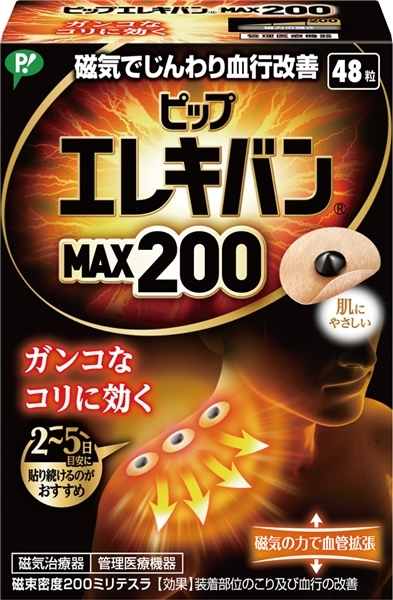
The full Japanese name is ピップエレキバンMAX200. Its maximum magnetic flux density is 200mT, and Pip describes its magnet as larger and cone-shaped. Its certification number is 228AGBZX00091000. The official shop lists packs of 12, 24 and 48; look for “MAX200” on the black-and-gold box.
Once you have checked suitability, choose 130 if you want the 130mT specification, or consider MAX200 if you want the 200mT specification and its different magnet design. The ratio 200/130 does not tell you how much better a person will feel. Neither the number nor the pack colour establishes a guaranteed clinical advantage. Both are labelled for improving stiffness and blood circulation at the application site. If you are trying one for the first time, a smaller pack lets you assess skin tolerance before buying more.
A magnetic device is a different choice from a medicine patch
In Japan, both are controlled medical devices: permanent-magnet therapy devices for home use. They consist of a magnet and an adhesive dressing; they are not topical NSAID medicines. The labelled purpose is local stiffness and circulation improvement, not treatment for every kind of pain, sprain, trapped nerve or vascular disease.
For medicated options, see the ROIHI warm, cool and loxoprofen patch guide or the Vantelin patch comparison. Medicated patches have their own ingredients, indications, age limits and replacement schedules. Do not transfer those instructions to ELEKIBAN. Equally, a product without a drug ingredient is not automatically safer: magnetic-device restrictions and adhesive reactions still matter.
Who must avoid them, and who needs advice first?
Do not use either model if you use an implanted medical electronic device, such as a cardiac pacemaker, or medical electrical equipment such as an adjustable-pressure cerebrospinal-fluid shunt. Magnetic interference can cause malfunction. Placing the patch farther away is not a substitute for this prohibition.
Consult a doctor or another appropriate healthcare professional before use if you are receiving medical treatment or have any of the following:
- A malignant tumour or a heart disorder.
- The unstable early stage of pregnancy, or the period immediately after childbirth.
- Impaired sensation caused by severe peripheral circulatory problems, for example due to diabetes.
- A skin infection or wound, or a condition requiring rest.
- A fever of 38°C or higher; the leaflet also highlights marked acute inflammatory symptoms such as fatigue, chills or blood-pressure changes, and states of physical debility.
- An acute painful condition such as a sprain or muscle strain.
Do not use alongside other therapeutic devices or modify the product. Do not apply to the head, face, around the eyes, mucous membranes or abnormal skin. Remove all patches before an MRI examination and tell the imaging staff about magnetic products you have been wearing. Keep magnets away from items susceptible to magnetism, including watches and magnetic cards.
How to apply them, and what “2–5 days” means
- Check the product and skin. Look for abnormalities, detached magnets or foreign material. If the product has been stored for some time, check that no metal has been attracted to it. Wipe the skin clean and dry; after exercise or bathing, wait until sweating has stopped.
- Find the actual stiff spot. The instructions describe gently pressing the stiff area to find a slightly tender spot that feels comfortable to press. Do not press hard or treat every dot in a diagram as a required application point.
- Peel back the backing and lift off one patch at a time. Apply at the stiff spot, adding patches to either side or around it if needed. Avoid overlapping or wrinkling the adhesive. Press gently after application; lifting and reapplying reduces adhesion.
- Use 2–5 days as a guide, while checking your skin. Both instruction sheets give this range and permit bathing while wearing the patches. Do not scrub the application area hard. The range is not a requirement to endure irritation for two days, nor permission to leave a patch on indefinitely.
- Peel off slowly. If removal hurts, thoroughly wet the patch in a bath or shower and support the skin as you peel. Discard promptly after use; do not reuse the magnet.
Remove immediately if you feel itching or pain. Stop use immediately for a rash, redness, itching or any unusual physical symptoms. Consult a physician immediately if dermatitis (skin inflammation) occurs; also seek medical advice if other physical symptoms concern you. Do not simply move the patch and push through a reaction. On later use, avoid repeatedly applying to the same spot, especially if you have reacted to adhesive dressings before.
If use does not help, consult a doctor or another appropriate professional. The leaflet does not specify a number of days you must wait before seeking advice. New, worsening or activity-limiting symptoms deserve assessment rather than repeated purchases.
Children, loose magnets and reuse
Pip’s FAQ does not recommend use in children aged six or younger for handling-safety reasons. Children aged 7–12 and anyone needing supervision should use it under a caregiver’s guidance. Age alone does not establish suitability; the medical and device restrictions above still apply.
Do not transfer a used magnet to fresh adhesive tape. Both complete leaflets explicitly prohibit magnet reuse. A permanent magnet retaining its magnetism does not mean the complete product can be reused indefinitely. Loose magnets create an ingestion risk for children, people needing supervision and pets; handling used magnets also creates hygiene concerns.
If a magnet is swallowed or you suspect it has been swallowed, seek medical attention immediately rather than waiting for it to pass. The leaflet warns that retained magnets may require surgery. Dispose of used patches promptly and safely, following local waste rules, where children cannot retrieve them.
Packing them for travel or buying for someone else
Keep the original packaging and instructions. Store out of reach of children and anyone needing supervision, away from direct sunlight, heat and humidity. Stack the remaining backing sheets with the magnets facing the same direction, as shown in the leaflet, to prevent repulsion from dislodging them. Do not leave loose magnets in a travel pouch.
My final check: confirm medical equipment, current treatment and skin condition first, then the exact model and pack quantity. “130” and “200” describe magnetic specifications; they are not a score telling you to upgrade whenever stiffness feels worse.
Official sources and complete instructions
- ELEKIBAN 130: official product information
- MAX200: official product information and FAQ
- Pip: current brand range
- 130: complete Japanese instructions (2 pages)
- MAX200: complete Japanese instructions (2 pages)
Product images: Pip official shop. Read the complete instructions supplied with your product. This guide supports product identification and label understanding; it does not replace individual medical advice.