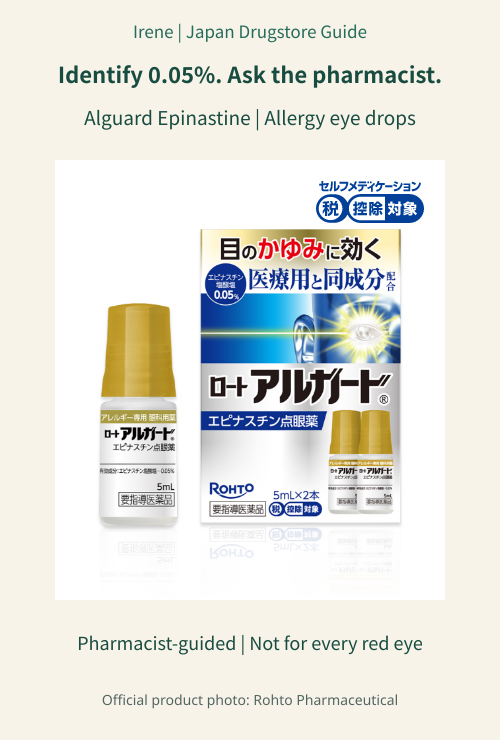

I’m Irene, a Taiwan-born pharmacist working in a Japanese drugstore. The Alguard name alone does not tell you which bottle to choose. For this product, match the full name and concentration first. Then decide with the pharmacist whether allergy treatment fits your symptoms, rather than choosing by a stronger-looking package.
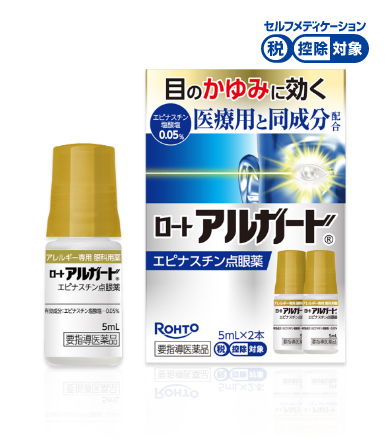
The three things to match on the shelf
Look for ロートアルガード エピナスチン点眼薬, epinastine hydrochloride 0.05%, and 5 mL × 2 bottles. The Japanese classification is 要指導医薬品: ask the pharmacist about this product and whether it is appropriate for you. Do not treat this article as a purchase eligibility check.
This is a different medicine from Alguard Clear Block EXa/Z. It is also not interchangeable with a prescription product just because both names include epinastine. Follow this exact product’s directions, not instructions remembered from another bottle.
What is new, and who might consider it?
Launched in Japan on March 12, 2026, this product brings epinastine hydrochloride 0.05% to a non-prescription allergy eye drop. Its role is relief of eye allergy symptoms caused by pollen, house dust and similar triggers: itching, redness, watering, a gritty sensation and blurred vision associated with discharge. That is not a promise to treat every red or uncomfortable eye.
It is not a general treatment for dry eyes, tired eyes or an eye infection. If only one eye is affected, eye symptoms occur without nasal symptoms, vision has declined, or you have a lot of thick, sticky, coloured discharge (such as yellow-green discharge), consult a doctor or pharmacist before using it. Do not guess that these signs are simply allergies.
The manufacturer describes use from age 1, but its FAQ also says the child should be able to communicate symptoms and how the drops feel. “Age 1+” is not a blanket recommendation for every young child. Children need adult supervision; children with atopic dermatitis, asthma or other allergic tendencies need advice before use.
Before opening the bottle
Do not use it if you have previously had an allergic reaction to this product or an ingredient. Consult a doctor or pharmacist first if you are receiving medical treatment, pregnant or possibly pregnant, have a history of reactions to medicines, are receiving allergy treatment such as desensitisation, have severe eye pain or a strong foreign-body sensation, have diagnosed or suspected dry eye, or do not know what is causing your symptoms. The manufacturer also recommends consultation when breastfeeding. Tell the pharmacist about your current medicines and eye drops.
A visual routine: one drop, four times daily
1. Remove contact lenses
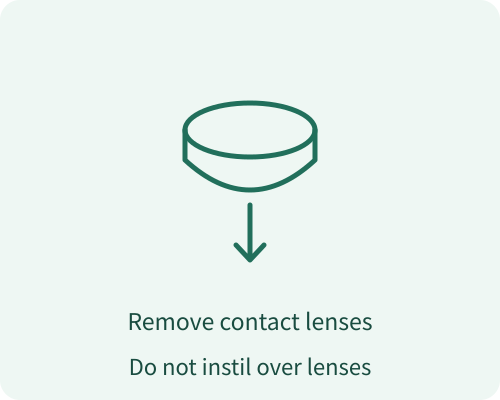
Do not instil these drops while wearing contact lenses, including hard lenses. The manufacturer’s FAQ advises waiting approximately 5–10 minutes after instillation before reinserting lenses. Check with the pharmacist if your eye condition makes wearing lenses unsuitable.
2. Use one drop each time
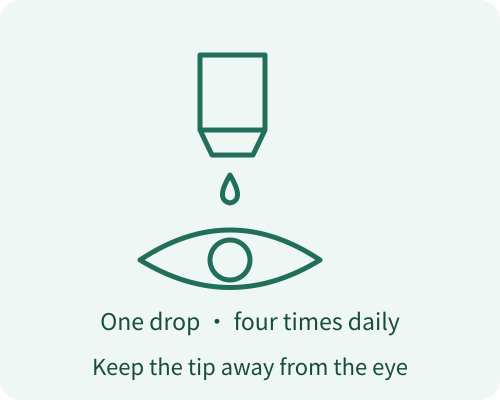
The labelled schedule is one drop, four times a day: morning, midday, evening and before bed. Do not use extra drops to make it work faster. Keep the bottle tip away from the eye, eyelid and eyelashes. Wipe away liquid that runs onto the surrounding skin. Use only in the eyes, and do not use liquid that is cloudy or contains floating particles.
3. Close gently and pause
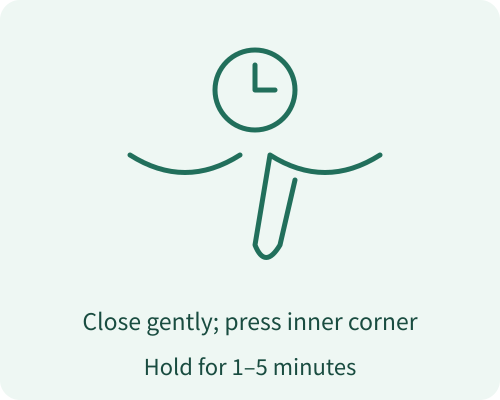
After instillation, close the eye and gently press the inner corner for 1–5 minutes. When another eye drop is also appropriate, leave at least 5 minutes between products. This spacing rule does not mean every combination is suitable: confirm your actual medicines with the pharmacist or doctor first.
For seasonal allergy, the label discusses starting 1–2 weeks before pollen dispersal or early in the symptomatic period. Ask how this applies to you rather than starting a preventive course simply because you are travelling to Japan.
Three stopping rules, not one long waiting period
Stop immediately and consult a doctor if vision declines, eye pain develops or symptoms worsen. Do not wait for a week in these situations.
Stop immediately and consult a doctor or pharmacist if possible side effects appear: skin rash/redness; eye irritation or stinging, gritty feeling, light sensitivity, pain, watering, itching, swelling, redness, discharge or blurred vision. Pain, itching, stinging and swelling may also affect the area around the eyes.
Stop and seek advice if blurred vision does not improve or symptoms have not improved after about one week. Even if symptoms improve, consult before continuing beyond two weeks. Bring the leaflet when seeking advice.
Two bottles do not mean “keep using until empty”
Keep tightly closed in a cool place, away from direct sunlight, heat and children. Do not share or decant the drops; do not use after expiry. Use promptly after opening. The manufacturer’s approximate 2–3-month after-opening quality guideline depends on storage and handling; it is not permission for continuous treatment for that long. Keep the treatment review rules above separate from bottle storage.
Irene’s shop-floor takeaway
Match the exact pack, tell the pharmacist your symptoms and existing treatment, and leave knowing the daily schedule and when to stop. If the cause is uncertain, getting it checked is more useful than leaving with a bottle that merely says “allergy.” This guide supports that conversation, not a diagnosis.
Official sources
Product photograph: Rohto Pharmaceutical’s official product page. The use diagrams are Irene’s illustrations based on official instructions, not manufacturer artwork. Read them together with the text and package leaflet.
Current linked package leaflet
Manufacturer FAQ, contact lenses