 I’m Irene, a Taiwanese pharmacist working in a Japanese drugstore. This guide brings together the official sizing, changing and disposal directions to help you choose in store and prepare for a trip.
- Look for the full name おでかけ交換ショーツ. These are disposable menstrual pad-shorts with side-fastening tabs.
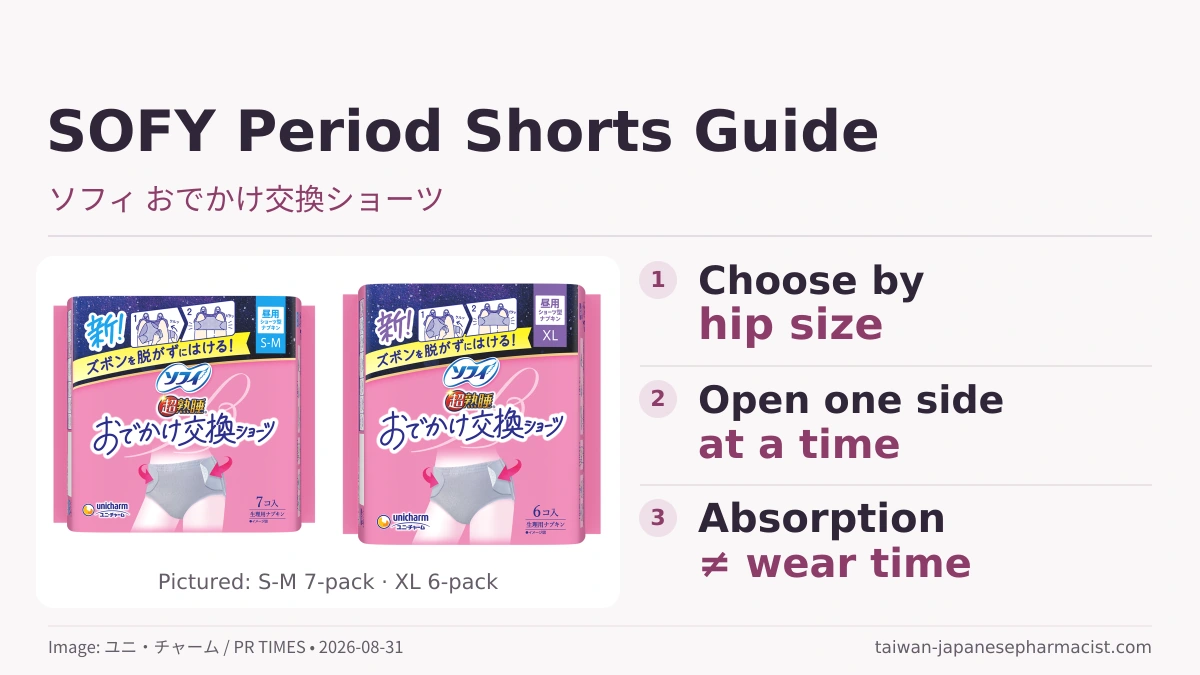
- Choose by hip measurement, not waist measurement. There are three sizes, S-M, M-L and XL, and their pack counts differ.
- “Up to 12 hours’ worth of absorption” is not a 12-hour changing schedule. The manufacturer says to change as appropriate for your menstrual flow.
- How to identify the right SOFY product in Japan
- Choose a size: hips first, then pack count and JAN
- Replace the whole pair, not an absorbent insert
- Plan spare supplies and toilet stops together
- Disposal: keep the individual wrapper handy
- Where to buy: check the exact size before the store
- Sources and image credit
How to identify the right SOFY product in Japan
Match ソフィ おでかけ交換ショーツ, then check 昼用 ショーツ型ナプキン (daytime shorts-shaped menstrual pad), the size and the pack count. The pack may also carry the 超熟睡 range name, but that alone is not specific enough. Other pad-shorts exist in the range; do not apply the side-fastening method below to a different product.
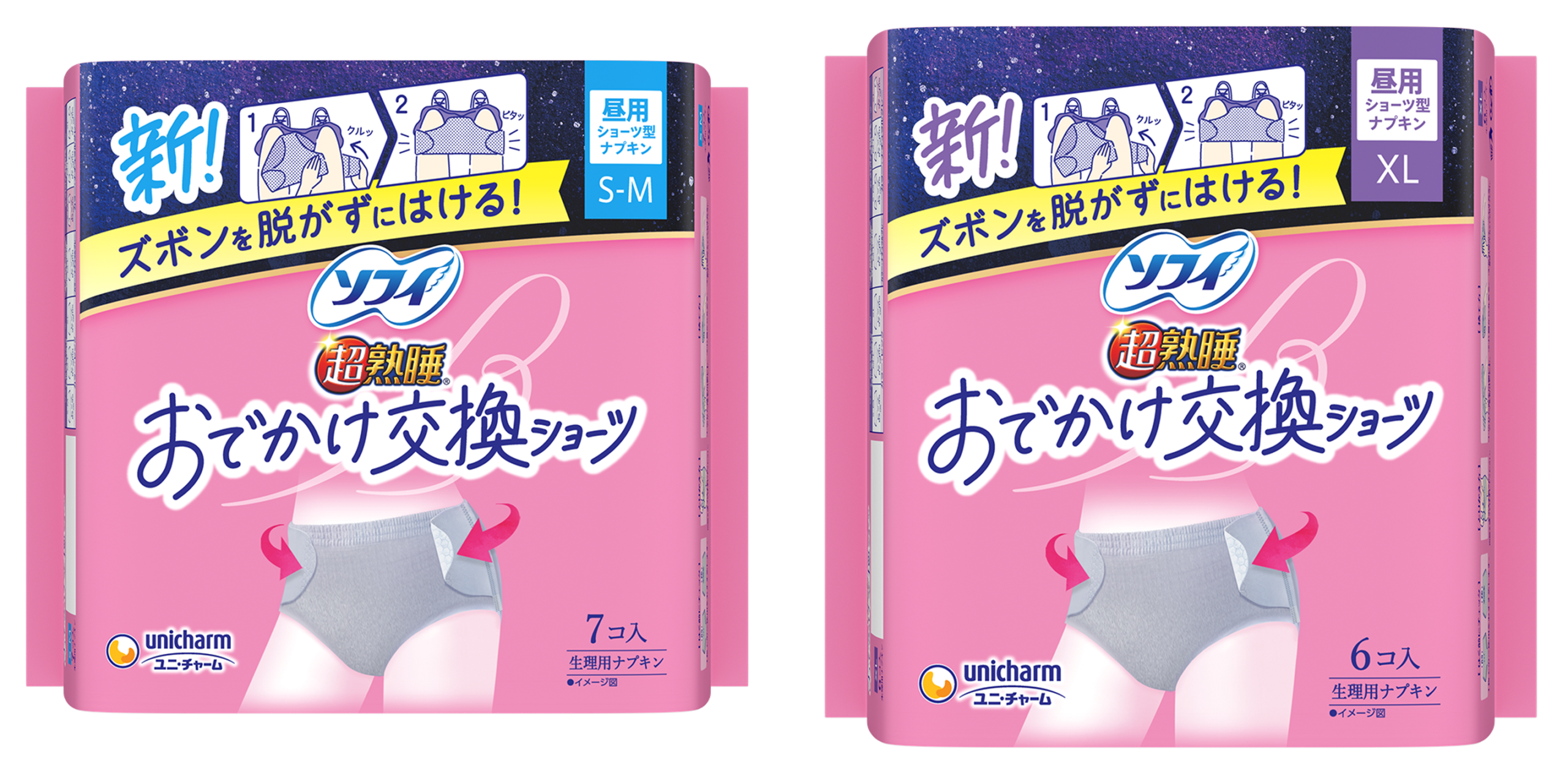
The image shows pink outer packs with grey pad-shorts illustrated on them. Neither pink nor grey is enough to identify the product, and packaging can change. These are Japan-market products; the official shop lists the origin of all three packs below as China. Being sold in Japanese drugstores does not mean they are made in Japan.
Choose a size: hips first, then pack count and JAN
The hip ranges below come from SOFY’s current guide. Pack counts and JAN barcodes were checked against the matching official-shop listings. These are hip measurements, not waist measurements, and the letters should not be treated as equivalent to your usual clothing size.
S-M
Hips: 82–95cm
Seven per pack
JAN
4903111285785
M-L
Hips: 87–100cm
Seven per pack
JAN
4903111025657
XL
Hips: 97–105cm
Six per pack
JAN
4903111053247
The ranges overlap, so falling within two ranges does not establish which size will fit you better. Compare your hip measurement with the actual pack and check the fit when wearing it. The tabs allow adjustment, but do not replace choosing an appropriate size.
S-M and XL were added in Japan on September 15, 2026; M-L was already on sale. Older information also shows an M-L four-piece pack. Its official-shop page displayed “販売停止中です” (sales suspended) when checked, so it is not included as a current buying option here. That shop status does not establish that the manufacturer has discontinued it everywhere.
Replace the whole pair, not an absorbent insert
This product combines a menstrual pad with a shorts-shaped body. Opening its sides lets you put on a fresh pair without fully taking off trousers, tights or shoes. You still need a suitable place to change and must move your clothing enough to reach the fastening area. These are not washable period underwear, and there is no separate insert to replace while keeping the same body.
To put on a fresh pair, follow the official sequence: finish one side before starting the other.
- Open the fastening tab on one side first. Do not begin by opening both sides.
- Tear that side along its perforation. Pull the joined sides apart as shown on the pack.
- Wrap it around above your knee and fasten at the original alignment. Secure this side first.
- Repeat on the other side, then pull up to your waist. Check the position and fit, adjusting the tabs according to the pack directions.
Before packing it for the first time, read the directions on the outer pack and individual wrapper. Remembering “one side, then the other” makes the sequence clearer. The steps above summarize the official directions; use the illustrations on your purchased pack when changing.
Plan spare supplies and toilet stops together
Not having to remove trousers completely can reduce the changing steps, but it does not remove the need to change. The manufacturer’s “up to 12 hours’ worth” describes absorption, not a universal wearing time. Change as appropriate for your flow. Do not calculate your daily supply by assuming each pair will last 12 hours, or deliberately postpone toilet visits because of that claim.
① At the shelf: identify the pack
おでかけ交換 + 昼用Match hips, size and pack countShow the matching JAN if you need help
② In your bag: prepare to change
Bring spares for your own changing needsRead the method and plan toilet opportunitiesFold, wrap and dispose of the used item properly
Keep unused spares in their individual wrappers inside an easy-to-reach pouch. A separate bag for wrapped used items can help if a toilet has no suitable disposal bin: carry the item away and dispose of it according to local rules. This is packing advice, not a claim that a disposal bag is included with the product.
Disposal: keep the individual wrapper handy
- Fold with the soiled surface inward. Fold the whole used item.
- Roll from one side. Secure it with the tab on the opposite side.
- Wrap it in the individual wrapper and bin it. Use a suitable sanitary-waste bin and follow local disposal instructions. Do not flush it.
The official precautions advise consulting a doctor if the product does not suit your skin. If you are concerned about your menstrual flow or clots, SOFY’s guide recommends seeing a gynecologist. The absorption claim is not a way to assess whether a change in your menstrual bleeding needs attention.
Where to buy: check the exact size before the store
SOFY lists Japanese drugstores, supermarkets and online shops as sales channels, with a store-search link on its product guide. This does not mean every branch stocks all three sizes. Show a shop assistant the full Japanese name, size and JAN rather than asking only for SOFY night shorts. Check the current price, packaging and availability when buying.
Sources and image credit
Checked November 11, 2026. This guide is based on manufacturer information, not a hands-on fit, absorption or leakage test. Specifications, packaging and sales status may change.
Primary official sources
- SOFY: Odekake Koukan Shorts product guide and FAQ: the three hip ranges, tab adjustment and its limits, qualifications to the 12-hour absorption claim, disposal and sales channels.
- Unicharm official shop: S-M seven-piece pack, M-L seven-piece pack and XL six-piece pack: pack counts, JANs, origin, wearing directions and precautions.
- Unicharm official shop: M-L four-piece pack: sales-suspended status at the time checked, not evidence of a manufacturer-wide discontinuation.
- Unicharm release, August 31, 2026: September 15, 2026 launch of the additional S-M and XL sizes, size information and the two-pack product image used here.
- Unicharm release, September 19, 2025: original product introduction and the four-step method for fastening one side, then the other.
Topic discovery
Japaholic’s Japanese everyday-products article (October 13, 2026) introduces this product through the problem of changing in public toilets. This guide adds official sizing, JANs, changing and disposal details. That media coverage is not used as sales, popularity or performance-test evidence.