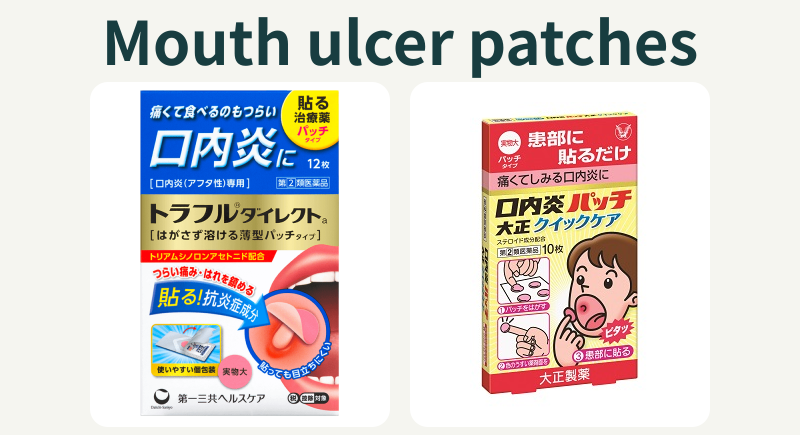
Traful Direct a dissolves; Taisho Quick Care does not. Quick Care comes off naturally, and you discard the loose patch. Both contain a corticosteroid and treat aphthous mouth ulcers, also called canker sores. Neither is a patch for every sore in or around the mouth.

I’m Irene, a Taiwanese pharmacist working in Japan. Let us check which side touches the sore, then whether your patch should dissolve or come off naturally.
A small ulcer can make meals uncomfortable during a trip. Before comparing boxes, let us check whether a patch fits the problem, then work through the two details that matter most: which side touches the ulcer, and what happens afterwards.
Recognise the correct Japanese boxes
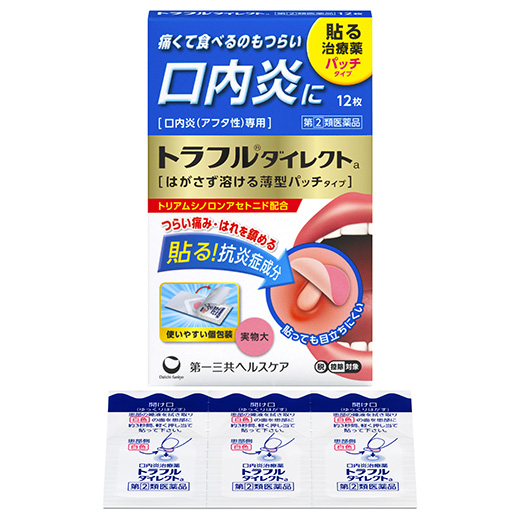
Traful Direct a: white side down, dissolving film
The white side goes against the ulcer; the pink side faces out. The film dissolves naturally, so you do not need to peel it off. Dissolving does not establish that it heals an ulcer faster than Quick Care.
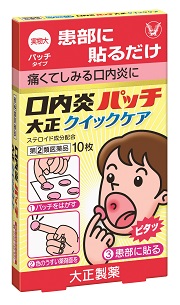
Taisho Quick Care: pale side down, non-dissolving film
Let the film come off by itself, then discard it. Do not pull it off forcibly. Taisho also sells a different product with “A” in its name; do not apply this guide’s ingredient information or instructions to that product.
Each contains triamcinolone acetonide 0.025mg per patch, an anti-inflammatory corticosteroid. Both are for ages 5 and over: one patch per affected site, once or twice daily. Children aged 5–14 need adult supervision, including watching that they do not pick the patch off. Do not use under age 5. This guide concerns the Japanese versions; check the full name and leaflet in your own pack.
Applying Traful: remove saliva, then find the white side
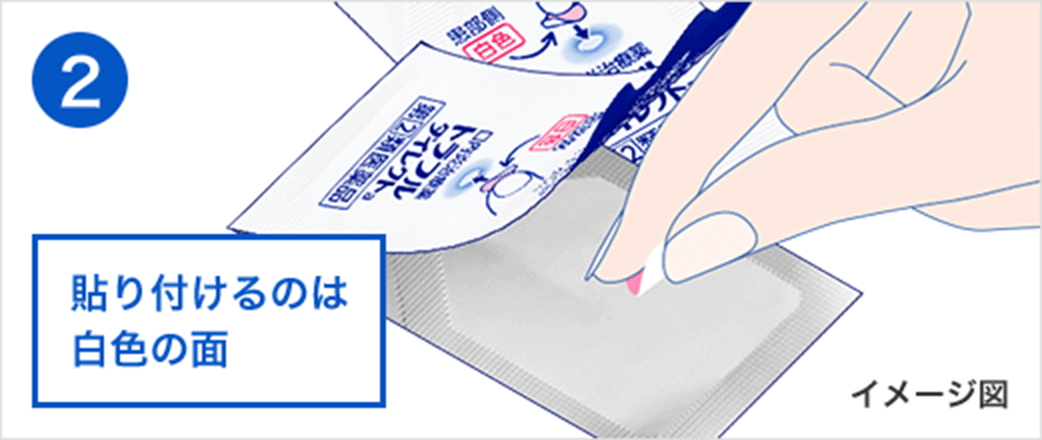
- Gently blot excess saliva from the ulcer with clean tissue or gauze.
- Peel the foil open slowly and lift out the film. Keep the packaging out of your mouth.
- Using a mirror, place the white side over the ulcer. Hold it for about three seconds, including the edges; try a little longer if needed.
- Avoid eating or drinking immediately afterwards, and do not push the patch with your tongue. Let it dissolve. If it falls off before dissolving, discard it rather than swallowing it.
If it keeps slipping, check moisture and orientation first. For a difficult-to-reach sore, ask a pharmacist about a more suitable treatment instead of repeatedly trying to attach a patch.
Applying Quick Care: find the pale side away from the backing
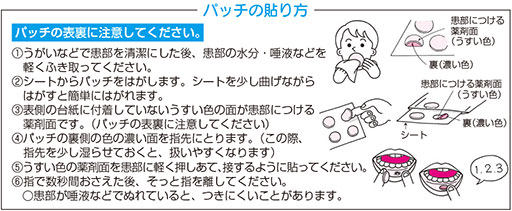
- Clean your mouth, for example by rinsing, then gently blot moisture from the affected site.
- Bend the clear backing sheet slightly to release a patch. Identify the pale side that was not attached to the sheet.
- Support the darker back with your fingertip. Press the pale medicine side onto the ulcer, hold for a few seconds, then lift your finger away.
- Avoid pushing it with your tongue. It does not dissolve. Let it loosen naturally and discard the detached patch or remaining pieces.
When these patches are unsuitable
Corticosteroids can worsen infections. Do not use either product for suspected infectious mouth sores or on sites with an oral infection such as infected gums. Warning signs include widespread removable white patches, yellow pus, multiple small blisters, blisters or rash outside the mouth, fever, appetite loss, feeling generally unwell or swollen lymph nodes.
Ask before use if you are pregnant or may be pregnant, breastfeeding, older, under medical or dental treatment, have a history of allergic reactions, or have a sore too extensive for a patch. Do not try to cover a large unexplained lesion with overlapping patches.
Stop and seek advice if symptoms worsen after one or two days, or have not improved after five days. Stop immediately for possible reactions such as new white patches, pus, asthma symptoms or swelling. New fever, rash, itching, blisters outside the mouth, spreading ulcers, eye pain, blurred vision or genital ulcers also need assessment. You do not need to wait five days when something is getting worse.
Common questions
Can I swallow the patch?
Neither is an oral tablet. If swallowed accidentally, both leaflets instruct you to apply a new patch to the ulcer and seek advice if symptoms change or you are concerned. Repeated detachment is a reason to check the technique, not to keep replacing patches without addressing it.
Can I eat immediately?
Traful’s leaflet says to avoid food and drink immediately after application. Its manufacturer also warns that chewing and increased saliva can make a patch applied before a meal come off more easily. Covering an ulcer does not guarantee a pain-free meal or uninterrupted adhesion.
What about cracked lips or corners of the mouth?
The outer lip and corners are different from the lining inside your mouth. See the MOILIP guide to cracked lips and mouth corners for that distinction. Blisters need assessment rather than choosing a medicine by location alone.
Keeping the remaining patches
Keep them in their original packaging, cool and dry, away from sunlight and children. Check expiry dates. Return unused Quick Care patches to the original pouch, fold its opening securely and use promptly after opening.
For other products, browse the Japanese drugstore guides by the problem you want to address.
Manufacturer sources
Checked 10 October 2026. Read the complete leaflet in your pack before use. This guide cannot diagnose an individual sore.