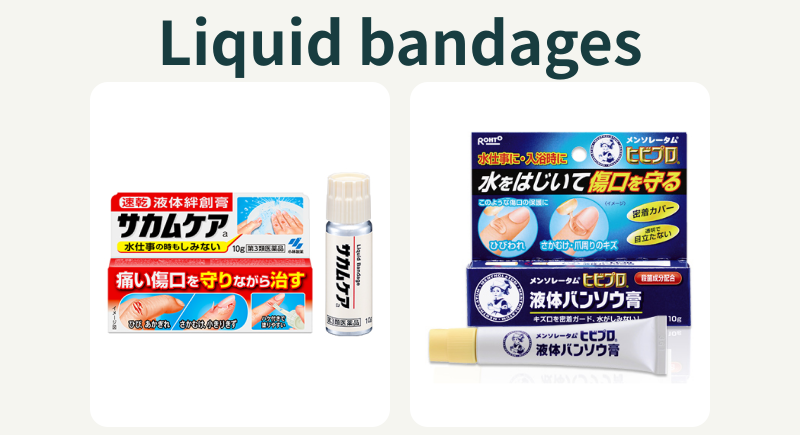
Check the wound before choosing the applicator. For a small finger cut or split beside a hangnail, consider a liquid bandage only after bleeding has stopped and the area is clean and dry, with no pus. Sakamucare a uses a brush; Mentholatum Hibipro Liquid Bandage uses a dome-shaped tube tip and also contains an antiseptic. Both may sting briefly on application. Let the film dry before getting it wet.
Do not seal a bleeding, large, deep, infected or ulcerated wound yourself. Keep both products away from eyes, the area around them and mucous membranes. If you are unsure about your wound, show it and the product to a pharmacist or doctor.

I’m Irene, a Taiwanese pharmacist working in Japan. An adhesive bandage that keeps lifting while you wash dishes can be frustrating. Before switching to a liquid version, let’s check whether it suits your wound and how to apply it without missing the drying step.
Find the right Japanese box
Liquid bandages dry into a protective film. In Japan, look for “液体絆創膏” or “液体バンソウ膏.” This guide covers two Japanese 10g products. Names used for products sold in Taiwan, including 創護寧, do not establish that a Japanese product has the same formula or instructions.
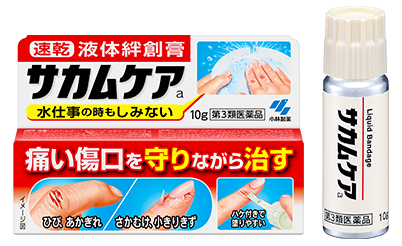
Sakamucare a: brush application
The Japanese registered name is サカムケアa. It is a Class 3 OTC medicine in Japan. Its active ingredient is pyroxylin, 12g per 100g, which forms a film over the affected area. Its labelled uses include hangnails, abrasions, skin cracks, chapped splits and small cuts.
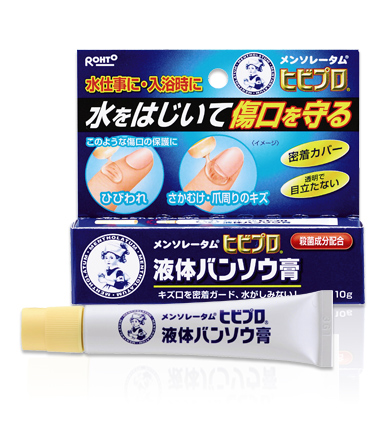
Mentholatum Hibipro Liquid Bandage: dome-shaped tube tip
The front says メンソレータム ヒビプロ 液体バンソウ膏; the registered name is メンソレータム液体絆創膏b. It is a designated quasi-drug in Japan, with the antiseptic triclocarban (trichlorocarbanilide) 0.1%. Pyroxylin is listed among its other ingredients. Labelled uses include disinfecting and covering abrasions, cuts, punctures, scratches and small wounds caused by shoe friction.
The different classifications do not rank their effectiveness or gentleness. An antiseptic ingredient does not make an infected wound suitable for sealing. Likewise, a label mentioning punctures should never be read as advice to close a deep puncture wound at home.
Avoid look-alikes: Hibipro ointments and lip products, and hydrocolloid dressings, have their own instructions. The steps here apply only to these two liquid products. Recheck the exact name, classification, ingredients and directions on the box you buy.
Where does the liquid go?
Clean the wound and surrounding skin, check that bleeding has stopped and dry the area. Even after bleeding stops, the wound must still meet the product’s labelled uses and precautions. Rohto warns that moisture and oil can make Hibipro harder to apply or its film easier to peel off.
Using Sakamucare’s brush
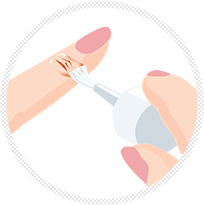
- Open the bottle and use the attached brush to pick up an appropriate amount.
- Apply only to the wound area, as the insert directs. Do not spread it across your hands like hand cream.
- Leave the area still and allow the liquid to dry into a film before wet activities.
- Close the bottle tightly. Do not rinse the brush with water: water can make the liquid form a gel.
Using Hibipro’s tube
- For first use, the carton instructions say to invert the cap and press it onto the tube opening to pierce the seal. Check the opening instructions on your own box.
- Remove moisture, oil and material on the area before opening the tube. Rohto notes that liquid may occasionally come out when the cap is opened.
- Use the dome-shaped tip to apply an appropriate amount of the clear gel directly to the affected area, without spreading it with your fingers.
- Allow it to dry. Do not use a large amount or cover a wide area.
- After use, wipe the tube opening with paper or cloth, then replace the cap securely.
Give the film time to dry before returning to the dishes. Neither set of directions gives one drying time that fits every application, and neither tells you to add extra layers for a stronger effect.
Can it sting, and what if pain continues?
Both products’ precautions say application may sting briefly and that the stinging should stop once the liquid dries. Water-resistant protection after drying does not mean painless application.
If pain continues after drying, stop applying it and have the wound assessed by a doctor. For either product, stop and seek advice with the packaging if you develop a rash, redness or itching. Sakamucare also lists contact dermatitis as a reason to stop and seek advice.
Removing the film and applying it again
Do not pull the film off forcibly. Rohto says Hibipro normally peels off naturally over several days. To remove it sooner, apply the same Hibipro product over the film and slowly wipe it away as it dissolves. For Sakamucare, Kobayashi similarly directs applying the same Sakamucare product over the film and wiping it off before it dries. Do not substitute nail-polish remover or another solvent.
The directions do not set a shared schedule such as a particular number of applications per day or changing the film every few hours. If the film has come off and protection is still needed, reassess the wound, then follow the original cleaning, drying and application steps. Do not seal dirt beneath a fresh layer. Increasing redness, pain or pus calls for medical assessment instead of another coat.
When to avoid these products
- Both prohibit use on: ulcerated or pus-producing areas, bleeding, large or deep wounds, eczema, eyes, the surrounding area and mucous membranes such as inside the mouth or nose.
- For Sakamucare, ask a doctor, pharmacist or registered medicine seller before use if you are receiving medical treatment or have had allergic symptoms from medicines or other substances.
- Hibipro also excludes: the face and head, and skin damaged by shaving, hair removal or bleaching. Consult a doctor or pharmacist first if you are receiving medical treatment, if you or your family have an allergic tendency, or if you have had a medicine allergy.
- Large or deep wounds, persistent bleeding or suspected infection: seek appropriate care instead of using a liquid film to replace assessment.
If either product gets into your eye, rinse immediately with water or lukewarm water and seek an eye doctor’s care immediately.
For Sakamucare, stop and seek advice with the packaging if symptoms have not improved after 5–6 days. Do not transfer that interval to Hibipro, and do not wait for a deadline if the wound worsens or a reaction develops.
Children, storage and flames
Sakamucare: children need adult guidance and supervision. Avoid use if there is a risk of swallowing it, including finger-sucking. Hibipro: Rohto’s child-use FAQ says use is possible from about age one, but does not recommend it for children because application can sting. If it is used, the carton also requires adult guidance and supervision. The age alone is not a reassurance that it is a good choice for your child.
Keep the products out of children’s reach. Store Sakamucare tightly closed in a cool, dry place away from direct sunlight and flames. Do not transfer it to another container. Keep Hibipro tightly capped in a cool place away from direct sunlight and flames, and do not transfer it to another container. After use, wipe the tube opening with paper or cloth, then replace the cap securely. Keep both products away from flames and do not use heat to speed drying. Before use, check your purchased box for opening instructions, directions, precautions and the expiry date. Both products are for external use only.
A practical way to choose
For a small area beside a nail, think about which applicator you can handle more easily: a brush or a direct-application tip. Then check the labelled uses, excluded areas and allergy precautions. Whether the wound is suitable matters more than the brand. The dried film can help protect against water and external irritation; it is not guaranteed to stay on indefinitely and it is not treatment for an infected wound.
This guide explains Japanese product labels and cannot diagnose an individual injury. Find more product-identification and use guides in the Japanese drugstore guide index.
Official sources
Checked 10 October 2026 against current Japanese product information. Read the packaging and directions supplied with the product you purchase.
- Kobayashi: Sakamucare a product information and precautions
- Kobayashi: Japanese Sakamucare a package insert (PDF)
- Kobayashi: brush application and removal
- Rohto: Hibipro Liquid Bandage product information
- Rohto official store: Hibipro ingredients and precautions
- Hibipro Japanese carton instructions (package photograph on Rakuten Bic)
- Rohto: removing the Hibipro film
- Rohto: Hibipro use in children