
Hi, I’m Irene, a Taiwan-born, Japan-licensed pharmacist working in a Japanese drugstore. With these three small bottles, I would check the full product name before the color. Plus and Cool share their active formula; Gold changes the ingredients. The cooling sensation is a separate choice.
The quick choice
- Sante40 Plus: the seven-active formula with a cooling level of 3 on Santen’s scale. Consider it if its labelled eye-fatigue and other uses fit your symptoms and you prefer less cooling than Cool.
- Sante40 Cool: the same seven active ingredients at the same concentrations, with a cooling level of 4. A stronger cooling sensation does not establish better treatment.
- Sante40 Gold: a different six-active formula that includes chondroitin sulfate sodium, with cooling level 3. It is not simply a higher-strength Plus.
- Soft contact lenses still in your eyes, severe eye pain or unexplained persistent blurred vision: check the restrictions below before choosing any of the three.
All three are Japanese Category 3 OTC medicines in 12 mL bottles. This guide covers サンテ40プラス, サンテ40クール and サンテ40ゴールド. Gold Neo, Sante Medical, Lion Smile40 and Rohto Gold40 are different products.
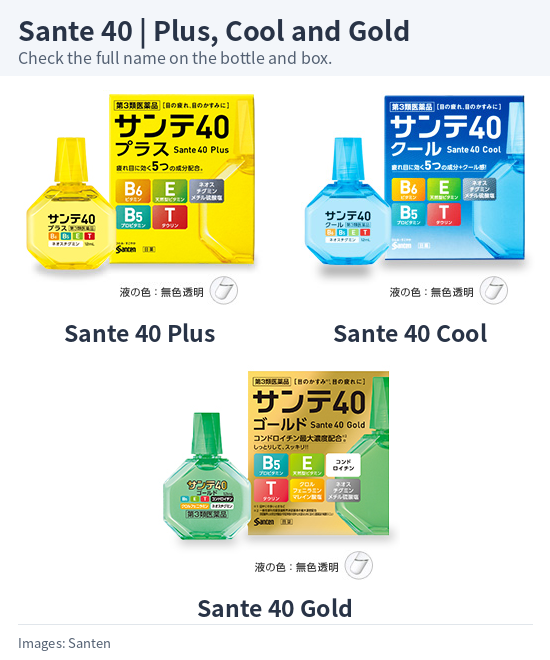
Recognize the three bottles and boxes
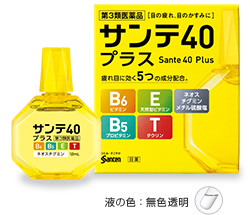
Plus has a yellow cap and the name サンテ40プラス. The “five ingredients” wording on its front highlights the eye-fatigue-focused group; its full active-ingredient list contains seven ingredients.
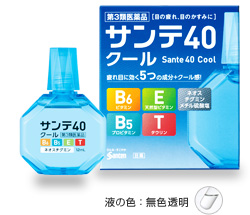
Cool has a blue cap and says サンテ40クール. The meaningful difference from Plus is the cooling formulation, not an increase in the seven active concentrations.
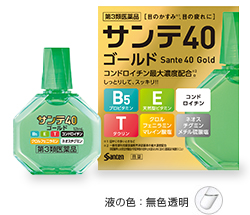
Gold has a green cap and says サンテ40ゴールド. Look for the full name rather than buying any gold-colored “40” eye drop.
| Product | Active formula distinction | Manufacturer cooling scale | Labelled dose for each administration |
|---|---|---|---|
| Sante40 Plus | Seven actives; same concentrations as Cool | 3 | 1–3 drops, 5–6 times daily |
| Sante40 Cool | Seven actives; same concentrations as Plus | 4 | 1–3 drops, 5–6 times daily |
| Sante40 Gold | Six actives; adds chondroitin sulfate sodium to a different mixture | 3 | 1–3 drops, 5–6 times daily |
The cooling numbers describe the maker’s sensation scale. They are not a clinical effectiveness ranking, and Plus and Gold are not cooling-free.
What actually changes in the ingredients?
The percentages below are the labelled concentration in the eye drops, not the amount in one drop.
| Active ingredient | Plus and Cool concentration | Gold concentration |
|---|---|---|
| Neostigmine methylsulfate | 0.005% | 0.005% |
| Natural vitamin E, d-α-tocopherol acetate | 0.05% | 0.05% |
| Vitamin B6, pyridoxine hydrochloride | 0.05% | Not listed as an active |
| Panthenol | 0.05% | 0.05% |
| Taurine | 1.0% | 0.5% |
| Chlorpheniramine maleate | 0.03% | 0.03% |
| Epsilon-aminocaproic acid | 1.0% | Not listed as an active |
| Chondroitin sulfate sodium | Not listed as an active | 0.5% |
Neostigmine supports the eye’s focusing function to relieve eye fatigue; chlorpheniramine is an antihistamine that relieves itching. Plus and Cool include epsilon-aminocaproic acid as an anti-inflammatory active. Gold’s chondroitin sulfate sodium is described by Santen as helping retain moisture by limiting tear evaporation.
Gold still contains aminocaproic acid among its additives. That is different from its being a quantified active ingredient. Similarly, Gold’s lower taurine concentration does not by itself make it weaker, and adding chondroitin does not prove it is best for everyone.
All three list benzalkonium chloride and chlorobutanol among their additives, so they should not be described as preservative-free. Check the complete leaflet if you have reacted to an eye drop before.
What symptoms are on the Japanese label?
The three have the same set of labelled uses: eye fatigue; blurred or bleary vision associated with conditions such as excessive eye discharge; conjunctival redness; itchy eyes; prevention of eye disease after swimming or when dust or sweat gets into the eyes; blepharitis; inflammation caused by ultraviolet or other light, such as snow blindness; and discomfort while wearing hard contact lenses.
This is a summary of the Japanese label, not a way to diagnose the cause of a red or blurred eye. The word “40” is part of the product name, not a labelled minimum age of 40. The leaflets require supervision when used for children; they do not give a numeric minimum age. Ask a pharmacist about a child’s symptoms before choosing.
These labels do not claim to treat cataracts or reverse presbyopia. Nor does Gold’s moisture-related ingredient turn the package into a general dry-eye diagnosis or treatment recommendation.
Contact lenses and the checks that come first
Do not use any of these three while wearing soft contact lenses, including colored soft lenses. The hard-contact-lens indication does not extend to every lens type. If you need drops to use with your lenses in, ask for a product explicitly suitable for your exact lenses.
Before use, consult a doctor, pharmacist or registered salesperson if you are receiving medical treatment, have had allergic reactions to medicines or other substances, have severe eye pain, or have been diagnosed with glaucoma. Bring your existing eye drops so the pharmacist can check your situation.
Stop immediately and seek advice if you develop skin rash, redness or itching, or eye redness, itching, swelling or stinging pain. Stop and consult if blurred vision does not improve, or if symptoms have not improved after about two weeks. Persistent blurred vision has its own stop instruction; do not assume you must wait two weeks.
How to use and store the bottle
- Check the name, expiry date and leaflet. Confirm that it is one of these exact products and remove soft contact lenses before use.
- Instill 1–3 drops per administration, 5–6 times daily. Keep the bottle tip away from the eye, eyelid and eyelashes. Use only as eye drops, and supervise children.
- Keep the contents clean. Do not share a bottle or transfer the liquid to another container. Do not use it if the solution is cloudy or contaminated.
- Close the cap and avoid heat. Store in a cool place out of direct sunlight and children’s reach. Do not leave it in a hot car or near a heater. If it has been left in a high-temperature place, do not use it, even if the bottle looks unchanged. Do not use it after the printed expiry date; after opening, use it as soon as possible even within that date.
- Check your response. Follow the stop-and-consult instructions above rather than increasing the number of drops when symptoms persist.
Irene’s takeaway
Start with the eye symptom and whether self-care is appropriate. If it is, Plus versus Cool is chiefly a cooling preference within the same active formula; Gold is a different ingredient combination. A pharmacist can help check the exact box, your lenses and your existing eye medicines before you buy.
Official sources and image credits
Checked on 14 October 2026. Follow the leaflet supplied with the Japanese product you buy. Package and bottle images: Santen Pharmaceutical Co., Ltd.