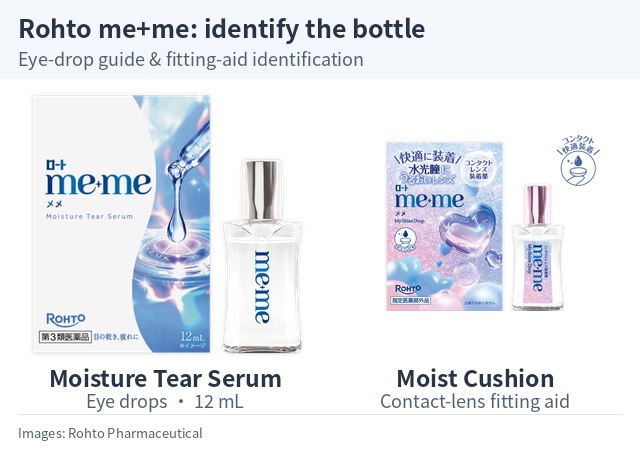

I'm Irene, a Taiwanese-born, Japanese-licensed pharmacist working in a Japanese drugstore. The transparent me+me bottle is easy to notice. Before choosing it, read the smaller product name: one is an eye medicine, while the similarly styled Moist Cushion is a contact-lens fitting aid.
Which bottle are you looking for?
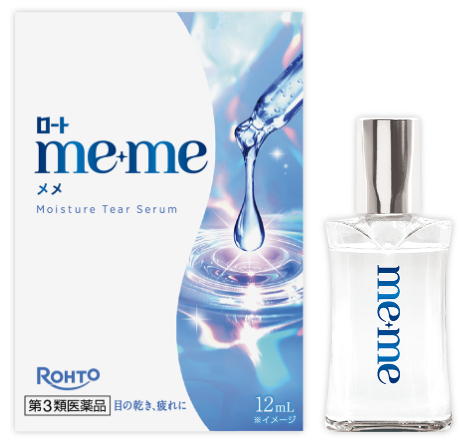
For moisturizing eye drops, look for Rohto me+me Moisture Tear Serum (ロートメメ モイスチャーティアセラム), 12 mL, marked 第3類医薬品. Its dose is one to two drops per application, three to four times daily.
If the box instead says ロートモイストクッション and コンタクトレンズ装着薬, it is the lens-fitting product. Rohto explicitly says it is not an eye drop. Do not use the eye-drop instructions below for it.
A similar look, a different job
| What to read on the pack | Moisture Tear Serum eye drops | Moist Cushion fitting aid |
|---|---|---|
| Full Japanese name | ロートメメ モイスチャーティアセラム | ロートモイストクッション |
| Category | Class 3 OTC medicine: 第3類医薬品 | Designated quasi-drug: 指定医薬部外品 |
| Purpose | Tear supplementation for dryness and other labelled eye symptoms | Makes contact lenses easier to insert |
| Key identification | Eye-drop medicine, 12 mL | コンタクトレンズ装着薬; explicitly not eye drops |
| Instructions in this guide | Exact eye-drop dose and precautions below | Follow its own pack; eye-drop directions do not apply |
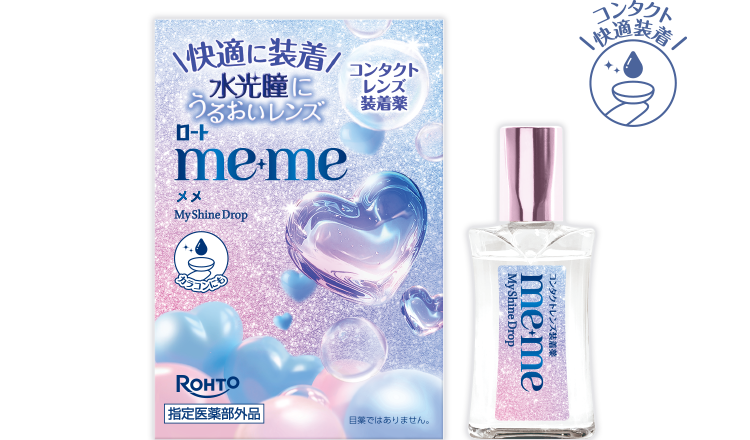
Rohto presents the pictured fitting-aid design as exclusive to Don Quijote and says it can be used for fitting coloured contacts. That does not establish stock at a particular store. Its sodium hyaluronate is described as an additive used for viscosity; do not assume the two similarly branded products have the same active formula.
This guide covers how to use the eye drops. For Moist Cushion, check its own complete instructions and ask the pharmacist or store staff to explain them before use. It should not be bought as a substitute for an eye-drop medicine.
What is in the eye drops?
| Active ingredient | Labelled concentration | Why it matters |
|---|---|---|
| Chondroitin sulfate sodium | 0.5% | Corneal-protection ingredient |
| Hydroxyethylcellulose, HEC | 0.6% | Gives the formulation viscosity |
| Potassium chloride | 0.02% | Electrolyte component |
| Sodium chloride | 0.4% | Electrolyte component |
The labelled indications are tear supplementation for dry eyes, tired eyes, blurred vision such as when there is excess discharge, and discomfort while wearing soft or hard contact lenses. These are symptom indications, not a way to diagnose why your eye is painful or your vision has changed.
Sodium hyaluronate is listed as an additive, not one of these four active ingredients. Other additives are boric acid, borax, l-menthol, polysorbate 80, sodium edetate, polyhexanide hydrochloride and a pH adjuster. “Contains hyaluronic acid” therefore does not make this the same formula as a medicine whose active ingredient is sodium hyaluronate.
Thick feel, mild cooling and contact lenses
Rohto describes the eye drops as highly viscous, intended to help moisture remain on the eye. Its cooling rating is 2 on the manufacturer's scale. That is a sensation rating, not evidence that it works better than a less cooling drop.
The manufacturer allows use without lenses and while wearing coloured contacts, soft lenses including disposables, and hard lenses including oxygen-permeable lenses. Read your own lens-care instructions as well; compatibility with this eye drop does not override the rules for your lenses.
The liquid can briefly blur vision after application because it is viscous. Wait until your vision is clear before driving or doing anything that requires sharp vision. Persistent blur is not something to brush aside as the normal thick feel: the leaflet says to stop and consult if blurred vision does not improve.
How to use Moisture Tear Serum
- Confirm the full name on the box and bottle. These directions apply to Moisture Tear Serum, not Moist Cushion.
- Apply one to two drops per application, three to four times daily. Do not touch the eye, eyelid or eyelashes with the nozzle.
- Close the cap by turning until it clicks. Do not share the bottle or use liquid that has become cloudy.
The drops are for eye use only. The leaflet gives no numerical minimum age; children must use them under a parent or guardian's supervision. For a young child's unexplained eye symptoms, ask a healthcare professional rather than treating the absence of an age number as a recommendation.
When to ask before use
Consult a doctor, pharmacist or registered OTC medicine seller first if you are under a doctor's care, have had medicine-related allergies, have severe eye pain, or have glaucoma. Severe pain deserves assessment; buying a comfortable-feeling drop should not delay that.
The leaflet does not list a specific pregnancy or breastfeeding restriction or a named drug-interaction list. That does not establish suitability for every person or every combination. Ask if pregnant, breastfeeding, using other eye medicines or unsure how this fits your care.
When to stop
Stop immediately and consult if you develop a skin rash, redness or itching, or eye redness, itching, swelling or painful stinging. Take the box or leaflet with you.
Also stop and consult if blurred vision does not improve, or if symptoms have not improved after about two weeks of use. Do not treat that two-week checkpoint as a reason to wait through worsening symptoms.
Keep the bottle tightly closed in a cool place away from direct sunlight and children. Avoid hot cars or heaters, particularly temperatures of 40°C or above. Do not transfer the contents, add anything to the bottle or use it beyond expiry. Even within its expiry date, use it as soon as possible after opening. If crystals collect around the nozzle or inside the cap, the leaflet permits gently wiping them off with clean gauze.
The one thing to remember at the shelf
Read “Moisture Tear Serum” before you follow eye-drop directions. If you want a viscous moisturizing drop that is labelled for use with coloured contacts, this is an option to discuss with the pharmacist. If you are holding Moist Cushion, pause and read its fitting-aid instructions instead. Similar styling does not mean interchangeable use.
Sources
Product information checked 15 October 2026. This guide explains Japanese labelling; use the leaflet supplied with your exact product and seek individual advice when needed.