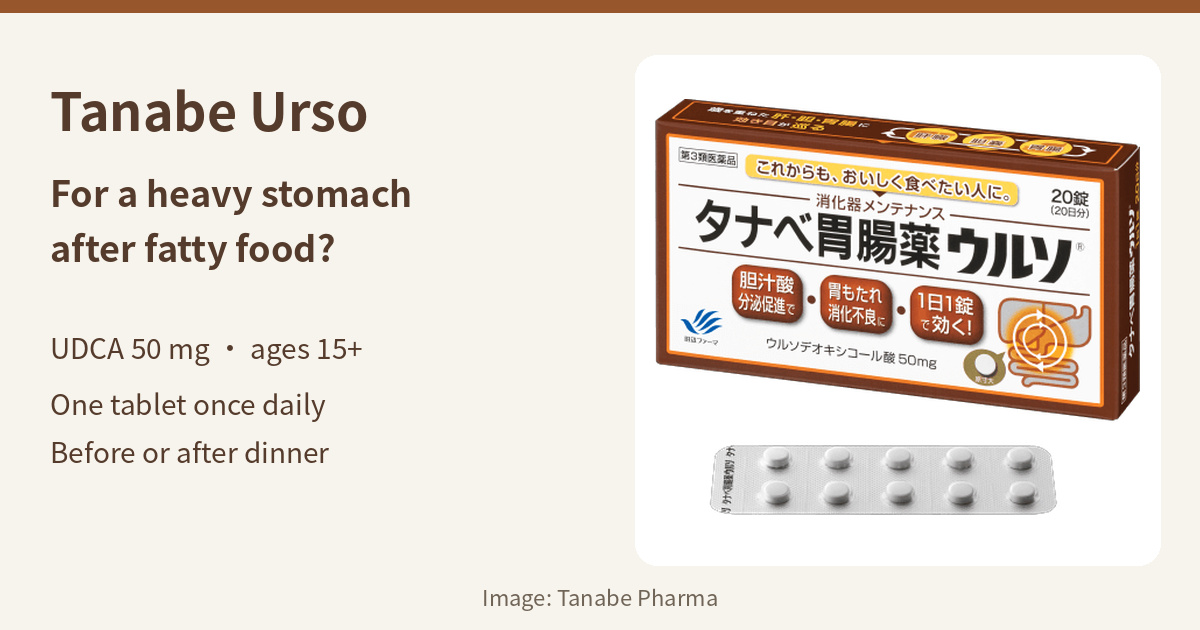
If fatty food leaves your stomach feeling heavy and your digestion uncomfortable, Tanabe Urso is one digestive medicine worth understanding. Its only active ingredient is ursodeoxycholic acid (UDCA). If your main problem is burning heartburn or acid coming back up, or you are shopping for a liver supplement, ask a pharmacist about that need before choosing this box.

I’m Irene, born in Taiwan, licensed as a pharmacist in Japan and working in a Japanese drugstore. With Urso, I’d start with two questions: does its labelled use match your symptoms, and do you know exactly when to take its one daily tablet? The pack size can come later.
Checked on 19 October 2026. This guide covers the Japanese non-prescription product タナベ胃腸薬ウルソ (Tanabe Ichoyaku Urso), a Japanese Class 3 medicine. It does not cover prescription UDCA products sold in Japan or elsewhere.
- Does this product match the problem you want help with?
- Recognise the full name before choosing a pack size
- What does UDCA do?
- How to take it: the evening meal matters
- Who needs advice before taking Urso?
- When to stop: diarrhoea is an immediate stop-and-check symptom
- Before you bring it home
- Official sources and medical information
Does this product match the problem you want help with?
- A heavy stomach or indigestion after fatty food: this is the situation highlighted by the manufacturer. If you are 15 or older, check the consultation points below before deciding it is suitable. A heavy stomach alone cannot establish that you have too little bile.
- Mostly burning heartburn or acid regurgitation: Urso has no acid-neutralising or acid-suppressing ingredient, and these symptoms are not in its indication list. Explain the main problem to a pharmacist rather than treating all stomach medicines as interchangeable.
- Improving liver blood tests, treating fatty liver or preventing a hangover: none is a labelled use of this Japanese OTC product. If you are receiving treatment for a liver or gallbladder condition, have your doctor or pharmacist check the exact medicine first.
Deal with warning signs first. Sudden or severe abdominal pain, chest pain, vomiting blood or black, sticky stools need immediate medical help. Recurring symptoms, persistent vomiting, trouble swallowing or unexplained weight loss also need assessment rather than repeated trials of stomach medicines.
Recognise the full name before choosing a pack size
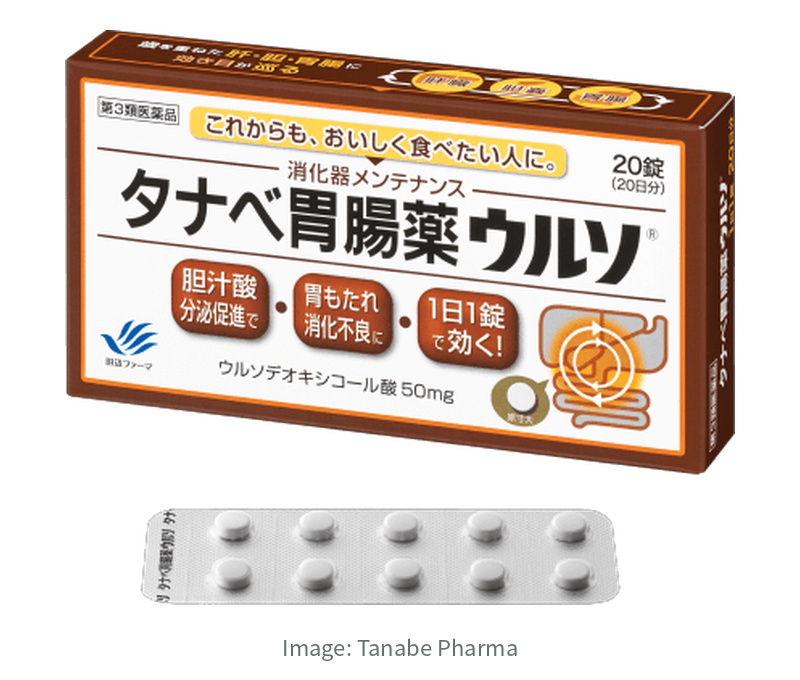
Look for タナベ胃腸薬ウルソ and ウルソデオキシコール酸50mg, the Japanese wording for ursodeoxycholic acid 50 mg. The image shows the current official 20-tablet carton and blister, not actual size. The official catalogue also lists 60 tablets: these are two quantities of the same medicine, not different-strength formulas.
The carton’s “20 days” wording is a quantity calculation at one tablet daily, not an instruction for everyone to take a 20-day course. A 60-tablet box is not a 60-day treatment plan either. Check suitability and when to stop before choosing a quantity. This guide does not confirm local shop stock.
What does UDCA do?
Each tablet contains ursodeoxycholic acid (UDCA) 50 mg, also the labelled daily amount. The manufacturer explains that UDCA promotes bile acid secretion, helping fat digestion and relieving a heavy stomach and indigestion associated with fatty food.
Bile acids and stomach acid have different roles. Urso does not work by neutralising stomach acid or blocking its production. UDCA is absorbed in the intestine, passes through the liver and gallbladder, and returns to the intestine for reabsorption. This is called enterohepatic circulation; the manufacturer uses it to explain the once-daily regimen. It is not a reason to add a tablet at every meal.
The Japanese label lists: a heavy stomach, indigestion, stomach or abdominal fullness caused by indigestion, reduced appetite, promotion of digestion, overeating, and a blocked or full sensation in the chest area related to digestion. That last wording is not permission to self-treat unexplained chest pain.
You may have seen UDCA in our Ohta’s Isan A tablet guide. That product also contains other digestive ingredients and antacids; Urso has UDCA as its sole active ingredient. The overlap does not make them suitable for taking together or allow you to transfer one product’s directions to the other.
How to take it: the evening meal matters
- Ages 15 and over
- Take one tablet once daily, before or after the evening meal.
- Under 15
- Do not take this product. Do not split a tablet to invent a child’s dose.
- Choose before or after dinner
- Do not take one before dinner and another afterwards. It is also not one tablet after each of three meals.
Follow the labelled dose and timing. A fatty lunch is not a reason to add an extra dose. If your routine makes the stated timing difficult, ask a pharmacist rather than changing it to an every-meal medicine.
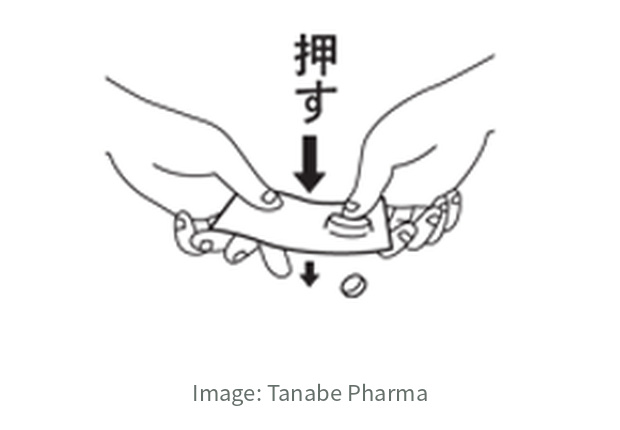
Press the raised part of the blister to push the tablet through the foil, then take the tablet out before swallowing it. Never swallow a cut piece of blister packaging with the tablet: it can injure the oesophagus.
Who needs advice before taking Urso?
The Japanese leaflet requires consultation with a doctor, pharmacist or qualified registered OTC seller before use if you:
- are receiving medical treatment;
- are pregnant or may be pregnant;
- have previously had an allergic reaction to a medicine or another substance.
Breastfeeding is not listed as a specific prohibition in this leaflet, but that does not establish individual suitability. If you are breastfeeding, or are unsure about your medical history or medicines, get advice before adding Urso.
Already taking another stomach medicine or a health food?
The manufacturer’s Q&A adds an important combination warning. If another stomach medicine says not to take other gastrointestinal medicines while using it, do not combine it with Urso. Having just one active ingredient does not make every combination suitable.
- Other medicines containing UDCA: consult a pharmacist or registered OTC seller before combining them. Ohta’s Isan A is one example of an overlapping combination product. Show your full medication list, including prescriptions.
- Japanese cholesterol-lowering Foods for Specified Health Uses (FOSHU): the manufacturer also says to seek advice before concurrent use. This is a reason to check before adding Urso, not to stop an existing treatment or health food on your own.
If you have an ingredient allergy, check the additives too. “One active ingredient” does not mean the tablet contains only one substance; the complete additive list is available in the leaflet linked below.
When to stop: diarrhoea is an immediate stop-and-check symptom
- A rash, skin redness, itching, diarrhoea or nausea after taking it: stop immediately and consult a doctor, pharmacist or registered OTC seller, taking the leaflet with you. Do not dismiss diarrhoea as “detox” or wait for it to become severe.
- No improvement after about two weeks: stop and seek advice. This is a limit for unresolved symptoms, not a requirement to keep taking it for two weeks before asking for help.
- Worsening or recurring symptoms, or the warning signs above: seek assessment earlier. Starting another box does not reset the need for review.
The official site discusses continued use and maintaining digestive function. That does not turn this medicine into routine liver care for everyone. There is no need to take it automatically before rich meals when you have no relevant symptoms; if you repeatedly need digestive medicine, finding the cause matters.
Before you bring it home
Keep it in a cool, dry place away from direct sunlight and out of children’s reach. Do not transfer it to another container or use it after the expiry date. Keep the box and leaflet so the exact name, directions and expiry information remain available.
My checklist: first distinguish a heavy stomach after fatty food from burning reflux, pain or another problem; then check medical history and other medicines. If Urso is suitable, remember ages 15+, one tablet once daily, before or after dinner, and the stop-and-consult points. Choose the pack size last.
Official sources and medical information
- Tanabe Pharma: Japan product information and brand product page
- Current Japanese leaflet, two pages
- Manufacturer Q&A, including combination precautions
- NHS: indigestion and when to seek assessment; abdominal pain and emergency warning signs. These support general symptom triage, not the Japanese product’s dose.
Images come from the Tanabe Pharma pages above, with the source embedded in each image. This guide explains the Japanese product and its label; it cannot replace individual medical advice or the full leaflet supplied with your medicine.