Trouble sleeping in Japan: can you buy ロゼレムS instead of your usual melatonin or prescribed sleep medicine? Do not make that substitution yourself. Rozerem S is a Japanese pharmacist-guidance medicine containing ramelteon, not a melatonin supplement. A pharmacist must assess suitability and provide written information before purchase.
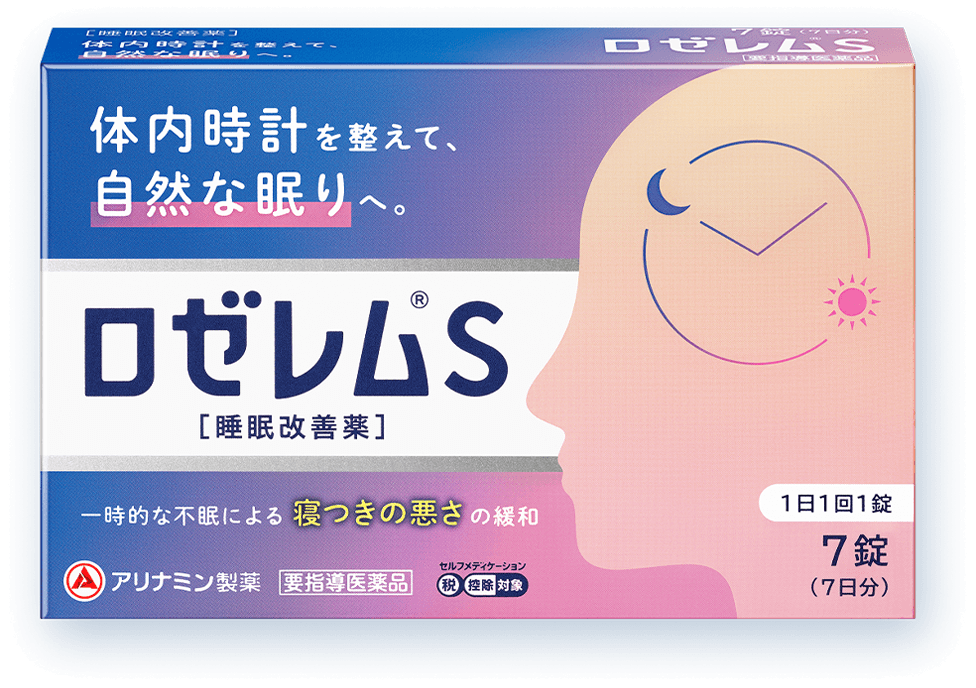
Checked: November 1, 2026. This guide concerns Japanese OTC ロゼレムS, illustrated with its official seven-tablet box. It does not transfer instructions from prescription or overseas products.
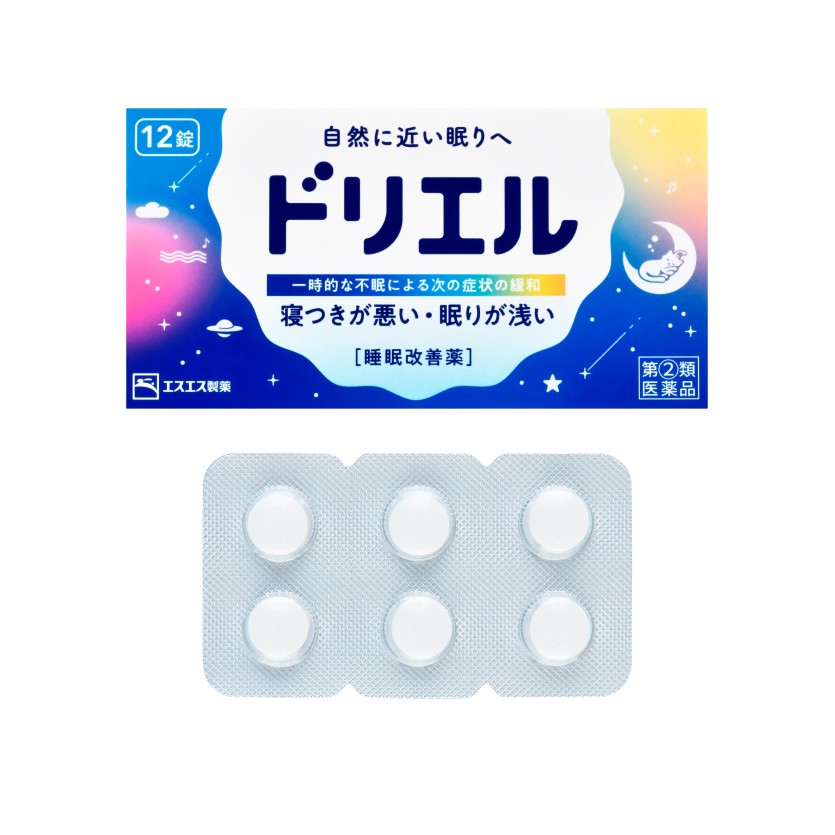
- First identify what this sleep medicine is for
- Two ways of influencing sleep—not stronger and weaker versions
- Compare the labelled purpose and stopping rules, not “strength”
- Prepare four groups of information before visiting the pharmacy
- Who must not take it, and who needs assessment?
- If the pharmacist confirms suitability, the dosing restrictions still apply
- Do not wait two weeks before deciding whether there is a problem
- Back at the hotel, record changes rather than adding medicine
- Official sources
First identify what this sleep medicine is for
Its approved purpose is relief of difficulty falling asleep associated with temporary sleeplessness. Each tablet contains 8mg ramelteon, which acts on melatonin receptors; the ingredient is not melatonin. A shared connection with sleep does not make it an equivalent replacement for your current medicine or supplement.
For example, sleeping in an unfamiliar hotel may make you want to find something at a pharmacy. But needing an early start tomorrow does not establish that a medicine is suitable. This guide does not present Rozerem S as a dedicated jet-lag treatment or teach you to force sleep on a flight. If you are already receiving treatment for a sleep condition, do not stop your prescribed medicine and replace it with this product.
For the separate diphenhydramine products, see the Drewell tablet and EX guide. These articles are not a chart for switching, combining medicines or choosing the strongest one.
Two ways of influencing sleep—not stronger and weaker versions
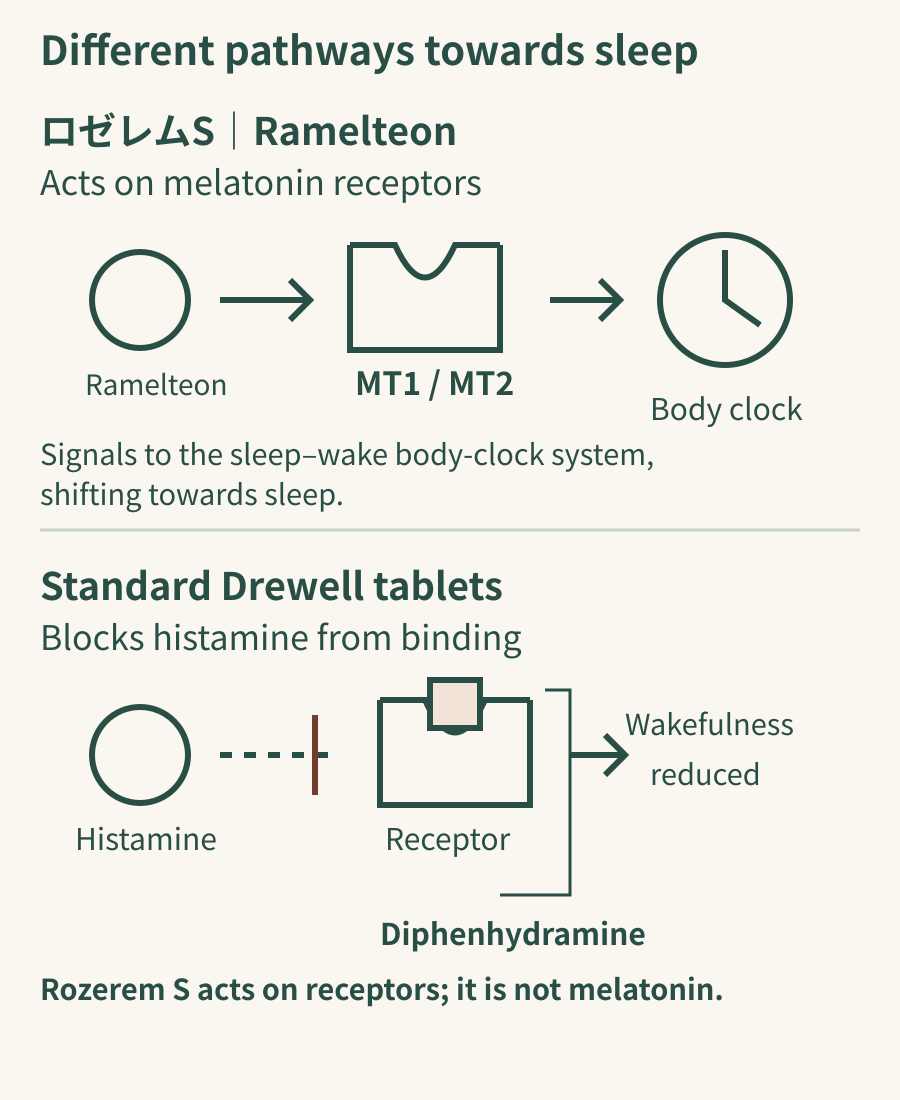
Rozerem S does not replenish melatonin. Its ramelteon acts on melatonin receptors MT1 and MT2, signalling to the body-clock system involved in switching between sleep and wakefulness and shifting the body towards sleep. That mechanism does not make it suitable for every sleep problem or give it an approved jet-lag indication.
Standard Drewell tablets act on a wakefulness signal instead. Their diphenhydramine interferes with histamine binding to receptors in the brain, suppressing its wakefulness-maintaining action. These are not different strengths of one mechanism. A different pathway does not by itself mean greater safety, permission to drive the next day, or interchangeable medicines.
What is new in Japan?
Rozerem S launched in Japan on July 28, 2026, making ramelteon available as an OTC medicine; the ingredient had already been used in prescription medicine. The change is a new pharmacy option requiring a pharmacist’s assessment, not unrestricted access to sleep medicines or permission to transfer prescription instructions to a trip.
Compare the labelled purpose and stopping rules, not “strength”
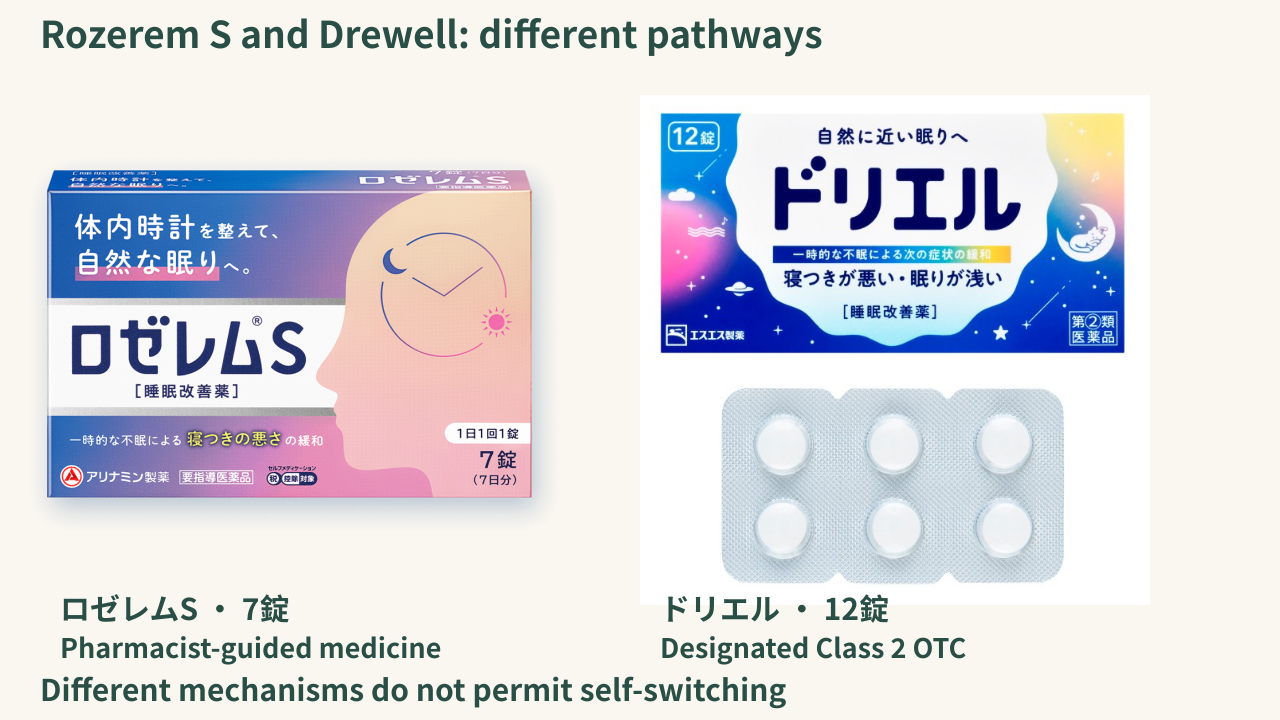
This comparison concerns Japanese Rozerem S and standard Drewell tablets, not Drewell EX or food products. These highlights explain differences; they are not a complete self-selection or contraindication checklist.
- Rozerem S: a Japanese pharmacist-guidance medicine. Its approved purpose is difficulty falling asleep associated with temporary sleeplessness. Stop and consult a doctor or pharmacist if two or three correctly taken doses do not help. Do not extend use beyond two weeks yourself; consult if still needing it. This is not a recommended two-week course.
- Standard Drewell tablets: Japanese designated Class 2 medicine. The labelled purpose includes difficulty falling asleep and shallow sleep associated with temporary sleeplessness. Do not use continuously. Stop and consult a doctor, pharmacist or registered medicine seller if two or three doses do not help. Do not transfer Rozerem S’s two-week condition to Drewell.
Neither is for people under 15 or those who are pregnant or possibly pregnant, but their other prohibitions and consultation requirements differ. For example, Drewell must not be used for habitual sleeplessness or diagnosed insomnia, and difficulty urinating, glaucoma or an enlarged prostate require prior consultation. Rozerem S has the treatment and medicine restrictions described below, including treatment for sleep disorders or liver disease. Age and a symptom label alone cannot establish suitability.
Both prohibit combining them with other sleep-improvement medicines and other specified medicines. Do not drink alcohol before or after taking either, or drive or operate machinery after taking it. If sleepiness or fatigue remains the next day, avoid those activities until it disappears. A different mechanism is not a promise of no side effects or dependence risk, or permission to switch medicines yourself. Do not continue despite an adverse reaction to reach two or three doses or two weeks; discuss symptoms and everything you take with a pharmacist.
Prepare four groups of information before visiting the pharmacy
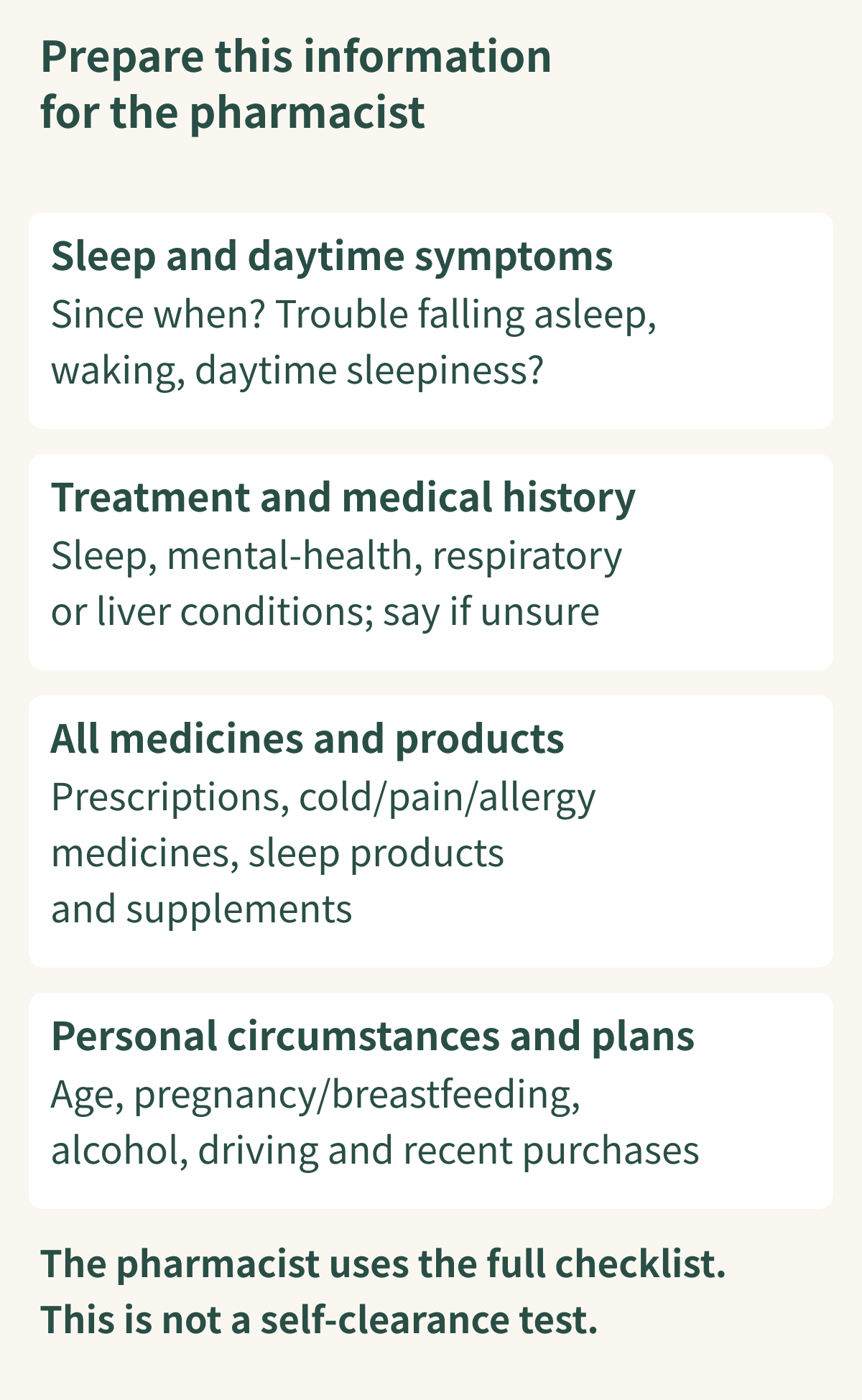
- Your sleep pattern: when the problem started; difficulty falling asleep versus repeatedly waking; strong daytime sleepiness; and any mood, memory or behaviour changes.
- Treatment and medical history: current conditions and previous sleep, mental-health or respiratory conditions. Say if you do not know the diagnosis rather than leaving it out.
- Everything you use: prescribed medicines, cold remedies, painkillers, allergy or motion-sickness tablets, other sleep products and supplements. Bring medication records, packaging or clear photographs. Mention if the sleep problem began after starting a medicine.
- Personal circumstances and upcoming plans: age, possible pregnancy, breastfeeding, alcohol, driving the next day and any recent purchase or use of this product.
The official purchase checklist is a tool to complete with a pharmacist, not a guarantee of eligibility if you tick the boxes yourself. The store locator does not guarantee stock, current opening or pharmacist availability: contact the store before travelling there. This product cannot be purchased when the pharmacist is absent.
Who must not take it, and who needs assessment?
The leaflet says not to take it if you are under 15, pregnant or possibly pregnant, or have had an allergic reaction to this product or its ingredients. It also prohibits use while receiving medical treatment for sleep disorders, mental-health conditions accompanied by insomnia, liver disease, or treatment with fluvoxamine. Sleep disorders include sleep apnoea, not just conditions for which someone takes sleeping tablets.
The official purchase checklist additionally directs people receiving treatment for chronic obstructive pulmonary disease (COPD), among other conditions, not to take it and to consult. Other treatment, older age, relevant medical history, pronounced daytime sleepiness, repeated night waking, low mood, unusual excitement, hallucinations or memory changes, and a repeat purchase within a short period also require professional assessment. Do not turn this into an abbreviated “none of these apply, so it must be safe” test.
The breastfeeding instruction is not to take the medicine, or to avoid breastfeeding if taking it. Discuss this with a healthcare professional rather than inventing a waiting interval. Stopping an existing treatment in order to buy this medicine is not a solution.
If the pharmacist confirms suitability, the dosing restrictions still apply
The Japanese label specifies one tablet once daily for ages 15 and over, within 30 minutes before going to bed, swallowed without chewing with water or lukewarm water. Use only when having difficulty falling asleep, not at other times. Do not take it with a meal or immediately after eating. Do not add another dose after waking during the night, or increase the tablet count or frequency.
While taking it, do not use another sleep-improvement medicine or hypnotic/sedative, cold medicine, fever/pain medicine, cough/expectorant medicine, or an oral medicine containing an antihistamine, such as some allergy, rhinitis or motion-sickness medicines. The purchase checklist also checks interactions with other prescribed medicines. Absence of an antihistamine on a label is not enough to establish that a combination is suitable.
Do not drink alcohol before or after taking it. Do not drive or operate machinery after taking it; if sleepiness or fatigue remains the next day, continue to avoid those activities until the symptoms disappear. Coffee or a self-selected number of hours asleep does not establish fitness to drive.
Do not wait two weeks before deciding whether there is a problem
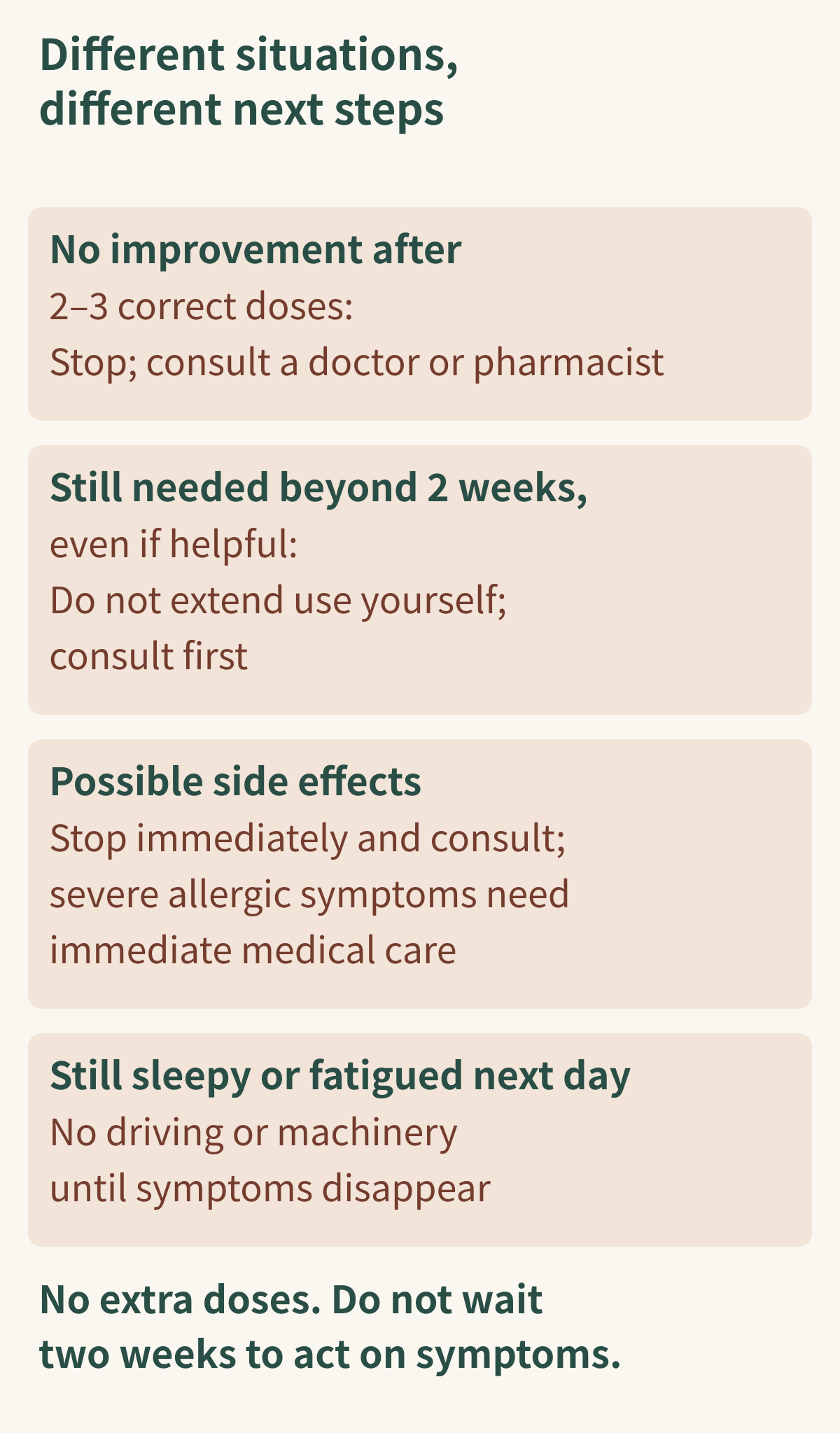
- No improvement after two or three correctly taken doses: stop and consult a doctor or pharmacist with the leaflet. Do not increase the dose or keep experimenting with another sleep medicine.
- Still needing it beyond two weeks, even if it helps: do not extend use yourself; consult a doctor or pharmacist. This is not a recommendation that everyone take a two-week course.
- Possible adverse effects: stop immediately and consult for rash, itching, constipation, nausea, dizziness, headache, daytime sleepiness, nightmares, fatigue or similar symptoms. Menstrual changes, milk discharge outside breastfeeding (including in men) or reduced sexual desire also require stopping and consultation.
Back at the hotel, record changes rather than adding medicine
Note the dates taken, whether falling asleep becomes easier, and any next-day drowsiness or other changes to discuss with the pharmacist or doctor. Keep the medicine in its original box away from moisture, sunlight and children; do not transfer it to another container. Record when the inner foil bag is opened. The leaflet advises using it promptly, with six months after opening as a guide, and never beyond its expiry date. That is not permission to take it daily until the pack is finished.
The useful question at the counter is not “Is this stronger?” It is “Given my sleep problem, current medicines and tomorrow’s plans, is self-treatment appropriate?” If medical assessment is needed, not buying a medicine today can be the right next step.
Official sources
- Manufacturer: Japanese Rozerem S product information and current packaging
- Complete Japanese OTC package leaflet
- Official pre-purchase checklist
- Official store search and purchase/use process
- Manufacturer’s FAQs
- Ministry of Health, Labour and Welfare: pharmacist-guidance medicines
- Manufacturer: Rozerem S mechanism explanation (not a comparison of trial results)
- Manufacturer: standard Drewell tablet mechanism
- Manufacturer: standard Drewell tablets and current package leaflet
- Manufacturer: Rozerem S launch announcement, July 28, 2026