Information checked: 12 October 2026 | Japanese-market products
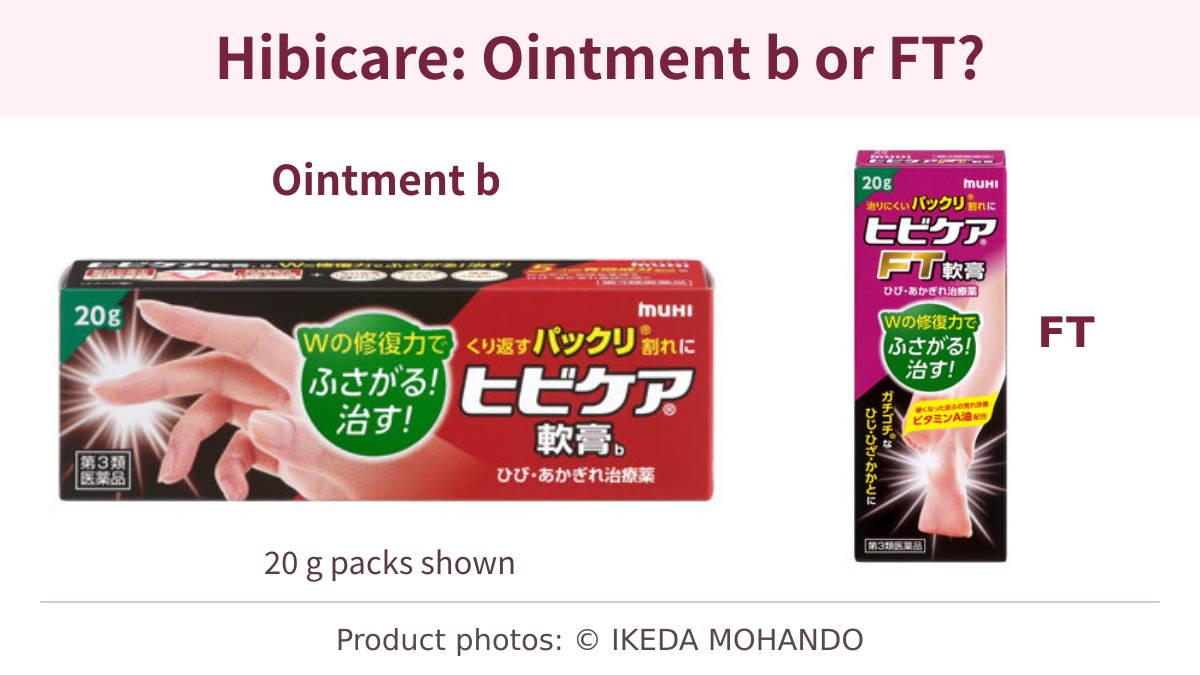
Cracked fingertips, rough heels and two similar names on the shelf: should you buy Hibicare Ointment b or Hibicare FT? Once you have checked that self-treatment is appropriate, Ointment b is worth comparing for cracked fingers, particularly if smell or stickiness matters to you. FT adds vitamin A oil for rough, hardened skin, especially around the heels. Its approved uses also include rough fingertips and palms, so it is not restricted to heels.
Before choosing, both medicines require advice from a doctor, pharmacist or registered OTC medicine seller in Japan if you have had an allergic reaction to medicines or similar products, or have severely weeping or raw skin. Pus, worsening redness, swelling or pain, or a fever need prompt medical attention. A very deep wound, bleeding that will not stop or an object stuck in a wound needs immediate medical assessment. Choosing a cracked-skin cream should not delay that care.

I’m Irene, a Taiwan-born, Japan-licensed pharmacist working in a Japanese drugstore. Let’s separate treatment creams from wound pads and preventive hand cream, then compare the details that will help you recognise the right product.
Recognise the current packs: Ointment b now comes in 20 g and 40 g
Hibicare Ointment b: a cream to consider for cracked fingers
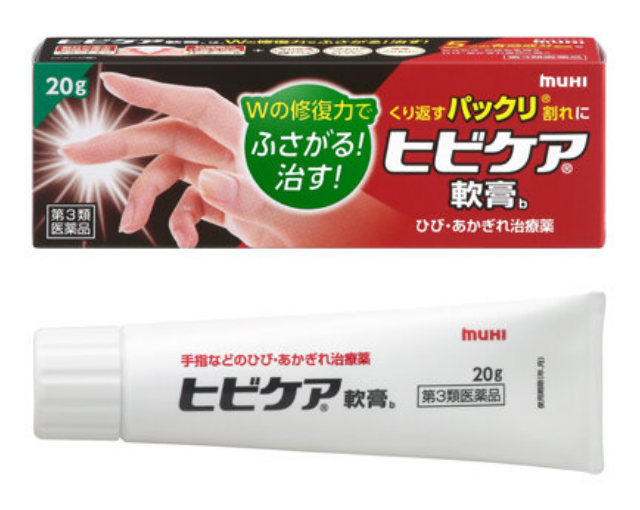
- Japanese name: ヒビケア軟膏b
- Japanese classification: Class 3 OTC medicine
- Form: cream, despite “ointment” in the product name
- Current sizes: 20 g and 40 g
- Approved uses: cracked skin, chapping and chilblains
The manufacturer has announced a size change from 15 g to 20 g and from 35 g to 40 g, with new packaging. If an old shopping list says “Ointment a, 15 g/35 g”, check the full name, size and instructions on the pack you are buying rather than matching an old photo. Individual shop stock has not been checked for this guide.
Hibicare FT: an additional ingredient for rough, hardened skin
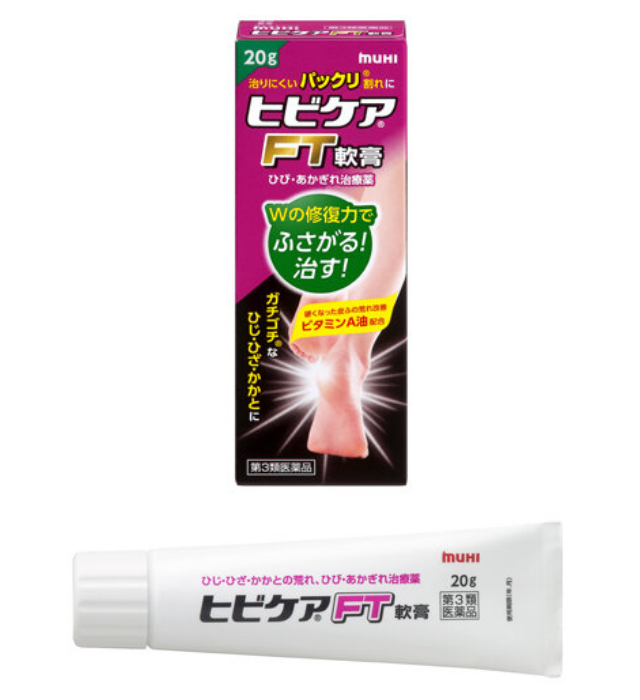
- Japanese name: ヒビケアFT
- Japanese classification: Class 3 OTC medicine
- Form and size: cream, 20 g
- Approved uses: rough elbows, knees and heels; cracked or chapped skin; rough fingertips and palms; chilblains
The manufacturer highlights FT for rough, hardened skin, especially heels. The heel pictured on the box is not a restriction to that body part. Ointment b can also be used on cracked skin on the feet. Consider the approved uses, the condition of the skin and the feel you prefer, rather than treating “hands = b, feet = FT” as a rule.
Formula and feel: what actually changes?
Four active ingredients are present at the same amounts in both products, per 100 g of cream:
- Allantoin, 0.2 g, to help repair damaged skin tissue
- Panthenol, 1 g, to support normal skin-cell function
- Glycerin, 40 g, for moisture
- Diphenhydramine, 0.5 g, to relieve itching associated with cracked and chapped skin
The main differences are:
- Ointment b: tocopherol acetate, a vitamin E derivative, at 0.2 g per 100 g; no vitamin A oil listed.
- FT: tocopherol acetate at 2 g per 100 g, plus 0.5 g of vitamin A oil, equivalent to 500,000 IU of vitamin A. The manufacturer describes vitamin A oil as supporting skin turnover to smooth rough, hardened skin.
These are formula amounts per 100 g, not the amount to apply each time. The different tocopherol acetate concentrations do not establish that FT works ten times better or is the best choice for every crack. Neither product contains a steroid or urea, but irritation or allergy is still possible.
For texture, the manufacturer describes Ointment b as odourless, smooth, non-sticky and formulated to be less likely to sting. FT is also described as smooth and non-sticky. However, its FAQ specifically suggests Ointment b for people using it on their hands who are concerned about smell or stickiness. This is useful manufacturer guidance, not a personal test or a guarantee of how either cream will feel on your skin.
How to apply them
Both labels say to apply a suitable amount to the affected area several times a day. The manufacturer gives about five or six applications a day as a practical guide and recommends reapplying after washing, because the cream washes off with water. Five or six refers to applications per day, not a five- or six-day treatment course.
- Apply to the appropriate cracked area and the surrounding rough, hardened skin. These are treatment creams, not general all-over body moisturisers.
- If a crack or chapped area is bleeding, the product FAQs say to wait until bleeding has stopped before applying; disinfectant is not needed first. This advice concerns cracks and chapping. It does not extend to knife cuts, dirty wounds or deep injuries.
- Applying soon after a bath is one of the manufacturer’s tips. It also suggests cotton gloves after Ointment b on the hands, or socks after FT on the feet. This does not mean you should seal the cream under a Hibicare hydrocolloid pad.
- Use externally only. Do not swallow either cream, and keep it out of your eyes. If it gets into an eye, rinse promptly with water or lukewarm water. Persistent redness, pain or watering needs an eye doctor’s assessment.
Neither cream is a liquid bandage that forms a protective film. If that is what you are shopping for, see the separate guide to Sakamucare and Hibipro liquid bandages, application and wound restrictions. Their instructions are different.
Similar names, different categories: Pad and PREVENT
Hibicare Pad (ヒビケアパッド) is a hydrocolloid wound dressing, classified in Japan as a controlled medical device, with 10 pads per pack. It has separate wound-eligibility rules. Do not use it as an ordinary plaster to cover a layer of cream: the manufacturer explicitly says not to combine it with ointments or creams for cracks and wounds.
The pads are for ages three and over. They are unsuitable for infected or deep wounds, wounds containing foreign material, and areas affected by eczema or dermatitis, among other restrictions. Anyone being treated for diabetes or a circulation disorder, or prone to adhesive reactions, must ask a doctor or pharmacist first. This is a category guide, not a complete application guide; read the full official Hibicare Pad instructions before use.
Hibicare PREVENT (ヒビケアプリベント) is a 60 g medicated hand cream, classified as a Japanese quasi-drug. Its formal sales name is PV薬用ハンドクリーム. Its role is skin care and prevention of cracking and chapping, rather than being a larger tube of either medicine. The current Japanese product page directs buyers online, so do not assume it will be stocked in every drugstore.
When to stop or get more advice
If a rash, redness, itching or swelling appears after application, stop immediately and take the product instructions to a doctor, pharmacist or registered OTC medicine seller in Japan. Watch for new or worsening reactions rather than assuming every uncomfortable sensation is part of healing.
The manufacturer says treatment may continue while symptoms remain if it is helping, reducing the frequency as symptoms improve. Persistent symptoms should be assessed by a medical professional. FT’s FAQ notes that thick heel skin may need about two weeks to assess its response. That is not a promise of healing in two weeks, or a reason to wait when symptoms worsen or infection is suspected. Lack of improvement, repeated splitting or uncertainty about the cause calls for reassessment.
Can I use them during pregnancy or breastfeeding?
The manufacturer’s product-specific FAQs say both Ointment b and FT can be used during pregnancy and breastfeeding. The approved uses and other precautions still apply. If you are receiving treatment or unsure what is happening to your skin, check with your doctor or pharmacist using the full product name. This advice concerns the two Japanese products checked here.
Does “from one month old” mean I can choose it for a baby myself?
The official wording gives one month of age as a suggested starting age, and both leaflets require adult supervision for children. An age guide does not show that a particular infant skin problem is suitable for the medicine. Ask a doctor or pharmacist about the condition and body area before choosing either for a baby or young child.
Can I use Ointment b every day to prevent cracks?
Its FAQ advises against using it like preventive hand cream when there are no symptoms. If your aim is everyday skin care, choose an appropriate moisturising hand cream rather than assuming an OTC medicine makes a better routine moisturiser.
Should I buy the bigger tube, and how long does it keep?
Ointment b has 20 g and 40 g sizes; FT currently comes in 20 g. For both, the manufacturer gives about six months after opening as a guide, always within the expiry date on the pack. Keep the tube tightly closed in a cool, dry place away from direct sunlight and children, and retain the original container. Consider how much you will use rather than choosing on tube size alone.
At the shelf, check four things: full name, size, approved uses and instructions. Establish that the skin problem is suitable for self-care first, then compare the formula and feel.
Sources
- Ikeda Mohando: Hibicare Ointment b product information, Japanese leaflet and product FAQs
- Ikeda Mohando: Hibicare FT product information, Japanese leaflet and product FAQs
- Ikeda Mohando: Hibicare range and size update, Hibicare Pad and Hibicare PREVENT
- NHS: Cuts and grazes, including when to seek medical care
This guide explains Japanese product choices and cannot provide an individual diagnosis. Follow the Japanese instructions supplied with the product and advice from your healthcare professional.