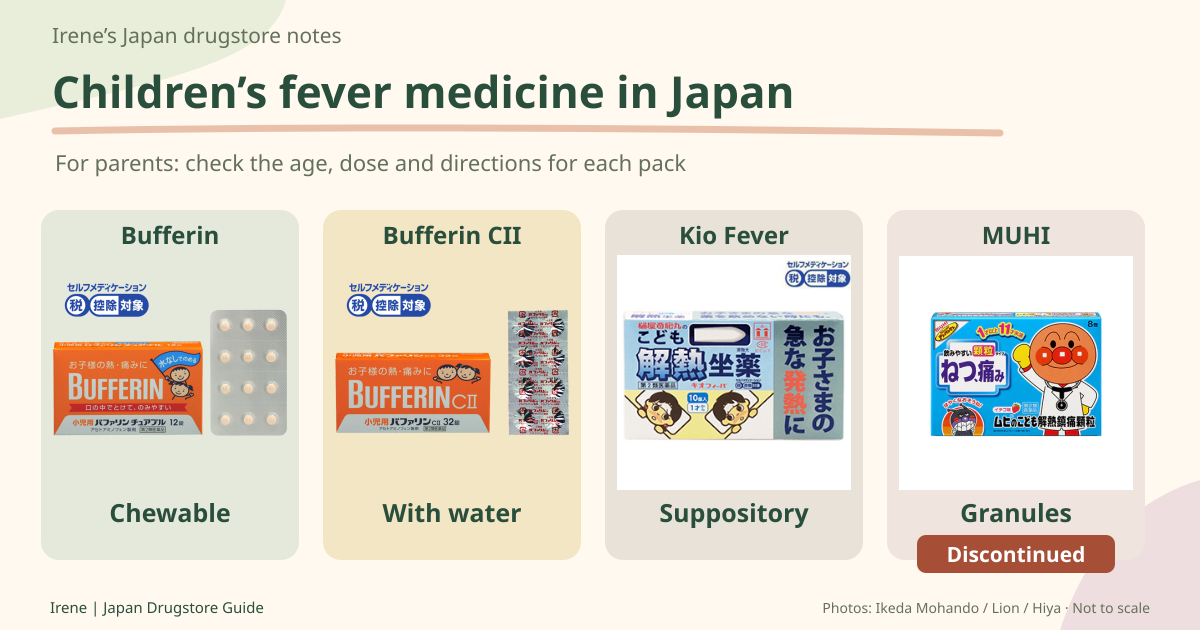
If you are packing for Japan, standing in a drugstore with an unwell child, or checking a Japanese medicine you already own, start with the full product name, your child’s age, the route of use, and medicines already given today. Children’s chewables, tablets taken with water, granules and suppositories have different directions.

I’m Irene, a pharmacist from Taiwan working in Japan.
When your child feels miserable, the last thing you need is two similar boxes with different doses. Let’s identify these four products first, then look up the details you need. One important update: the MUHI granules below have been discontinued; they remain here to help you check an existing pack or remaining retail stock.
First check age suitability, then the form your child can manage
All four are Japanese Class 2 OTC medicines. Age and safety restrictions come first; taste and convenience come next. A fruity taste does not tell you that a medicine is weaker or free of side effects.
Chewable: 小児用バファリンチュアブル
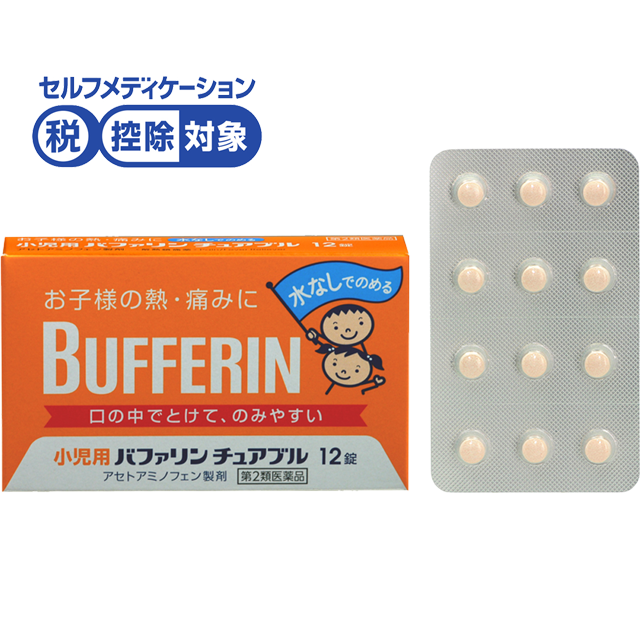
Ages 3 to under 15 | Orange flavour
Chew or let the tablets dissolve in the mouth; water is not required. Look for チュアブル and 水なしでのめる. Your child still needs to manage this method safely. Stay with them and watch for choking.
Tablets with water: 小児用バファリンCII
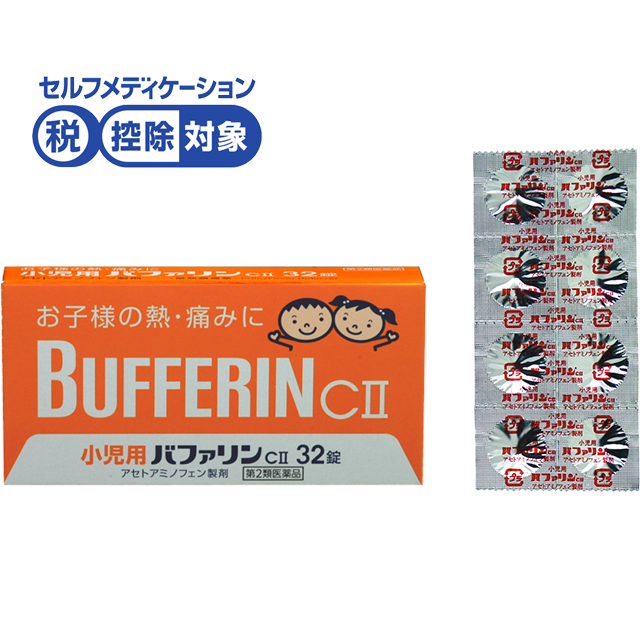
Ages 3 to under 15 | Small, fruit-flavoured tablets
Take with water or lukewarm water. Check for CII at the end of the name. Both Bufferin packs are orange, but the strength per tablet, tablet count per dose and directions differ. A sweet taste does not make CII the chewable version.
Suppository: キオフィーバ こども解熱坐薬
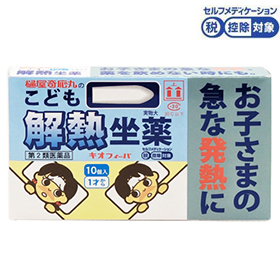
Ages 1–12 inclusive, under 13 | Rectal use
Labelled for temporary reduction of fever in children. It avoids taking medicine by mouth, but it is not a different fever ingredient you can add after an oral medicine. Use only once in a day and never on two consecutive days. Check the storage temperature before travel.
Granules: ムヒのこども解熱鎮痛顆粒
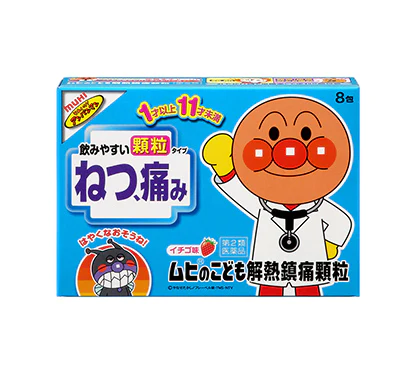
Discontinued | Existing-pack and remaining-stock reference
Ages 1 to under 11 | Strawberry flavour
The manufacturer says sales end as remaining stock runs out; availability is not guaranteed. Children under 7 take less than a full sachet per dose. Check expiry and storage if you already have a box. The same brand’s かぜ顆粒b combination cold medicine is a different product.
Photos help identify the packs and are not to scale. Before travel, discuss your child’s age, allergies and usual medicines with a pharmacist. If you are using Japanese products overseas, do not transfer the tablet count or mL dose from a product sold in another country, even when the ingredient name matches. When choosing a Japanese medicine, check your child’s age, health conditions and that product’s directions together.
Acetaminophen and paracetamol are the same fever ingredient
All four contain acetaminophen, also called paracetamol; the Japanese label reads アセトアミノフェン. In Taiwan, you may know it as 乙醯胺酚. The three oral products are labelled for fever and pain; Kio Fever’s labelled use is temporary fever reduction in children, so do not assume it has every pain indication of the oral products.
- Bufferin Chewable: 50 mg acetaminophen per tablet.
- Bufferin CII: 33 mg acetaminophen per tablet. Neither of these two is an aspirin formulation. Other Bufferin products can contain different ingredients.
- Kio Fever: 100 mg acetaminophen per suppository. Each whole suppository weighs 950 mg; 950 mg is not the acetaminophen dose. Hard fat is the suppository base.
- MUHI granules: the manufacturer’s 3-sachet basis contains 450 mg acetaminophen, 150 mg ascorbic acid (vitamin C), and 450 mg glycine. Vitamin C is included to replenish vitamin C used during fever; glycine is included to reduce stomach burden. The whole formulation therefore has more than one active ingredient.
These figures identify the ingredients; they are not every child’s dose or a ranking of strength. In particular, MUHI’s 3-sachet ingredient total must not be given as one dose. Use the individual age rows below.
Put all of today’s medicines together before giving another.
A suppository and an oral medicine can contain exactly the same fever ingredient. Changing the route does not cancel the earlier dose. Show a doctor or pharmacist the product names, times and amounts already given.
All four leaflets prohibit combining the product with other fever/pain medicines, cold medicines or sedatives. Checking only for duplicate acetaminophen is not enough to approve a combination. Do not add one of these to Pabron Kids combination cold medicine, or make up your own alternating schedule.
Looking for a fever syrup?
シロップ describes a liquid dosage form; it does not mean the medicine contains only a fever reducer. Japanese children’s cold syrups may add cough or antihistamine ingredients, so this comparison does not treat them as equivalent to a simple fever-reducing liquid. If your child can only manage a liquid, tell a doctor or pharmacist so they can check a specific suitable product, its concentration and the amount per dose.
If your child struggles with tablets or powders, the guide to children’s medicine syrups in Japan explains the differences between cold, cough and nasal products, and a simple fever liquid, before you check ages and ingredients.
Age, amount and interval: follow the exact product
These are the Japanese labelled directions. “Under” excludes that birthday. Do not extrapolate beyond the age range, calculate a different weight-based dose from this article, or divide an adult medicine to substitute. A parent or carer must supervise every dose.
小児用バファリンチュアブル: chewable
- Ages 3 to under 7: 2 tablets per dose
- Ages 7 to under 11: 3 tablets per dose
- Ages 11 to under 15: 4 tablets per dose
- Under 3: do not use
Maximum 3 doses a day, at least 4 hours apart; avoid an empty stomach where possible. Chew or dissolve in the mouth. Remove the tablets from their PTP blister before giving them; never swallow the packaging. Watch carefully for choking, especially in younger children.
小児用バファリンCII: tablets with water
- Ages 3 to under 7: 3 tablets per dose
- Ages 7 to under 11: 4 tablets per dose
- Ages 11 to under 15: 6 tablets per dose
- Under 3: do not use
Maximum 3 doses a day, at least 4 hours apart; avoid an empty stomach where possible. Take with water or lukewarm water. Remove the tablets from their packaging first. If your child cannot manage swallowing tablets, do not force them just because they meet the age limit; ask a pharmacist about a suitable form. CII uses a different tablet count from the chewable.
ムヒのこども解熱鎮痛顆粒: discontinued granules
- Ages 1 to under 3: ½ sachet per dose
- Ages 3 to under 7: ⅔ sachet per dose
- Ages 7 to under 11: 1 sachet per dose
- Under 1: do not use
Maximum 3 doses a day, at least 4 hours apart; avoid an empty stomach where possible. For children under 2, medical assessment takes priority and use is only when unavoidable. Ikeda Mohando’s granule-giving guidance advises water or lukewarm water. If you are unsure how to divide a sachet accurately, ask a pharmacist to show you; do not give a whole sachet for convenience.
For a partially used sachet, fold the opening over twice and use the remainder within 2 days, as directed. Discontinuation is not a reason to keep using expired medicine or a pack whose storage history is uncertain.
キオフィーバ こども解熱坐薬: suppository
- Ages 1 to under 3: ½–1 suppository per dose
- Ages 3 to under 6: 1 suppository per dose
- Ages 6 to under 13: 1–2 suppositories per dose
- Under 1: do not use
Rectal use only, once a day, never on two consecutive days. Do not swallow. This product does not have a “repeat after 4 hours” rule. Where the label gives a range, ask a doctor or pharmacist to confirm the amount if you are unsure; do not choose the larger amount solely because the temperature is higher.
If one use does not improve symptoms, stop and consult. The oral products’ 5–6-dose stopping rule does not apply to Kio Fever.
First-time suppository use, and how to store it on a trip
The following follows Kio Fever’s current Japanese leaflet. First confirm suitability, medicines already given and the exact amount for this use. Ask the pharmacist to demonstrate opening the wrapper and cutting a half if you are unsure.
- Use after a bowel movement if possible. This helps reduce the chance of immediate expulsion.
- For a confirmed half-dose, follow the leaflet’s diagonal cutting diagram. It shows scissors or a knife cutting diagonally through the still-wrapped suppository, followed by unwrapping as usual. Do not break off an arbitrary piece.
- Peel the wrapper apart at the pointed end and remove it completely. Do not insert the wrapper. Lying on the back is often easier; insert rectally as shown in the leaflet.
- If insertion is difficult, moisten the tip with water or olive oil. After insertion, gently hold a finger at the anus for several tens of seconds to help keep it from slipping straight out.
If medicine comes back out, pause before giving more.
After vomiting, an unfinished dose or a suppository slipping out, it may be hard to know how much was absorbed. Note the time, amount and what happened, then ask a doctor or pharmacist. Do not automatically repeat it or switch to another fever medicine.
Store away from direct sunlight and humidity, at 30°C or below in a cool place, such as a refrigerator. Keep upright with the tip pointing down, following the box diagram. Plan how to meet that temperature limit during a summer outing or long journey; avoid a sun-heated car. Ask a pharmacist about a pack that has become hot or misshapen rather than assuming cooling it makes it usable again.
When to ask first, stop, or get medical help
Look at comfort and behaviour, as well as the thermometer
The Japan Pediatric Society’s emergency guidance says a child who is active and drinking well may not need a fever reducer even above 38.5°C. Watch alertness, breathing, fluid intake and urine output, and offer fluids regularly. Seek medical advice promptly if your child cannot drink, is passing much less urine, is getting worse, or you are worried. Do not wait for medicine to work when the urgent signs at the top of this guide are present.
Do not use, or check first, in these situations
- Do not use after an allergic reaction to that product or its ingredients, or a history of asthma triggered by fever/pain or cold medicines.
- MUHI granules also prohibit use in phenylketonuria. They contain aspartame (an L-phenylalanine compound). Bufferin Chewable also lists that additive; if phenylalanine intake must be restricted, have a doctor or pharmacist check the full ingredient list.
- Consult before use if the child is receiving medical or dental treatment, has had medicine-related allergies, or has heart, kidney or liver disease, or a stomach/duodenal ulcer.
- All four prohibit prolonged continuous use and alcohol before or after use. Their general warnings also ask pregnant or possibly pregnant people and older adults to consult first; this does not supply an adult dose.
The stopping point differs for suppositories and oral products
MUHI granules and both Bufferin products: stop and consult if symptoms have not improved after 5–6 doses. Kio Fever: stop and consult after one unsuccessful use. Bring the leaflet. These are limits on self-treatment, not instructions to wait until you have used every permitted dose.
Stop and seek advice if a rash, redness, itching, nausea, vomiting, loss of appetite, dizziness or excessive temperature fall occurs after use. Difficulty breathing, altered consciousness, or a widespread rash with high fever or damaged lips needs immediate medical attention.
Other serious reactions and storage reminders in the leaflets
All four list rare serious reactions including anaphylaxis, severe skin reactions, drug hypersensitivity syndrome, liver or kidney problems, interstitial pneumonia and asthma. Yellow skin or eyes, brown urine, reduced urine with swelling, persistent dry cough or wheezing also need immediate medical assessment. Read the full leaflet in your pack.
Keep the oral products in a cool, dry place away from direct sunlight. Kio Fever additionally requires 30°C or below, upright with the tip down. Keep all medicines in their original packaging, out of children’s reach. They are not sweets, and children should not help themselves. Do not use expired medicines.
Questions parents ask
Can I use the same tablet count for Bufferin Chewable and CII?
No. Chewable contains 50 mg acetaminophen per tablet, while CII contains 33 mg. Their age-based tablet counts differ. Chew or dissolve the chewable in the mouth; take CII with water or lukewarm water. Check the full name.
Does switching from an oral medicine to a suppository avoid overlap?
No. All four contain acetaminophen. Their leaflets prohibit combining them with other fever/pain medicines, cold medicines or sedatives. Show a doctor or pharmacist the names, times and amounts already given before adding or alternating anything.
Can Kio Fever be repeated after four hours?
Do not apply the oral products’ interval. Kio Fever is used only once a day and never on two consecutive days. Stop and consult if one use does not improve symptoms.
Can I still buy MUHI children’s fever granules?
The manufacturer marks them discontinued and says sales end when remaining stock runs out. Availability is not guaranteed. This guide retains the details for existing-pack and remaining-stock identification; check expiry, storage and the full product name.
Why not compare children’s cold syrups here?
Syrup is a dosage form. Children’s cold syrups may also contain cough or antihistamine ingredients, so they are not equivalent to a simple fever-reducing liquid. Ask a doctor or pharmacist to check a specific product if a liquid is needed.
Does a temperature above 38.5°C always need medicine?
No. Japan Pediatric Society guidance says an active child who is drinking well may not need a fever reducer even above 38.5°C. Alertness, breathing, drinking and urine output also matter. Difficulty breathing or being hard to wake needs immediate medical help.
Sources and image credits
Checked against official Japanese information available on 8 October 2026. MUHI and both Bufferin leaflets were revised in January 2023; Kio Fever in March 2023. Clinical warning signs draw on the Japan Pediatric Society and NHS; UK medicine doses are not applied to these Japanese products.
- Product and discontinuation
- MUHI Japanese leaflet
- Granule-giving guidance
- Chewable product
- Chewable leaflet
- Bufferin CII product
- Bufferin CII Japanese leaflet
- Children’s fever product information
- Kio Fever product
- Leaflet, insertion and storage diagrams
- Japan Pediatric Society: fever checks
- Japan Pediatric Society: fever care
- Japan Pediatric Society: calling an ambulance
- NHS: childhood fever and urgent warning signs
Product photos: Ikeda Mohando, Lion Corporation and Hiya Pharmaceutical / Hiya Kiogan, used for product identification and formulation comparison. Original pack details and proportions are retained. This guide helps with product labels and does not replace individual medical assessment.