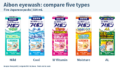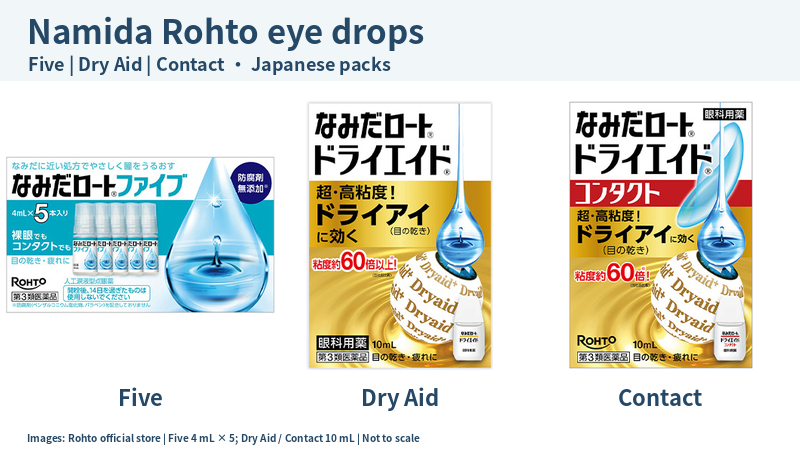
When choosing Rohto drops for dry eyes in Japan, start with whether you are wearing contact lenses, then compare a simple artificial-tear formula with thicker drops. The small Namida Five bottles and gold Dry Aid boxes differ by more than capacity.

I’m Irene, a Taiwan-born, Japan-licensed pharmacist working in a Japanese drugstore. Let’s compare lens compatibility, ingredients and opened-bottle limits so “Rohto” or “dry eyes” does not become your only shopping cue. Sources checked: 13 October 2026, Japanese-market products.
- Narrow the choice at the shelf
- Five: 4mL per bottle, with a 14-day opened-bottle limit
- Dry Aid: prefer a thicker drop? Check your lenses first
- Dry Aid Contact: find the red コンタクト strip
- Higher viscosity does not mean proportionally greater relief
- When to consult, and when to stop
- When to discard: the 14-day rule is specific to Five
- Irene’s final check
- Official sources
Narrow the choice at the shelf
| Japanese name | Capacity / feel | With ordinary soft lenses | With hard / oxygen-permeable lenses | With coloured / circle lenses |
|---|---|---|---|---|
| なみだロートファイブ (Five) | 4mL×5 bottles; artificial tears, cooling 0 | Yes | Yes | Yes |
| なみだロートドライエイド (Dry Aid) | 10mL; high viscosity, cooling 2 | No | Yes | No |
| なみだロートドライエイドコンタクト (Dry Aid Contact) | 10mL; high viscosity, cooling 2 | Yes | Yes | Yes |
All three are Class 3 OTC medicines and can also be used without lenses. This table follows current official product information and lens FAQs. Lenses still require appropriate eye-care prescription, check-ups and compliance with their own instructions. Cooling numbers describe sensation, not efficacy.
Five: 4mL per bottle, with a 14-day opened-bottle limit
Look for なみだロートファイブ and 4mL×5本 on the blue-green-and-white box. It is not 14mL per bottle or five single-use vials. These are resealable small bottles; do not use a bottle more than 14 days after opening.
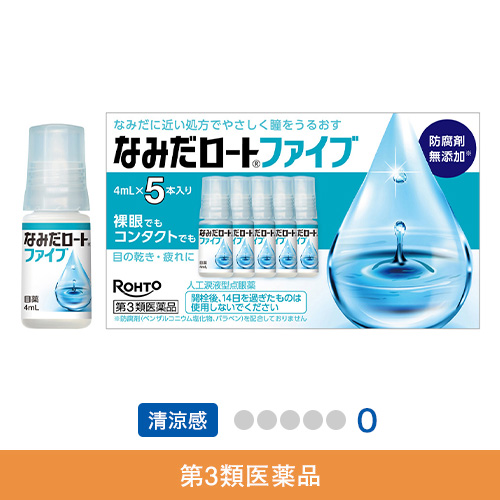
Its active ingredients are potassium chloride 0.1% and sodium chloride 0.4%; additives are boric acid and a pH adjuster. It offers a relatively simple artificial-tear formula without a cooling sensation. The maker specifies no benzalkonium chloride or paraben preservatives; that does not permit contaminating the tip or extending storage.
Use one to three drops per application, five to six times daily. Labelled uses include tear supplementation for dry eyes, eye fatigue, blurred vision such as with excess discharge, and discomfort while wearing soft or hard contact lenses. The official product page permits use from age one; children need adult guidance and supervision.
Open only the bottle you need and note its opening date. A five-bottle pack is a packaging choice, not an invitation for people to share the same bottle.
Dry Aid: prefer a thicker drop? Check your lenses first
The gold box says なみだロートドライエイド, 10mL. It can be used without lenses or while wearing ordinary hard and oxygen-permeable lenses. Do not use while wearing soft lenses, including disposables, or coloured/circle lenses.
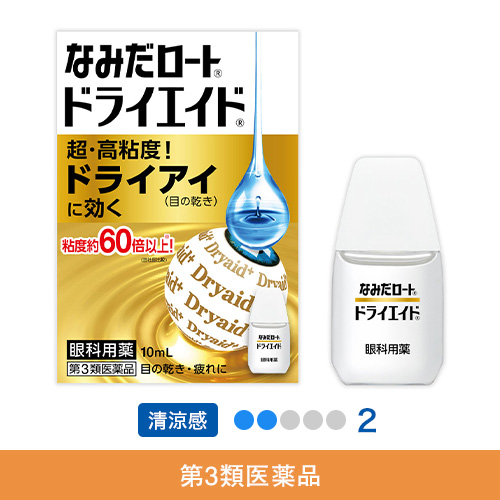
The active ingredients are chondroitin sulfate sodium 0.5%, hydroxyethylcellulose (HEC) 0.6%, potassium chloride 0.02% and sodium chloride 0.44%. Sodium hyaluronate and sesame oil are among the additives. The maker specifies no benzalkonium chloride or paraben preservatives.
Use one to two drops per application, three to four times daily. Labelled uses are tear supplementation for dry eyes, eye fatigue, blurred vision such as with excess discharge, and discomfort while wearing hard contact lenses. Do not copy Five’s drop count or frequency.
Dry Aid Contact: find the red コンタクト strip
なみだロートドライエイドコンタクト also contains 10mL, but the box has a prominent red コンタクト strip. The current official FAQ explicitly allows use with coloured lenses, including circle lenses. Ordinary soft, hard, oxygen-permeable and disposable lenses are also covered.
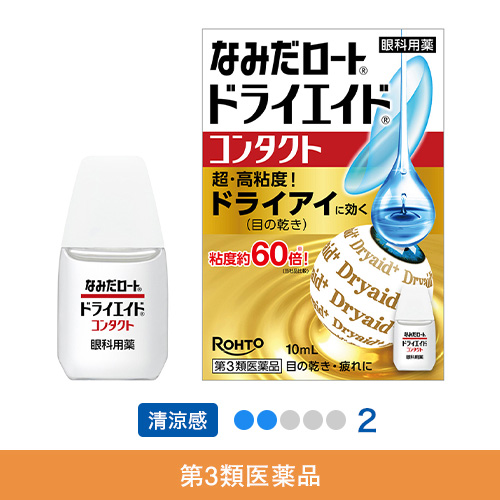
Its active ingredients are chondroitin sulfate sodium 0.5%, HEC 0.6%, potassium chloride 0.02% and sodium chloride 0.4%. The sodium chloride concentration and additives differ from standard Dry Aid. Contact lists polyhexanide hydrochloride among its additives; do not transfer the other product’s preservative-free wording to this one.
Use one to two drops per application, three to four times daily. The indications are similar to standard Dry Aid, but lens discomfort includes both soft and hard lenses. It also works as a labelled option without lenses, so you do not need a second bottle just for lens-free periods.
Higher viscosity does not mean proportionally greater relief
Rohto describes Dry Aid as having about 60 times or more the viscosity of Namida Five; Contact’s product page says about 60 times. These comparisons are made immediately after manufacture. These figures describe thickness, not a multiple of pain relief, hours of moisture or clinical effectiveness. Both thicker formulas may temporarily blur vision after use. Wait for clear vision before tasks that need it.
For children, the Dry Aid and Contact FAQs advise waiting until they can communicate eye symptoms and how the drops feel, with around age one as a reference. Young children may be more sensitive to cooling. This is not an automatic recommendation for every one-year-old; ask a pharmacist about the symptoms and supervise use.
When to consult, and when to stop
For all three, ask a doctor or pharmacist before use if you are receiving medical treatment, have previously had an allergic reaction to medicines or other substances, have severe eye pain, or have been diagnosed with glaucoma. Do not assume every stinging sensation or blurred view is simply dryness.
Stop using the drops immediately and take the box to a doctor or pharmacist if you develop a skin rash, redness or itching, or eye redness, itching, swelling or painful stinging. Also stop and consult if blurred vision does not improve or symptoms remain after about two weeks. Severe symptoms should not wait two weeks.
Do not let the tip touch the eye, eyelid or lashes. Use only as eye drops; do not share, decant or add anything to the bottle. Stop using cloudy liquid or liquid with floating material even if the printed expiry has not passed.
When to discard: the 14-day rule is specific to Five
Do not use Five more than 14 days after opening each bottle. Dry Aid and Contact labels say to use promptly after opening. Their official FAQs give about two to three months as a general guide, dependent on storage and handling, not a guarantee of three months’ usability. The box expiry is for unopened product and must never be exceeded.
Close all bottles firmly, store cool and away from direct light and children, and avoid places at 40°C or above, such as a hot car or near a heater. Storage limits and the stopping point for unimproved symptoms are different rules.
Irene’s final check
If wearing soft or coloured lenses, start by comparing Five with Dry Aid Contact. If you dislike cooling sensation, consider Five first. If you prefer a thicker liquid, compare the two Dry Aid boxes according to your lenses. Persistent dryness or recurring discomfort deserves eye-care assessment rather than repeatedly increasing viscosity.
Official sources
- Rohto: Namida Five / Dry Aid / Dry Aid Contact: current ingredients, directions and full Japanese labels
- Dry Aid range and viscosity comparison
- Standard Dry Aid lens restrictions / Contact coloured-lens FAQ
- Dry Aid age FAQ / Contact age FAQ
- Dry Aid opened storage / Contact opened storage