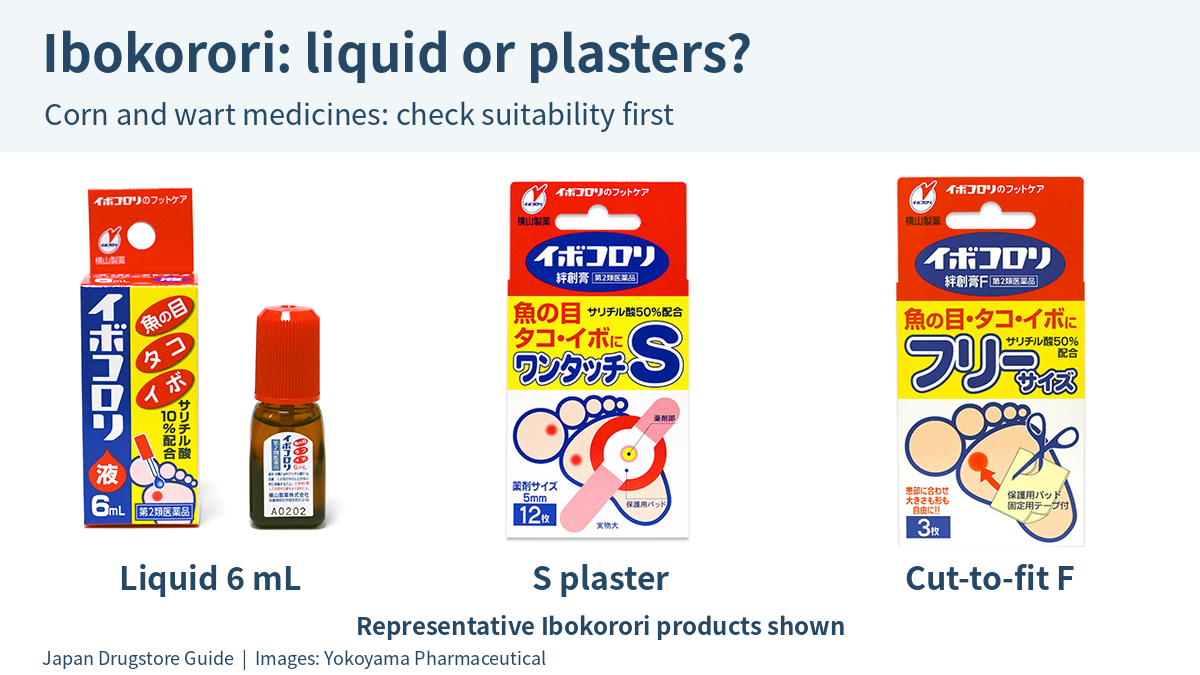
When you see Ibokorori liquid, S/M/L plasters and the cut-to-fit F version, convenience is only the second question. First establish that self-treatment suits the lesion; then choose a format that keeps the medicine off healthy skin. This guide also compares similarly named Uonomekorori liquid. All four are Japanese Category 2 OTC medicines.

I’m Irene, a Taiwan-born, Japan-licensed pharmacist working in a Japanese drugstore. With these medicines, the key questions are what you are treating and where the medicine will touch.
Unsure whether it is a corn, callus or wart? Ask first
Ibokorori liquid and plasters are labeled for corns, calluses and warts, but the wart indication is limited to hard, rough, keratinized warts. Uonomekorori liquid is labeled for corns and calluses only, not warts. Do not identify an unfamiliar growth from the brand name or online pictures. Ask a pharmacist first, with dermatology assessment when needed.
- Do not use any of the four products compared here in children under 7. Children using them need adult supervision.
- Do not apply them to the face, around the eyes, lips, mucous membranes, soft skin such as the neck, or inflamed or wounded areas.
- Ibokorori must not be used on molluscum, flat dark-brown age-related growths, anal or genital warts, or warts in a line, in clusters or widespread over the body. Treating them in smaller batches does not remove this restriction.
Before use, consult a doctor, pharmacist or registered medicine seller if you are pregnant or might be pregnant, are being treated for diabetes or another condition, or have a history of allergic reactions to medicines or other substances.
Once suitable, narrow the choice by format
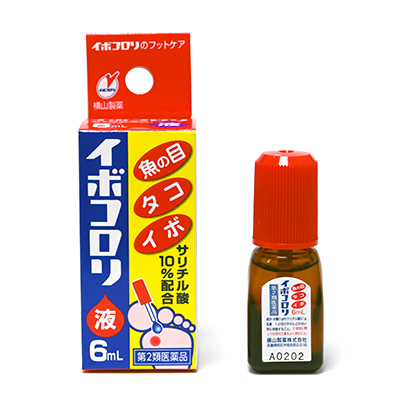
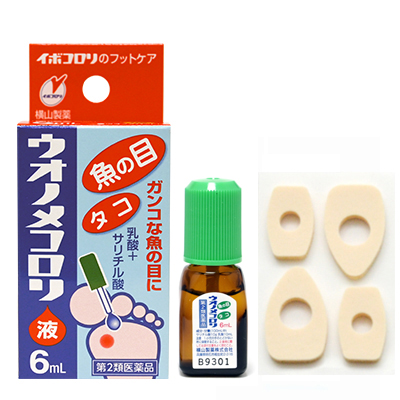
- If you can apply it precisely and follow the daily schedule, consider liquid. Ibokorori is used four times daily; Uonomekorori once or twice daily and is not indicated for warts. Do not swap their schedules.
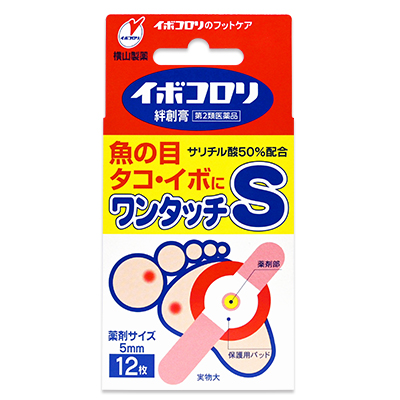
- For a ready-made plaster, look at S/M/L. Choose by the central medicated area, not the size of the whole adhesive strip. The medicated area should be slightly smaller than the lesion; buying a larger medicated area does not make application safer.
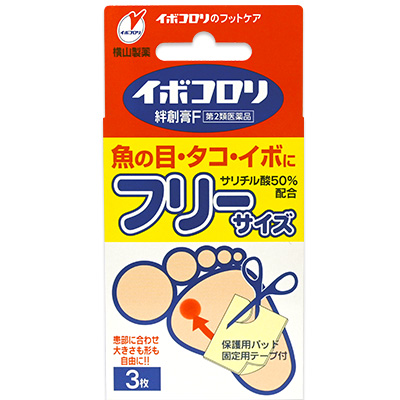
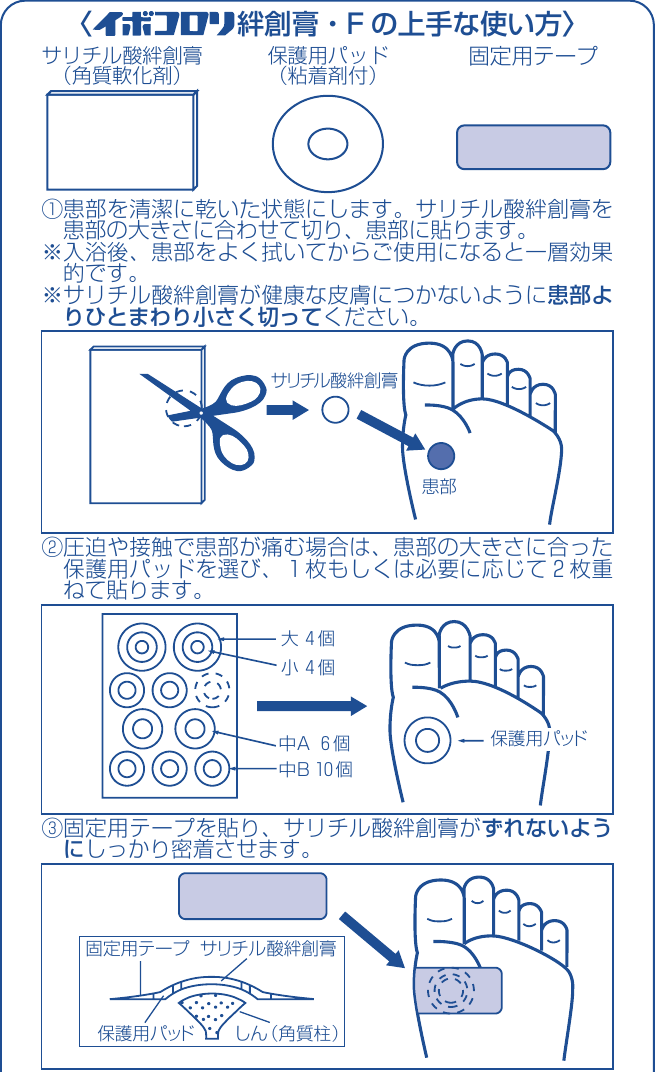
- For a custom-cut medicated area, consider F if you are comfortable with the extra steps. Cut the medicated plaster slightly smaller than the lesion and secure it with the fixing tape as directed. Add a protective pad when needed.
The formula and schedule matter too
| Product / format | Ingredients as stated on the Japanese label | Application outline |
|---|---|---|
| Ibokorori liquid, 6/10mL | Salicylic acid 0.1g per 1g | Apply one drop to the lesion with the cap applicator, four times daily |
| Ibokorori S/M/L plasters | Salicylic acid 50g per 100g of plaster mass; medicated diameters 5/8/12mm | Apply to clean, dry skin and generally leave for 2–3 days; replace if displaced or detached |
| Ibokorori Plaster F | Salicylic acid 50g per 100g of plaster mass | Cut smaller than the lesion, secure and generally leave for 2–3 days; replace if displaced or detached |
| Uonomekorori liquid, 6mL | Salicylic acid 10g and lactic acid 10mL per 100mL | Apply with the cap applicator once or twice daily |
Salicylic acid softens keratin and can also whiten and hurt healthy skin. The manufacturer describes the added lactic acid in Uonomekorori as moistening dry keratin. The stated denominators, formulations and contact times differ: 50% does not mean a plaster is “five times stronger” than the liquid. Do not layer liquid and a medicated plaster on the same spot for extra effect.
Keep the medicine off healthy skin
Apply liquid only to the lesion and avoid run-off. For otherwise eligible Ibokorori liquid use, treat only one or two sites at a time, not every lesion at once. Wipe it off immediately if it reaches healthy skin; make sure it dries, especially between digits. Before the next application, remove the white film if it comes away easily as the instructions describe; do not force it. Both liquids are flammable. Keep them away from flames, wipe the bottle neck and close tightly after use.
With plasters, treat one lesion at a time. Keep the medicated area from sliding onto healthy skin. Replace a plaster that shifts or comes off after bathing, and dry the skin before applying the replacement. Once the keratin has whitened, softened and loosened, remove only what comes away without pain. Do not dig into, cut or forcibly pull off the skin. Stop removing loosened skin if it hurts.
When should you stop?
Stop and seek advice with the leaflet if a rash, redness, itching or worsening develops. Stop and consult if there is no improvement after about one month. Wart treatment can take months, but that is not permission to ignore lack of improvement or deterioration.
If liquid enters an eye, rinse immediately with water or lukewarm water and see an eye specialist straight away; do not wait for severe symptoms. All products are for external use only and must be kept out of children’s reach.
Check the full name once more: a plain protective pad is different from a medicated plaster. Oral tablets under the same brand are not the salicylic-acid treatments compared here and should not be treated as an oral substitute for corn-removing medicine.
Official sources
- Ibokorori liquid Japanese leaflet
- S/M/L Japanese leaflet
- F Japanese leaflet
- Uonomekorori Japanese leaflet
- Yokoyama Ibokorori range
- Yokoyama Uonomekorori range
Checked 13 October 2026. Follow the Japanese box and current leaflet supplied with your product.