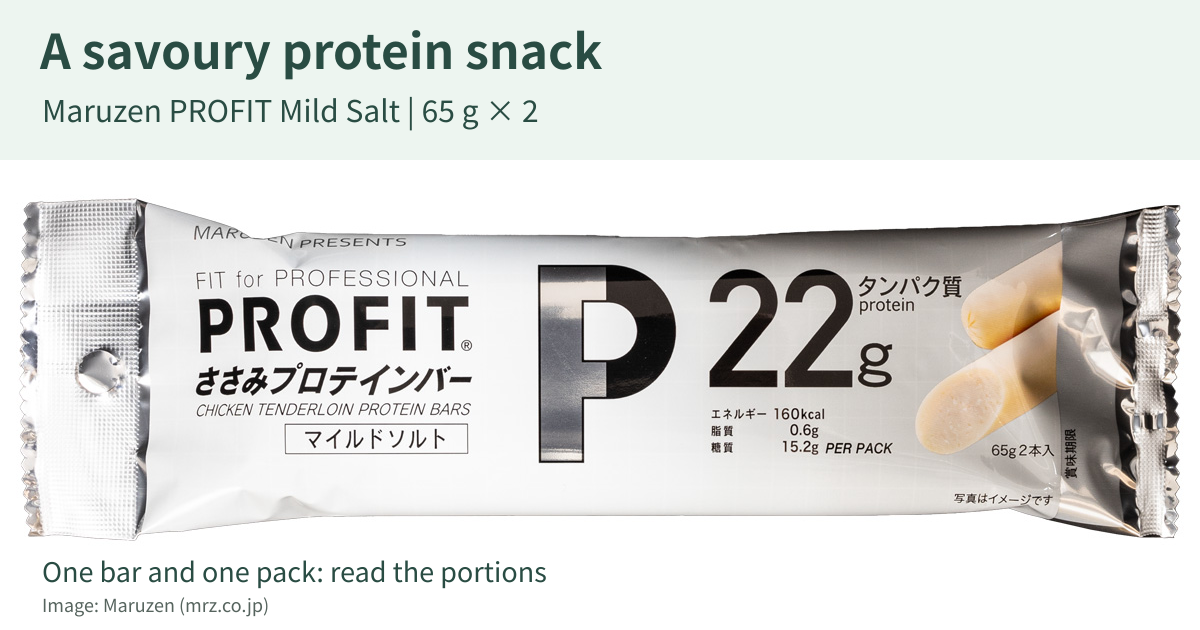
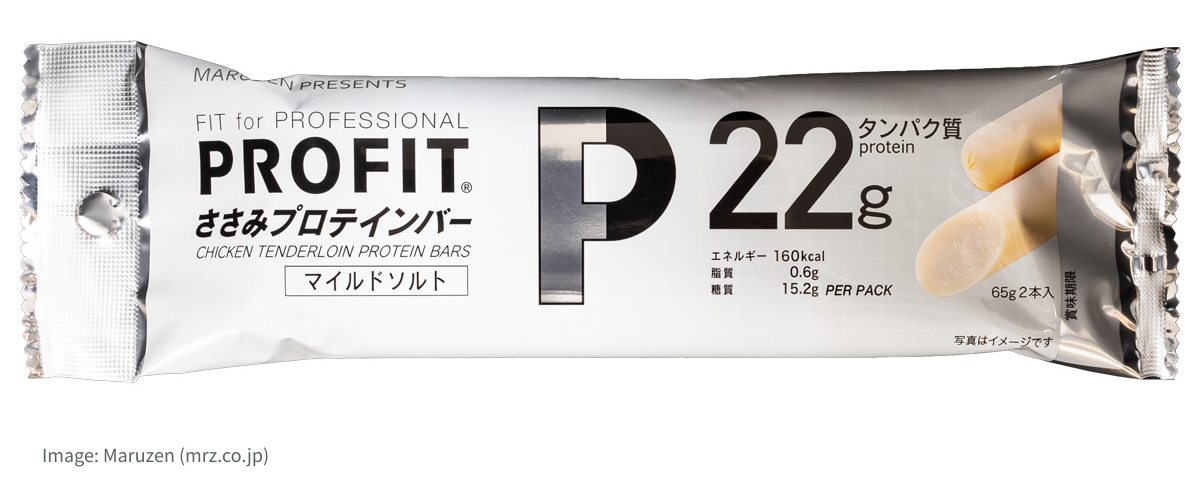
For a savoury alternative to sweet protein bars in Japan, look at Maruzen PROFIT Chicken Protein Bar in Mild Salt. This is a ready-to-eat, sausage-style food made with chicken tenderloin. The unopened product can be stored at room temperature. Check two things first: the pack contains two bars, and its large “22 g protein” claim is for the pack. It also contains pork-derived ingredients.

I’m Irene, born in Taiwan, licensed as a pharmacist in Japan, and working in a Japanese drugstore. When choosing a snack for a day out, I start with what I feel like eating and the portion, then check the protein number. Here is how to recognise this particular pack.
Checked 19 October 2026. This guide covers the Japanese “PROFITささみプロテインバー マイルドソルト”: two 65 g bars, 130 g in total. It is an ordinary food. Check the specific label for other flavours or pack sizes.
- Choose the kind of snack you want first
- What should Mild Salt taste and feel like?
- Recognise the complete 65 g × 2 pack
- One bar or the whole pack?
- Chicken-based does not mean pork-free
- Eating it during your stay in Japan
- Unopened storage: check the date and directions
- Irene’s quick takeaway
- Official sources
Choose the kind of snack you want first
- Want something savoury and meat-based? This is an option to consider: Maruzen positions it as a non-sweet, meal-style protein bar.
- Prefer chocolate, cereal crunch or a baked snack? See the Asahi Ippon Manzoku bar comparison for a different eating experience.
- Avoid pork or need a low-salt choice? Do not rely on “chicken” or “Mild Salt.” The ingredients include pork collagen peptides and pork extract; one bar supplies 1.0 g salt equivalent.
What should Mild Salt taste and feel like?
Maruzen describes Mild Salt as a straightforward, lightly salted flavour. That is a flavour description, not a low-sodium nutrition claim.
In its 2024 reformulation announcement, the manufacturer says it combined two chicken tenderloin textures to bring out both fibres and small meat particles. Expect a savoury, sausage-style food with a meaty texture, rather than a crunchy chocolate bar. These are attributed manufacturer descriptions, not a personal tasting review; your impression of firmness and saltiness may differ.
Recognise the complete 65 g × 2 pack
One bar or the whole pack?
The one-bar column below follows the current product page. The whole-pack figures are calculated by doubling it, not a recommended daily serving.
| Nutrient | One bar, 65 g | Pack, 130 g (calculated) |
|---|---|---|
| Energy | 80 kcal | 160 kcal |
| Protein | 11.4 g | 22.8 g |
| Fat | 0.3 g | 0.6 g |
| Carbohydrate | 7.8 g | 15.6 g |
| Carbohydrate excluding fibre | 7.6 g | 15.2 g |
| Dietary fibre | 0.2 g | 0.4 g |
| Salt equivalent | 1.0 g | 2.0 g |
The front says 22 g protein per pack; doubling the current nutrition-table figure of 11.4 g gives 22.8 g. Use the calculated total when comparing portions. The front’s 22 g claim is for the pack, not one bar.
Japanese “糖質” means carbohydrate excluding dietary fibre, not total sugars. A non-sweet flavour does not mean carbohydrate-free: one bar contains 7.8 g carbohydrate.
Chicken-based does not mean pork-free
The ingredients include chicken tenderloin, pork collagen peptides and pork extract. This is unsuitable if you avoid pork, and it is not vegetarian. The full ingredient declaration lists wheat, soy, chicken, pork and gelatin. The separate box covering Japan’s eight specified allergens lists wheat, but that is not the complete ingredient-allergen declaration.
The factory also makes products containing shrimp, crab, egg and milk. That is a shared-factory statement, rather than a statement that all four are ingredients in this bar. Check your actual pack if you have food allergies.
Full ingredient list, translated from the current Japanese product page
Chicken tenderloin (Thailand or Japan), pork collagen peptides, salt, reduced starch syrup, pork extract, fermented seasoning, onion extract, spices; modified starch, flavour enhancers (amino acids, etc.), trehalose, polysaccharide thickeners, sodium phosphates, pH adjusters, antioxidant (vitamin E). Contains wheat, soy, chicken, pork and gelatin.
Eating it during your stay in Japan
No cooking or reheating is required. It can be a savoury snack or something to add alongside the food you already planned to eat. My practical check is the rest of that meal: if you are also buying soup or salty side dishes, include the bar’s 1.0 g salt equivalent in your comparison. Both bars together provide 2.0 g.
Before eating, check the exact product name, printed date, and opening and eating directions on your pack. Maruzen’s current product page says it is ready to eat, with no further heating needed. A two-bar pack is not a fixed daily serving.
Unopened storage: check the date and directions
Maruzen gives a room-temperature shelf life of 180 days. Follow the printed date and storage directions on the pack you buy; do not start a fresh 180-day count on the purchase date. Unopened shelf-life information does not establish safe long-term storage after opening.
This guide treats it as food to eat within Japan. Room-temperature storage alone is not a reason to pack meat products as souvenirs for another country.
Irene’s quick takeaway
For a non-sweet snack, match the Mild Salt name and 65 g × 2 size. For nutrition, decide whether you mean one bar or both. Check pork ingredients and salt alongside the protein number.