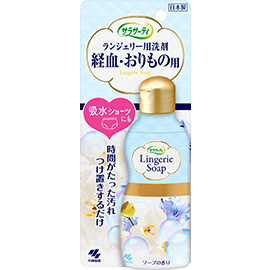
Buying a Japanese detergent for stained underwear? Check the garment first, then learn the bottle’s 10 mL scale. Kobayashi’s サラサーティ ランジェリー用洗剤 (Sarasaty Lingerie Detergent, 120 mL) cleans menstrual blood and discharge stains on clothing. “Lingerie Soap” on the bottle does not mean body wash or intimate cleanser.
I’m Irene, a Taiwan-born pharmacist qualified in Japan. This guide explains the current Japanese manufacturer’s instructions; it is not a hands-on stain-removal test.
Before buying: three checks for your underwear
This is a weakly alkaline synthetic laundry detergent, with a soap fragrance. Cotton, linen and synthetic fibres are the manufacturer’s intended fabrics, but the garment’s instructions still apply.
- Read every material listed, including blends and layers. Do not use on silk, wool, cupra or rayon.
- Check the care label. A crossed-out wash tub means no washing in water. Do not use this detergent if the garment specifies neutral detergent only (中性洗剤使用).
- For soaking, check that the garment permits soaking too. The pink 吸水ショーツ callout means absorbent underwear; it does not override that underwear maker’s restrictions.
If the materials or permitted washing method are unclear, do not try a soak to find out. Check with the garment maker before using this product. Disposable period products are outside this guide.
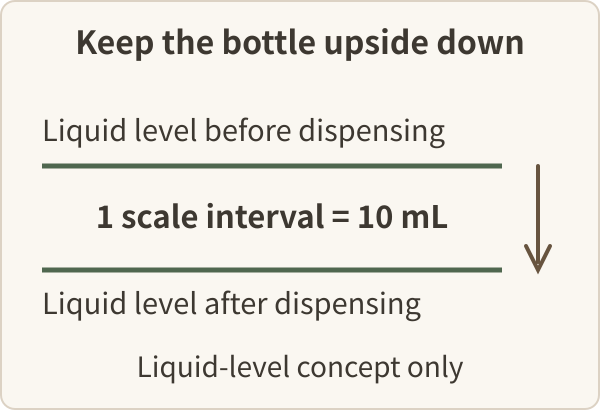
Measure 10 mL by the liquid-level change
- Hold the bottle upside down and note the liquid level against the side scale.
- Gently press the bottle with your fingers to dispense detergent. Compare the level before and after, with the bottle still upside down.
- A decrease of one adjacent scale interval equals 10 mL. This is the difference between two levels, not one capful or a fixed “10 mL remaining” line.
500 mL of water: soak, then rinse
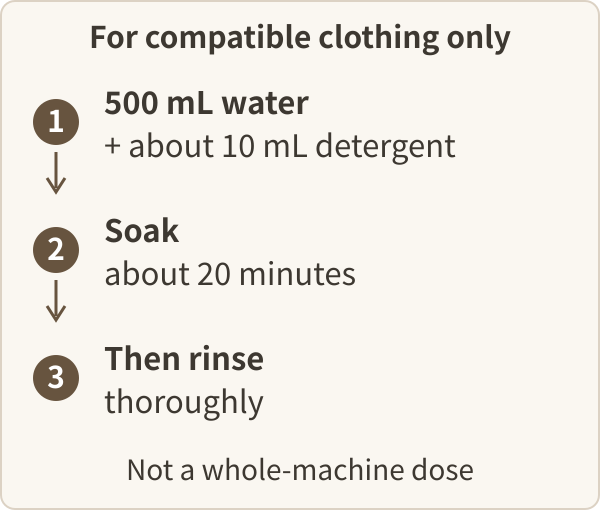
Only after the fabric and care-label checks, add about 10 mL detergent to 500 mL of water or lukewarm water. Soak for about 20 minutes, then rinse thoroughly. Twenty minutes is the soaking step, not the end of washing.
For older or stubborn stains, the manufacturer allows direct application followed by a longer soak in the same solution. Wear household gloves when using undiluted detergent. No numerical longer-soak limit is given; do not turn this into an overnight-soaking instruction or override the garment’s limits.
Machine washing is a separate pretreatment route
Wear gloves, apply an appropriate amount to the stain, rub gently, then machine-wash according to the garment’s instructions. Do not let the cap touch the fabric. The manufacturer gives no whole-machine detergent dose here. Do not transfer the 10 mL soaking dose to a full machine load.
If a shop listing says something different
The Japanese product page checked on 27 October 2026 lists 22% surfactants and excludes all four fibres above. Before use, check the current official instructions and the label on your own bottle for the full fabric restrictions. A shortened product description does not make an omitted fabric suitable: do not use this detergent on garments containing silk, wool, cupra or rayon.
Keep it for laundry, in its original container
Do not apply it to skin or intimate areas. This guide makes no treatment, disinfection or infection-prevention claim. Stain removal is not proof of disinfection.
Avoid eye contact and accidental swallowing. Keep it out of reach of children and anyone at risk of swallowing it accidentally; do not transfer it to another container. Wear household gloves for sensitive skin, prolonged contact or undiluted use, and wash hands well afterwards. For an accident, follow the full first-aid directions on the pack or official page.
Official sources and scope
Checked 27 October 2026. The diagrams explain the manufacturer’s instructions; they are not a hands-on test or a drawing of the actual bottle scale. The latest physical bottle’s full label has not been checked. Follow your garment’s care label and product instructions. Complete stain removal is not promised. The unchanged cover photograph is from Kobayashi; image and trademark rights remain with their owners. This does not imply endorsement.