Current Japanese official product and complete instructions checked: 2 November 2026. This guide covers MUHI ER 15mL and pre-purchase suitability—not ear cleaning or a deep-ear application tutorial.
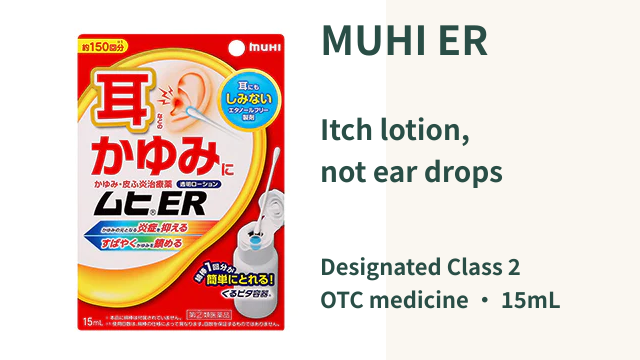
A liquid sold for itchy ears is not necessarily an ear-drop medicine. MUHI ER is a topical anti-itch and anti-inflammatory medicine. Its current instructions explicitly say that it is not an ear drop and must not be dripped directly into the ear. It is not an earwax-removal liquid either: itching does not establish that an ear needs cleaning.
The useful distinctions are the anti-inflammatory ingredient, the cooling ingredient and the product design intended to reduce liquid running deeper into the ear. None replaces checking whether this medicine is appropriate in the first place.
- Identify the 15mL box and bottle—not an ear-use substitute for another MUHI
- PVA addresses inflammation; menthol provides a cooling sensation
- Ethanol-free, viscous and specially packaged does not mean pour it in
- Applying a medicine is not cleaning an ear
- Age 10 is a starting-use guideline; under-15s still need supervision
- Separate do-not-use conditions, prior consultation and stopping
- Keep the original bottle and instructions—not a replacement dropper bottle
- Official sources
Identify the 15mL box and bottle—not an ear-use substitute for another MUHI
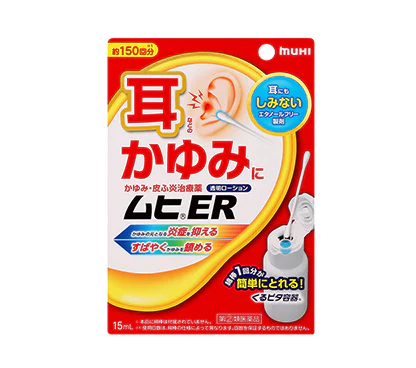
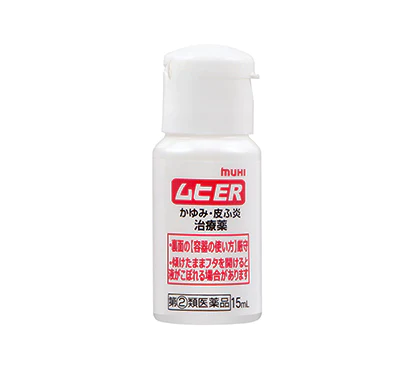
The full name is ムヒER / MUHI ER, a Japanese Designated Class 2 OTC medicine, in a current 15mL pack. Its labelled indications include itching, dermatitis, eczema, contact dermatitis, prickly heat, hives and insect bites. It may also be used on skin outside the ear, but those other-site instructions must not replace the ear-specific limits.
MUHI products do not all have the same ingredients, container or application sites. For general insect-bite products, see the separate MUHI S, Liquid S2a and Alpha SII comparison. Do not substitute them for ER or drip them into an ear.
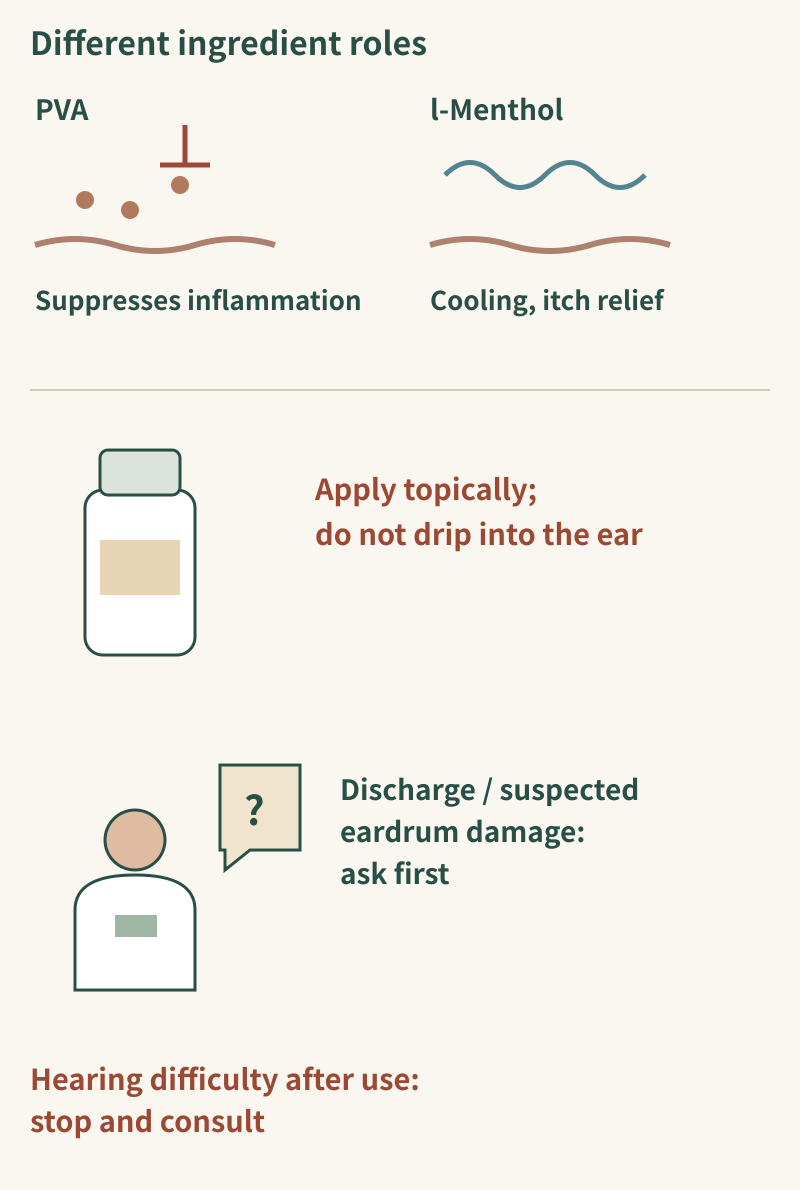
PVA addresses inflammation; menthol provides a cooling sensation
The active-ingredient quantities are stated per 100g, not per application and not as a weight conversion for the 15mL bottle:
- PVA 0.15g: prednisolone valerate acetate, a corticosteroid anti-inflammatory ingredient that suppresses inflammation associated with itching.
- l-Menthol 1.0g: provides a cooling sensation and relieves itching. Feeling cooler does not establish that an ear condition has resolved, or justify applying more.
The manufacturer describes PVA as an “antedrug-type” anti-inflammatory ingredient. That term does not mean steroid-free, free of side effects or suitable for prolonged continuous use. This guide does not turn every cause of ear itching into one inflammation diagram or ask readers to diagnose infection, wax blockage or an eardrum problem themselves.
Ethanol-free, viscous and specially packaged does not mean pour it in
The formulation contains no ethanol, fragrance or colouring. The manufacturer omits ethanol as a source of irritation and uses a transparent lotion with moderate viscosity to make it less likely to run deeper into the ear. Less likely to run is not a no-drip guarantee; ethanol-free is not a guarantee against irritation or allergy.
The “Kuru-Pita” container collects liquid at a designated point inside the container for a cotton swab. It is not a dropper for delivering medicine directly into the ear. Follow the complete official container and application instructions to prevent liquid running deeper. If you cannot understand or confidently follow them, take the actual product for professional explanation before trying it.
Applying a medicine is not cleaning an ear
The labelled directions are to apply an appropriate amount to the affected area several times a day. It is for external use only: do not swallow it or drip it directly into an ear. Do not put a cotton swab deep into the ear, rub or dig. Excessive cleaning or scratching may worsen inflammation; applying medicine is not an opportunity to excavate wax.
Follow the complete container instructions. Opening the cap while the bottle is tilted may spill liquid, so place it on a flat surface before opening. Do not dip a used swab back into the medicine, which could introduce foreign matter. Do not cover treated skin with plastic wrap or another non-breathable material.
If using earphones or a hearing aid afterwards, the manufacturer directs you to gently wipe away the medicine first. Keep the liquid off these devices, as it may damage their materials. It is not a protective layer permitting continued irritation of the affected area.
Age 10 is a starting-use guideline; under-15s still need supervision
The manufacturer’s starting-use age guideline for the ear is 10 and above. Children under 15 must use it under a guardian’s instruction and supervision, not alone. Reaching 10 is not an automatic suitability decision: medical history, skin condition, discharge and eardrum concerns still matter. Do not independently treat younger children as suitable users.
Separate do-not-use conditions, prior consultation and stopping
- Do not apply to chickenpox, athlete’s foot or ringworm, suppurating skin, around the eyes or to mucous membranes. Do not apply over a large facial area.
- Consult before use if under medical treatment, pregnant or possibly pregnant, with previous allergic symptoms from medicines or other substances, a widespread affected area, or severe wetness or erosion. Also follow the ear-discharge and suspected-perforation consultation requirements above.
- Stop immediately and take the instructions for advice if rash, redness or itching develops, or the affected skin develops fungal infection, acne, suppuration or persistent irritation. Hearing difficulty after use also requires stopping and consultation.
- If it enters the eyes: rinse immediately with water or lukewarm water. Seek an ophthalmologist for severe symptoms such as persistent redness or pain, or tears that do not stop.
Stop and consult if there is no improvement after five to six days. Ear use also carries a prohibition on prolonged continuous use, with a guideline of no more than two weeks. These are not alternative deadlines: being short of two weeks does not override no improvement at five to six days, and an adverse reaction must not wait for either. The general four-week guideline for other body sites is not an ear-use allowance.
Keep the original bottle and instructions—not a replacement dropper bottle
Keep tightly closed in a cool place away from direct sunlight, out of children’s reach. Do not transfer to another container. Avoid dripping and close the cap firmly to prevent leaks. Keep the liquid off painted floors or furniture, glasses, watches, jewellery, plastics, synthetic fabrics, leather and bedding, as it may damage them.
Do not use past the expiry printed on the carton and bottle bottom. Even within that date, use promptly after opening to maintain quality; do not invent a fixed post-opening number of months.
The useful purchase decision is not “itchy ears need an ear liquid,” but what kind of topical medicine this is, whether your symptoms require a doctor first, and whether you can follow the complete instructions correctly. A product photograph cannot identify the cause of an itchy ear.