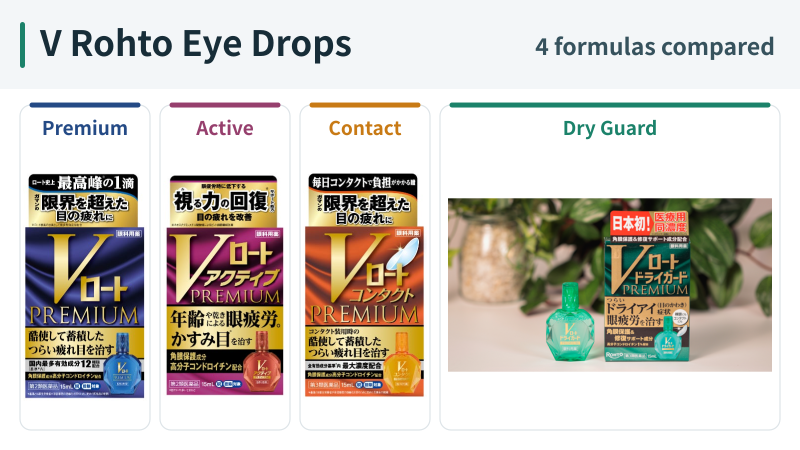
If dryness is your main concern, start by checking Dry Guard. If you wear ordinary, non-coloured soft lenses and have tired or itchy eyes, consider Contact. Without lenses, or with ordinary hard lenses, compare Premium and Active when fatigue comes with redness or itching. None of these four should be used while wearing coloured or circle lenses.
For all four, consult a doctor, pharmacist or registered OTC medicine seller before use if you are receiving medical treatment, have a history of allergic reactions to medicines or similar substances, have severe eye pain, or have been diagnosed with glaucoma.

I’m Irene, a Taiwan-born, Japan-licensed pharmacist working in a Japanese drugstore. Similar names can make this shelf confusing. Start with what is bothering your eyes and which lenses you wear, then check the box.
Product information checked: 11 October 2026 · Japanese-market versions.
This guide covers the four current Japanese products. Dry Guard launched in March 2026. Other markets and older versions may have different instructions.
Compare symptoms and lens compatibility first
| What to check | Premium | Active | Contact | Dry Guard |
|---|---|---|---|---|
| Selection pointer | Tired eyes, with labelled uses including redness and itching | Rohto’s age- or dryness-related eye-fatigue positioning, with less cooling | Fatigue, itching or discomfort while wearing non-coloured soft lenses | Dryness, including while wearing non-coloured soft lenses |
| Tear supplementation for dry eyes | Not listed | Not listed | Not listed | Listed |
| Itchy eyes | Listed | Listed | Listed | Not listed |
| Conjunctival redness | Listed | Listed | Not listed | Not listed |
| With non-coloured soft lenses | No | No | Yes | Yes |
| Without lenses or with ordinary hard lenses | Yes | Yes | Yes | Yes |
| With coloured or circle lenses | No | No | No | No |
| Rohto cooling rating, out of 5 | 4 | 2 | 4 | 1 |
All four list eye fatigue, blurred vision such as when there is excess eye discharge, and discomfort while wearing hard lenses. This table highlights selected differences in their Japanese labelled uses; it is not the full indication list.
Both Contact and Dry Guard can be used with ordinary, non-coloured soft lenses in place. Dry Guard has the specific tear-supplementation indication for dryness. Contact includes itching as well as fatigue and lens discomfort. Both can also be used without lenses for their labelled symptoms.
Active’s positioning mentions fatigue associated with age or dryness, but its indications do not list tear supplementation. Its current leaflet gives no numerical minimum age, and it does not treat presbyopia or cataracts. The manufacturer’s description of supporting recovery of visual function reduced by eye fatigue does not mean the drops correct short-sightedness. Cooling ratings describe sensation, not comparative effectiveness or a guarantee against irritation.
Match the full Japanese name on the box
Premium
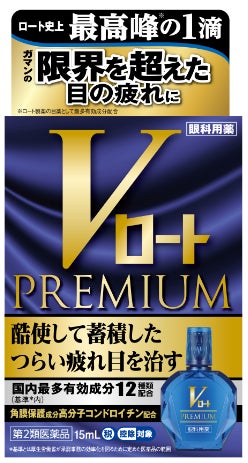
Japanese product name: Vロートプレミアム
15 mL | Japanese Class 2 OTC medicine | JAN barcode: 4987241174454
The blue-box base version, without Active or Contact in its name.
Active
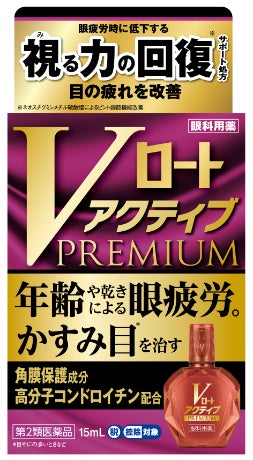
Japanese product name: Vロートアクティブプレミアム
15 mL | Japanese Class 2 OTC medicine | JAN barcode: 4987241174461
The burgundy-box version. Match the full name rather than relying on colour alone.
Contact
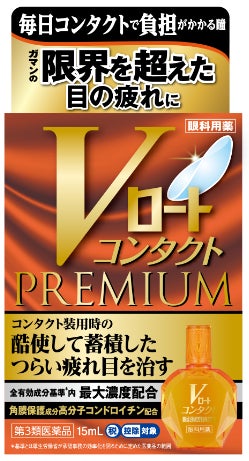
Japanese product name: Vロートコンタクトプレミアム
15 mL | Japanese Class 3 OTC medicine | JAN barcode: 4987241174508
The orange-box version. “Contact” does not mean it is compatible with every lens type.
Dry Guard
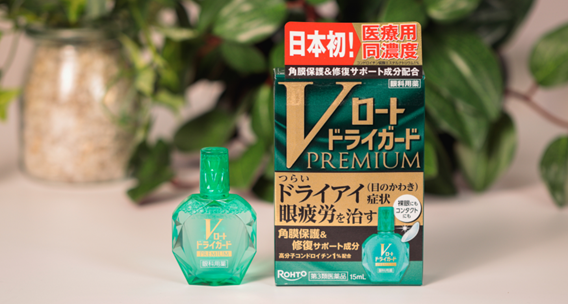
Japanese product name: Vロートドライガードプレミアム
15 mL | Japanese Class 3 OTC medicine | JAN barcode: 4987241194193
The green-box version. Check this name and barcode carefully. Information for the older Dry Eye product should not be used for this formula or dose.
Packaging can change, so check the name, size and barcode together.
What do the main ingredients do?
Corneal protection in all four, with Dry Guard focused on dryness
All four contain chondroitin sulfate sodium, which Rohto describes as protecting the corneal surface. Dry Guard uses it at 1% as its only active ingredient. Rohto describes corneal protection and reduced tear evaporation, alongside its labelled tear-supplementation use.
The sesame oil in Dry Guard is a formulation stabiliser, not a second active ingredient. Ingredient counts and concentrations do not tell you which product is more effective or justify claims of several-fold stronger relief.
Fatigue and itching ingredients in Premium, Active and Contact
These three contain neostigmine methylsulfate, described as helping focusing function to relieve eye fatigue, and the antihistamine chlorpheniramine maleate for itching. Dry Guard contains neither and has no itching indication.
Redness relief and vitamin A differ between products
- Premium and Active contain tetrahydrozoline hydrochloride, which constricts blood vessels to reduce redness. Premium also contains anti-inflammatory ingredients including allantoin, dipotassium glycyrrhizinate and zinc sulfate hydrate.
- Active and Contact contain retinol palmitate, or vitamin A. Rohto describes its role in corneal repair and, for Active, tear-film stability.
- Contact and Dry Guard contain no tetrahydrozoline. Their leaflets still require consultation before use for people with glaucoma.
Ingredient descriptions do not replace assessment of persistent blurred vision or an eye injury. Do not assume these products are preservative-free; ask a pharmacist to check the full formula if you need to avoid an additive. Dry Guard contains menthol, so its low cooling rating does not mean irritation is impossible.
Dose: Dry Guard has a different daily frequency
| Product | Drops per use | Times per day |
|---|---|---|
| Premium | 1–2 | 5–6 |
| Active | 1–3 | 5–6 |
| Contact | 1–3 | 5–6 |
| Dry Guard | 1–2 | 3–4 |
Follow the current leaflet in your box. Do not increase the dose because your eyes feel more tired or red, or because you want more cooling. Premium and Active specifically warn that overuse may worsen redness or cause unusual sensitivity to light.
Rohto’s application guide gives this sequence:

1. Wash your hands
Use soap, then check compatibility with your lens type.

2. Keep the nozzle clear
Look upwards and gently pull down the lower lid. Apply the labelled dose without touching the eye, eyelid or eyelashes with the nozzle.
3. Close gently for about 1 minute
Lightly press the inner corner beside the nose. Avoid squeezing or repeated blinking. Wipe liquid from the skin with a clean tissue.
Close the bottle promptly. Use these products only as eye drops, never to clean or store contact lenses.
When should you stop and seek advice?
Stop conditions shared by all four
Stop immediately and take the leaflet to a doctor, pharmacist or registered OTC medicine seller if you develop a skin rash, redness or itching, or eye redness, itching, swelling or stinging pain after use. Stop and seek advice if blurred vision does not improve.
The leaflets give different time limits for symptoms that are not improving:
- Premium, Active and Contact: stop and seek advice after 5–6 days without improvement.
- Dry Guard: stop and seek advice after about 2 weeks without improvement.
Do not wait for these limits if you have a reaction or persistent blurred vision. If lenses cause pain, a strong foreign-body sensation or ongoing symptoms, stop wearing them and promptly see an eye doctor.
Children need an individual check
All four Japanese leaflets require parent or guardian supervision and give no numerical minimum age. Rohto’s general FAQ advises waiting until children can describe their symptoms and how the drops feel; cooling drops may feel too strong. Ask a pharmacist before choosing one for a child, especially a young child.
Storage and time after opening
Turn the cap until it clicks shut. Store in a cool place away from sunlight and children. Avoid temperatures of 40°C or above, such as in a hot car or beside a heater. Do not transfer, share or add anything to the liquid. Do not use cloudy or expired drops. Gently wipe any ingredient crystals on the nozzle or inside the cap with clean gauze.
- Premium, Active and Dry Guard: the leaflets say to use promptly after opening.
- Contact: the leaflet gives a guideline of 2–3 months after opening with correct storage, without exceeding the printed expiry date.
Do not apply Contact’s guideline to the others. Dry Guard’s two-week consultation advice is not an expiry period after opening.
One last check before buying
For dryness, look at Dry Guard. For fatigue or itching while wearing non-coloured soft lenses, compare Contact. Without lenses or with ordinary hard lenses, Premium and Active are options to compare when redness is also relevant.
Show the pharmacist your main symptoms, lens type and the product name. Persistent discomfort deserves an eye examination so you can address its cause.
Manufacturer sources
- Premium product information and Japanese leaflet
- Active product information and Japanese leaflet
- Contact product information and Japanese leaflet
- Dry Guard product information and Japanese leaflet
- Rohto’s Dry Guard launch announcement, 26 March 2026
- Rohto’s guidance on coloured and circle lenses
- Rohto’s FAQ on children using eye drops
- Rohto’s instructions for applying eye drops
This guide concerns the Japanese products and does not replace individual medical advice. Follow the latest leaflet supplied with your medicine.