Buying Milton in Japan? Check for ミルトン(液体タイプ), the liquid bottle-and-teat disinfectant. The important details are the measuring line, which container you use, and how long each item remains immersed. “One capful” and “no rinse” need that context.
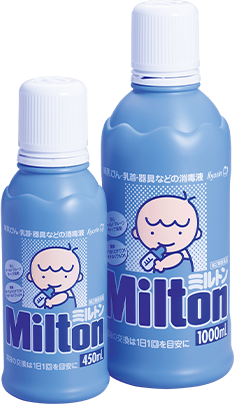
This guide covers the Japanese liquid product only. It is a Class 2 medicine containing sodium hypochlorite 1.1 w/v%, sold in 450 mL and 1,000 mL bottles. Washing detergent, Milton CP tablets and overseas Milton products have separate instructions. Do not transfer recipes between them.
- Check compatibilityCheck the exact bottle, teat and container instructions. If chemical disinfection is not permitted or is unclear, stop and ask the item maker.
- Wash and rinseRemove milk residue with suitable detergent and a brush. Rinse thoroughly before placing items in disinfectant.
- Prepare, then immerseFollow the applicable manufacturer recipe below. Keep each item completely immersed for at least 1 hour.
- Drain; track the bathShake/drain off solution well. Replace the prepared bath about every 24 hours; each new item still needs its full hour.
1. Check the item and the soaking container
First read the exact bottle and teat maker’s instructions for chemical disinfection, including any separate parts. A general material list does not approve every assembled product, coating or printed marking. If instructions conflict or compatibility is unclear, ask the item maker before soaking.
- Materials listed by Milton
- Glass, ceramics, polycarbonate (PC), polypropylene (PP), polyethylene (PE), acrylic resin and rubber. Natural rubber may deteriorate faster with prolonged immersion. The exact item’s instructions still matter.
- Materials to exclude
- Metal, including stainless steel; melamine resin, phenolic resin, polyurethane and ABS resin. Do not assume that all plastic is suitable. Keep metal tongs, spoons and precious-metal rings out of the solution.
- Container check
- For a container other than Milton’s dedicated liquid vessel, the FAQ specifies a covered, light-shielding colored glass or plastic container, or ceramic container. Do not use a metal pot. Choose one compatible with this chemical method and large enough for complete immersion.
2. Wash, then read the correct measuring line
Disinfection does not replace cleaning. Wash bottles and teats with a suitable baby-item detergent and brush to remove milk/protein residue, then rinse thoroughly. Do not add detergent to the disinfecting bath.
Primary example: the current 1,000 mL label
Measure 50 mL of Milton liquid, using two bottle-cap measures filled to the INNER LINE, and dilute with 4 L of water. Each inner-line measure is 25 mL. A brimful cap is not the stated measure. The label describes the bottle/teat method as approximately 80-fold dilution.
The official FAQ gives this same “50 mL plus 4 L water” example for a container other than the dedicated Milton vessel. Read the package you actually have; do not estimate from a drinking cup or copy a recipe for a different product.
Separate branch: Milton’s dedicated liquid container
The dedicated-container FAQ says to measure 50 mL with the measuring compartment on the underside of its lid, transfer it into the container, then add tap water up to the container’s 4 L mark. This is a separate measuring lid, not the bottle’s cap.
These are two manufacturer instructions with different volume wording: “add 4 L of water” versus “fill to the 4 L mark.” They do not specify an identical exact final volume. Follow the instructions for your actual package and container; do not combine the two sequences or calculate an improvised smaller travel-cup recipe.
3. One hour for each item; about 24 hours for the bath
Completely immerse the washed and rinsed bottle and teat for at least 1 hour. Keep them submerged; the dedicated vessel’s inner drop lid helps prevent floating. Partly submerged items have not followed this method.
Replace the prepared solution about every 24 hours, as directed by the label; the FAQ says to replace it after each 24 hours of use. Several washed items or batches may be treated within that period, but every newly added item needs its own full immersion time. One hour is not the bath’s replacement interval, and 24 hours is not the required soak time.
If the freshly prepared solution changes color, avoid using that water to prepare it. Do not rely on a discolored bath or extend its life by guesswork.
4. What “no rinse” actually means
After correct preparation and the required immersion, remove the item and shake/drain off the solution thoroughly. The manufacturer says rinsing is not required for this method. If residual solution or odor concerns you, its instructions allow rinsing with tap water.
This does not mean that the concentrated liquid or the prepared bath is safe to drink. It also does not remove the washing-and-rinsing step before disinfection or apply to other bottle-care products. If storing treated items after removal, protect them from dust and recontamination in hygienic covered storage. Dry them well before carrying them out.
5. Keep the liquid separate and out of reach
Never drink the stock liquid or bath, and never mix Milton with other products. The label specifically warns against mixing with cyanuric-acid products, acidic cleaners or bleaches. Do not add vinegar or another acid to “neutralize” it.
Keep the original bottle tightly closed in a cool, low-humidity place away from sunlight and children. Never transfer it into another container, especially a drink bottle. A child-resistant cap does not make accessible storage safe. Observe the printed expiry date. The liquid can bleach fabric and alter printing or materials. If your hands are prone to irritation, the label advises household protective gloves.
6. If exposure happens
If anyone swallows the stock or bath, do not induce vomiting. Seek prompt, individualized advice from a medical professional or poison information service, with the product available. Do not wait for symptoms or improvise an infant home remedy. Severe symptoms such as unconsciousness or convulsions require emergency help.
If liquid enters the eyes, do not rub; immediately rinse thoroughly with water or lukewarm water and seek medical advice, urgently for severe symptoms. If contact causes rash, redness, itching or hand irritation, stop use and consult a clinician, pharmacist or registered seller with the product.
Sources checked: 12 November 2026. The linked 1,000 mL label was reviewed; this is not a claim that both package labels were inspected or newly revised. Use the current directions supplied with your product. This article explains label reading, not an infant-age schedule or formula preparation.
Sources and photo credit
- Japanese Milton liquid: product information
- Current linked 1,000 mL label / leaflet
- Liquid FAQ: preparation, materials, rinsing and storage
- Dedicated liquid container and measuring lid
- Japan Poison Information Center: first response to poisoning
- Manufacturer website terms
Official identification photo: KYORIN Pharmaceutical, Milton official website. Shown unaltered at its natural 234 × 404 px size. Original image