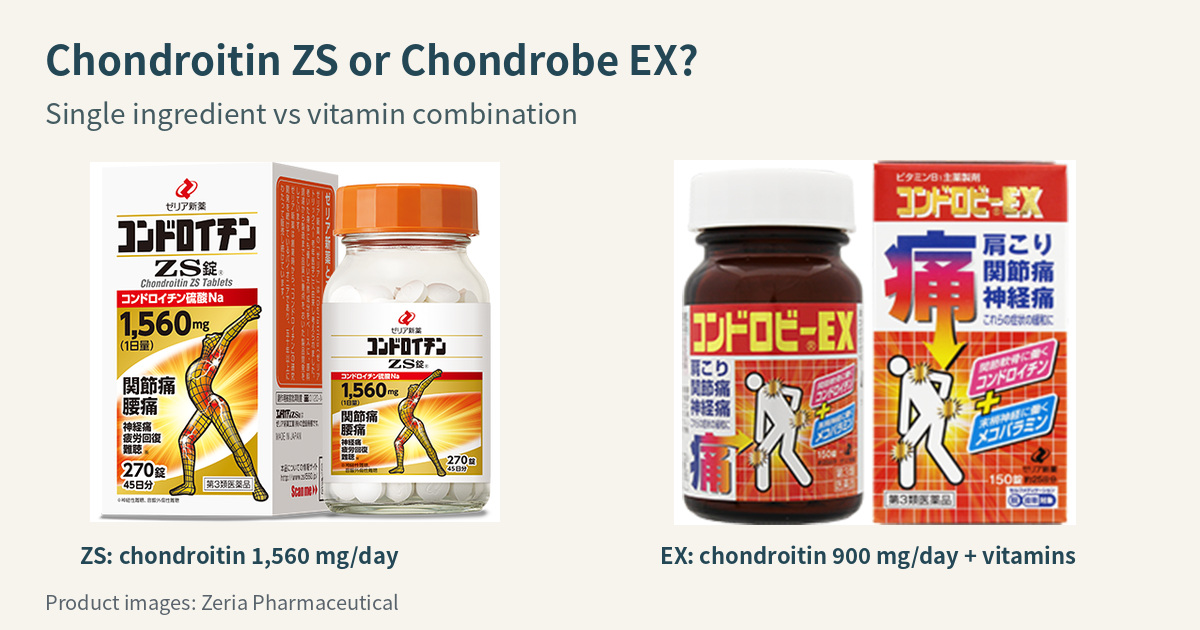
The key choice is a single active ingredient or a chondroitin-plus-vitamin formula. Chondroitin ZS Tablets provide 1,560 mg of chondroitin sulfate sodium per six-tablet daily dose. Chondrobe EX provides 900 mg plus vitamins B1, B6, B12 and E. Both are Class 3 OTC medicines in Japan; neither the larger number nor the EX name proves a better result for you.

I’m Irene, a Taiwan-born pharmacist licensed in Japan and working in a Japanese drugstore. If you’re choosing a product for yourself or a family member, start with the full name and the medicines already being taken. This guide helps you identify the two bottles and spot the dosing and safety details that are easy to miss.
Japan-market products. Information checked on October 19, 2026, Japan time. This is a comparison of ZS Tablets and Chondrobe EX, not the entire Zeria chondroitin range.
- Start with the formula you need to check
- Recognise the packs: 270 and 150 are tablet counts
- All active ingredients, compared per six-tablet daily dose
- What the Japanese labels cover
- Both: age 15+, two tablets three times daily
- Before taking either: treatment, allergies and duplication
- When to stop: the digestive warnings differ
- Keep the original bottle, and keep EX in its carton
- Official labels and medical sources
Start with the formula you need to check
- Looking for chondroitin as the only active ingredient? Identify Chondroitin ZS Tablets, labelled コンドロイチンZS錠. Its Japanese indications include joint pain, lower back pain, frozen shoulder and neuralgia.
- Comparing chondroitin with a vitamin combination? Identify Chondrobe EX, labelled コンドロビーEX. It is a vitamin-B1-based medicine whose listed symptom-relief uses also include numbness in the hands and feet and eye strain.
- Already taking Alinamin, Q&P or a B-vitamin product? Ask a pharmacist to check overlapping ingredients before adding another bottle, particularly EX with its four vitamins.
- A hot, swollen joint, or pain that prevents walking or bearing weight? Seek medical assessment instead of choosing another bottle.
The uses overlap: ZS is not limited to joints, and EX is not limited to nerves. The 1,560 mg and 900 mg daily amounts describe different formulas. They do not establish which will work better for an individual, and additional vitamins are not automatically an advantage.
Recognise the packs: 270 and 150 are tablet counts
Zeria’s English product names are Chondroitin ZS Tablets and Chondrobe EX. Match the complete Japanese pack name when shopping. The official Japan pack images below are not to the same scale.
ZS: white carton, orange cap, and “ZS錠”
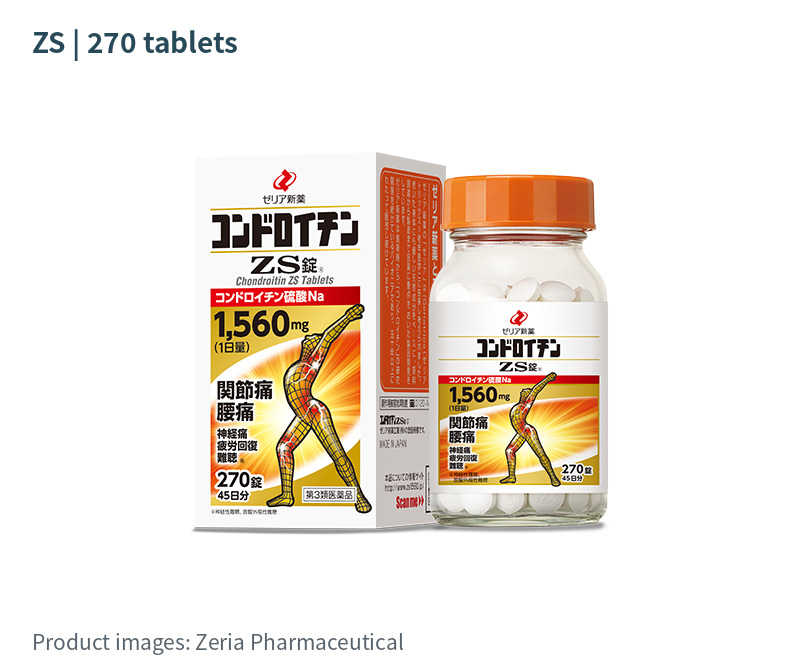
The example is a 270-tablet pack. The large “1,560 mg” means the amount in six tablets across a whole day, not in one tablet or one dose. The Japanese product page also lists 60-tablet blister packs and 108- and 180-tablet bottles. These are pack-size options, not different strengths.
EX: red carton, white cap, and “コンドロビーEX”
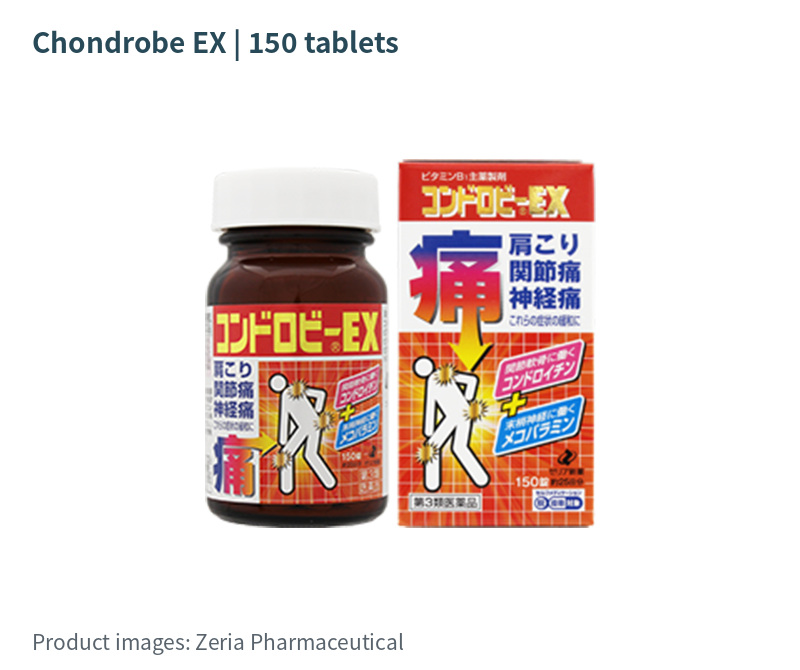
This is the 150-tablet pack listed on the current Japanese product page. Its ingredient combination differs from ZS, so it is not simply a smaller ZS bottle. Use the manufacturer’s spelling Chondrobe EX together with the Japanese name to identify it.
All active ingredients, compared per six-tablet daily dose
Both products are Japanese Class 3 OTC medicines. These amounts are for six tablets divided into three doses, not six tablets taken at once.
| Active ingredient | ZS: six tablets/day | EX: six tablets/day |
|---|---|---|
| Chondroitin sulfate sodium | 1,560 mg | 900 mg |
| Bisbentiamine, a vitamin B1 derivative | Not listed as an active ingredient | 50 mg |
| Pyridoxal phosphate hydrate, an active form of vitamin B6 | Not listed as an active ingredient | 20 mg |
| Calcium tocopherol succinate, a vitamin E ingredient | Not listed as an active ingredient | 50 mg |
| Mecobalamin, an active form of vitamin B12 | Not listed as an active ingredient | 60 μg |
“Single ingredient” describes the active formula: ZS still contains excipients. EX’s amounts are listed for the stated chemical forms. Do not add the milligrams together as a measure of “strength” or directly rank other brands with different vitamin forms. Neither product lists glucosamine as an active ingredient.
Checking an allergy or an excipient? See the complete lists
ZS excipients: calcium silicate, light anhydrous silicic acid, microcrystalline cellulose, acesulfame potassium, magnesium stearate and flavouring.
EX excipients: gelatin, sorbitan monolaurate, sucrose, glycerol fatty acid esters, lactose hydrate, microcrystalline cellulose, light anhydrous silicic acid, carmellose calcium and magnesium stearate. Ask a pharmacist to check the actual label if you have a relevant allergy history.
What the Japanese labels cover
ZS: joint pain, neuralgia, lower back pain, frozen shoulder and recovery from fatigue. The complete Japanese label also lists nerve-related hearing loss and noise-related traumatic hearing loss. Those hearing indications should not guide self-treatment; see the urgent warning below.
EX: relief of neuralgia, muscle and joint pain including lower back pain, stiff shoulders and frozen shoulder, numbness in the hands and feet, constipation and eye strain. It also lists beriberi and vitamin B1 supplementation during physical fatigue, pregnancy or breastfeeding, and reduced strength during or after illness. Beriberi is associated with vitamin B1 deficiency, not athlete’s foot.
These are Japanese labelled uses, not a diagnosis or evidence of approval in your home country. The labels do not promise cartilage regrowth, reversal of osteoarthritis or replacement of existing treatment. If you have a diagnosed joint or nerve condition, discuss the purchase with your usual clinician.
Sudden hearing loss needs immediate medical attention. Do not try ZS for a month first, even if only one ear is affected or hearing worsens rapidly over a few days. The US NIDCD treats sudden hearing loss as a medical emergency; delaying assessment and treatment can reduce treatment effectiveness.
Both: age 15+, two tablets three times daily
| Product | Dose and daily total | Water and timing |
|---|---|---|
| ZS | 2 tablets per dose, 3 times daily; 6 tablets in total | Take with plenty of water or lukewarm water. Before or after meals is acceptable. |
| Chondrobe EX | 2 tablets per dose, 3 times daily: morning, midday and evening; 6 tablets in total | Take with water or warm water. The Japanese leaflet does not specify before or after meals. |
| Under 15 | Do not take either product | Do not improvise a reduced child dose. |
Do not dry-swallow ZS. The tablets can stick inside the mouth, so its leaflet specifically asks for plenty of water or lukewarm water. For the 60-tablet blister pack, push the tablet out before taking it; never swallow a piece of blister packaging.
Do not take the six-tablet daily total in one go or borrow another brand’s once-daily schedule. A “45-day supply” on a 270-tablet bottle is the arithmetic of 270 divided by six, not advice to self-treat for 45 days.
Before taking either: treatment, allergies and duplication
Both leaflets require consultation before use if you are receiving medical treatment or have previously had an allergic reaction to medicines or similar products. Bring your prescription medicines, OTC products, vitamins and supplements for a doctor, pharmacist or registered OTC medicine seller in Japan to check.
Although EX includes vitamin B1 supplementation during pregnancy and breastfeeding among its uses, check your individual need and overlap with prenatal vitamins and other medicines first. If pregnant, possibly pregnant or breastfeeding, do not choose either product solely from this comparison.
Do not combine ZS and EX on your own. Zeria’s FAQ recommends selecting one according to symptoms because their ingredients overlap, with advice from a pharmacist or registered seller. Adding EX to Alinamin or another B-vitamin product also needs an ingredient and total-dose check. Taking the products at different times does not remove same-day duplication.
To identify a bottle you already have, see the five-type Alinamin comparison or the Q&P Kowa Gold tablet comparison. These links help you check formulas; they are not recommendations to combine medicines.
When to stop: the digestive warnings differ
- ZS: stop immediately and consult with the leaflet if you develop a rash, redness, itching, diarrhoea, nausea or stomach discomfort.
- EX: stop immediately and consult for a rash, redness, itching, stomach discomfort, nausea/vomiting, loss of appetite or abdominal bloating. Stop and consult if constipation, loose stools or diarrhoea persist or become worse.
- EX also has a menstrual warning: a period may start earlier or flow may become slightly heavier. Consult a healthcare professional if bleeding continues for a long time; do not simply dismiss it as expected.
- Both: if symptoms have not improved after about one month, stop and consult, taking the leaflet with you. This is not permission to wait a month with any symptom.
Arrange earlier medical assessment for joint pain that affects normal activities or sleep, keeps returning or is getting worse. A hot, swollen joint or joint pain with fever, shivering or feeling unwell needs urgent assessment. Severe pain after an injury or inability to walk or bear weight needs immediate emergency assessment. These general red flags are separate from the medicine’s one-month review rule.
Keep the original bottle, and keep EX in its carton
Store both out of direct sunlight in a cool, dry place away from children, with the bottle tightly closed. Do not transfer tablets to another container, handle them with wet hands or use them after expiry. If ZS tablets become wet, discard those tablets rather than returning them to the bottle. EX is light-sensitive: its leaflet says to store the bottle in its carton.
EX tablets can normally have pale-red to red specks from mecobalamin. ZS contains flavouring, so you may notice an odour when opening it. If the appearance has changed or storage is questionable, ask a pharmacist to inspect it.
My checking order: Does this need medical assessment first? → Exact Japanese name → Single ingredient or vitamin combination → Overlap with current medicines → Two tablets, three times daily. That is more useful than choosing the biggest number or the longest ingredient list.
Official labels and medical sources
- Zeria: current Japanese product information
- Zeria: Japanese product FAQs
- Original Japanese ZS leaflet: bottle and blister versions (PMDA)
- Original Japanese EX leaflet (PMDA)
- Zeria: English product names
- NIDCD: sudden hearing loss
- NHS: joint-pain red flags
This guide helps identify Japanese products and understand their labels. It does not replace individual medical advice or the complete leaflet supplied with your purchase.