
Hi, I’m Irene, a Taiwanese pharmacist working in Japan.
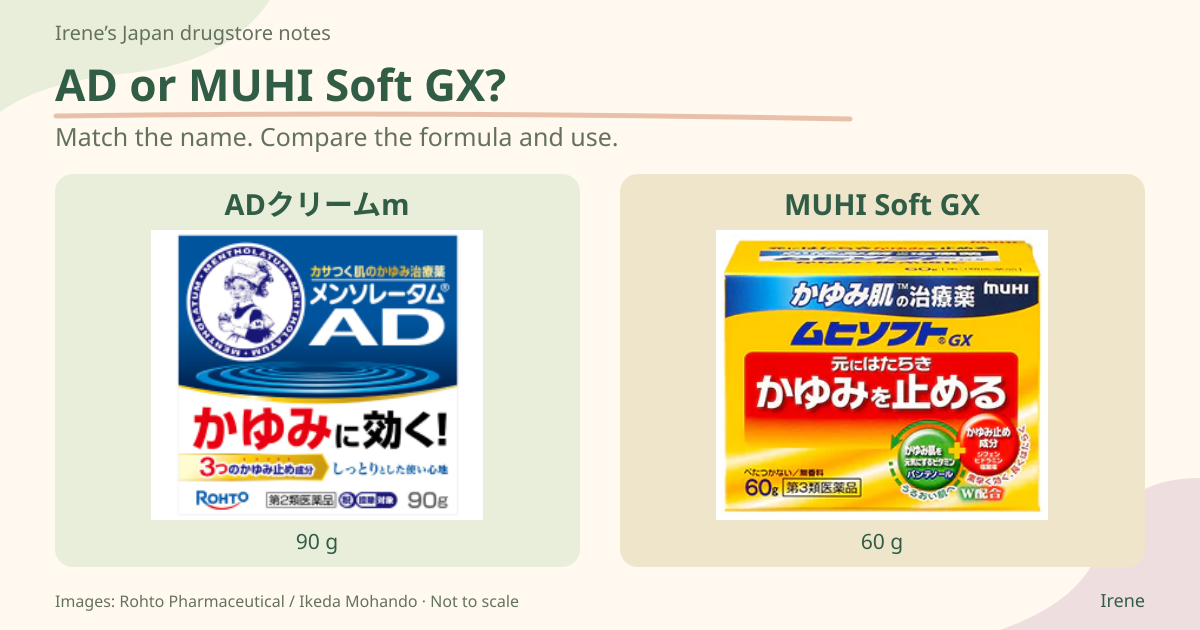
You have a photo of the family’s nearly empty AD jar, but the Japanese drugstore also stocks MUHI Soft GX. Which should you bring home? Start with the full name, the person using it and the itchy area, then compare the formulas.
Both are medicated itch creams. The useful question is who needs treatment and where, rather than which jar has more ingredients. If you want an everyday moisturizer, tell the pharmacist that specifically.
Replacing a familiar jar, avoiding cooling, or buying moisturizer?
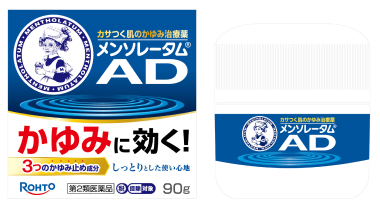
- Replacing the family’s AD: match メンソレータム ADクリームm and the weight. “AD” alone also covers other products.
- Avoiding a cooling sensation: MUHI’s FAQ says Soft GX has no cooling ingredients. AD Cream m lists l-menthol among its additives. This does not establish that MUHI cannot irritate skin.
- Comparing dry-itch formulas: both combine itch medicines with moisturizing bases. MUHI includes panthenol; AD uses crotamiton and lidocaine alongside diphenhydramine. Their roles differ.
- Buying routine dry-skin care: do not use itch medicine indefinitely as body cream when there are no symptoms to treat.
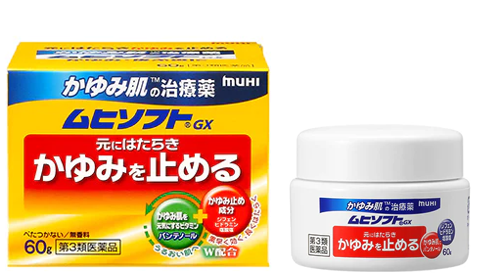
Match the complete product name and size
This guide covers only Mentholatum AD Cream m and MUHI Soft GX cream. AD emulsions, AD20, AD Botanical and MUHI Soft GX emulsion need their own instructions.
| Check | AD Cream m | MUHI Soft GX |
|---|---|---|
| Maker / Japanese OTC category | Rohto Pharmaceutical / Class 2 | Ikeda Mohando / Class 3 |
| Current sizes | 90 g and 145 g jars | 60 g, 100 g and 150 g cream |
| Manufacturer-described feel | Spreads easily; non-sticky | Moisturizing; non-sticky |
| Formula pointers | Multiple itch-relief mechanisms; urea and menthol are additives | Panthenol alongside itch medicine; no urea or cooling ingredients |
These texture descriptions come from the manufacturers, not a hands-on comparison. Japanese OTC categories are not an efficacy ranking.
Irene’s refill tip:
Ask for photos of the full name, weight and expiry date. Also ask whether the same area is itchy this time. Familiar packaging helps you find the shelf; the wording confirms the product.
What do the ingredients do?
Amounts below are standardized to 1 g of cream; MUHI’s source table uses 100 g. They are not single-application amounts.
| Ingredient / role | AD Cream m, per 1 g | MUHI Soft GX, per 1 g |
|---|---|---|
| Crotamiton / itch relief | 50 mg | Not listed as an active |
| Lidocaine / local anesthetic, reducing itch-signal transmission | 20 mg | Not listed as an active |
| Diphenhydramine-type antihistamine / itch relief | Diphenhydramine 10 mg | Diphenhydramine hydrochloride 20 mg |
| Panthenol / supports normal skin function | Not listed as an active | 10 mg |
| Tocopherol acetate / vitamin E derivative | 5 mg | 5 mg |
| Glycyrrhetinic acid / anti-inflammatory | 2 mg | 2 mg |
Rohto describes different itch-relief actions for crotamiton, lidocaine and diphenhydramine. MUHI pairs its antihistamine with panthenol, a vitamin E derivative described as supporting circulation, and anti-inflammatory glycyrrhetinic acid. Diphenhydramine and its hydrochloride salt are different labeled forms: 20 mg versus 10 mg does not mean “twice as effective.” Ingredient totals cannot establish which cream will work better for you.
Moisturizing bases are a separate part of the formula. AD names glycerin and lists urea as an additive; this is not a 20% urea product. MUHI names glycerin, hydrogenated lecithin and sodium lactate, and its FAQ confirms no urea. Both products are steroid-free according to their manufacturers, but either can cause irritation or an allergic reaction.
How to apply, and where does ordinary moisturizer fit?
- Check the affected skin first. Make sure the symptom fits the product and there is no wound, severe weeping or erosion. Itching alone does not establish the cause.
- Follow that product’s directions. Both labels say to apply an appropriate amount to the affected area several times daily. They do not specify a universal number of grams per application. MUHI’s FAQ gives roughly 5–6 applications daily as a guide and recommends prompt application after bathing for dry, itchy skin. Do not apply MUHI’s numeric frequency to AD; follow AD’s own label.
- Do not improvise combinations. If you already have prescribed skin treatment, ask your clinician or pharmacist about the exact products. These two creams have overlapping ingredients; do not mix them to “boost” treatment.
- Watch progress. MUHI advises adjusting frequency to symptoms, reducing it as symptoms improve, and seeking medical care for prolonged symptoms.
Ikeda Mohando says not to layer body cream on areas with itching, eczema or similar symptoms; use ordinary body cream on symptom-free areas. If one patch of your lower leg is itchy, distinguish treatment of that patch from routine care elsewhere. This is MUHI Soft GX’s own advice, not a universal rule for every skin medicine.
Children, the face and pregnancy need product-specific checks
Children: manufacturer age guidance is only one check
Rohto’s FAQ says AD Cream m can be used from around one year old. MUHI gives one month and older as a starting-age guide. These are manufacturer instructions, not a recommendation to diagnose and treat an infant’s rash yourself. Children need adult supervision. Ask a clinician or pharmacist about infants or unexplained, recurring rashes. MUHI’s leaflet calls for a small trial on an inconspicuous area and observation the next day before use on infants or sensitive sites such as the face and neck.
Face use: the eye-area rules differ
- AD Cream m: Rohto allows face and neck use but prohibits the eyes, surrounding eye area, lips and other mucosal areas, as well as wounds.
- MUHI Soft GX: its FAQ allows facial use, including a very small, thin application around the eyes and on eyelids, while avoiding entry into the eyes. Follow its sensitive-area trial instruction. Eye symptoms or an uncertain diagnosis warrant medical assessment; a skin cream is not an eye medicine.
For accidental eye exposure, both labels instruct rinsing immediately with water or lukewarm water and seeking eye care if symptoms are severe. Do not assume body use covers genital itching: Rohto specifically discourages AD on the penis or scrotum because these sites are easily irritated, and prohibits mucosal use.
Pregnancy and breastfeeding
The product-specific FAQs from both makers permit use in pregnancy and breastfeeding. Rohto also advises discussing concerning symptoms with a doctor during pregnancy. For existing treatment or application to the breast or skin a baby may contact, ask about the actual site and use.
When to stop, and how long does an opened jar last?
Both are for external use only: do not swallow them, and do not use either product after its printed expiry date.
Stop either product and seek advice if symptoms have not improved after 5–6 days. Bring the packaging or leaflet. Stop immediately for suspected reactions rather than waiting: MUHI lists rash, redness, itching and swelling; AD additionally lists contact dermatitis, dryness, irritation, warmth and stinging.
- Opened AD: Rohto gives no fixed number of months. Keep it tightly closed in a cool place away from sunlight and use promptly. Do not use it if the smell or color changes. The printed expiry date applies to the unopened product.
- Opened MUHI: its FAQ gives six months as a guide, provided the printed expiry has not passed. The leaflet also advises using promptly after opening.
- For both: keep in the original container, tightly closed, cool, away from direct sunlight and out of children’s reach. MUHI also specifies a low-humidity location. A nearly full jar is not a reason to keep it beyond its suitable use period.
Irene’s jar-size tip:
If you only treat a small patch occasionally, the biggest jar may not suit your needs. Write the opening date on the base and keep the box. Those details also help when you need advice about treatment that is not working.
Frequently asked questions
Is AD Cream m stronger than MUHI Soft GX?
Ingredient counts and amounts cannot establish that. The formulas, additives and body-area instructions differ. This guide has no head-to-head clinical evidence to rank their effectiveness.
Can I use a steroid-free itch cream as everyday body cream?
Do not use these medicines indefinitely as routine body cream. Use them for appropriate symptoms and follow the label. MUHI specifically cautions against casual ongoing body-cream use. Stop either product and seek advice if there is no improvement after 5–6 days.
Can I layer MUHI Soft GX with ordinary body cream?
Ikeda Mohando says not to layer body cream over areas with itching, eczema or similar symptoms. Use ordinary body cream on symptom-free areas. This is product-specific guidance for MUHI Soft GX.
Does a different AD box mean I bought the wrong product?
Not necessarily. Rohto shows an old-to-new box comparison for AD Cream m and states the formulation is unchanged. Still check the full name, weight, expiry date and instructions; other AD products are different.
Can MUHI Soft GX sting even without menthol?
Yes. Its FAQ says lightly scratched skin may sting and advises trying a small amount; do not use it on areas scratched into wounds. Stop and seek advice for suspected reactions such as rash, redness, itching or swelling.
Official sources and image credits
Japanese manufacturer information checked on 9 October 2026. Follow the current labeling on the product you buy. This guide supports product identification and informed reading; it does not replace individual medical care.
- Rohto: AD Cream m product information and current package instructions: Product · Package PDF
- Rohto: age, face, genital-area and duration FAQs: Age · Face and neck · Male genital area · Duration
- Rohto: pregnancy, breastfeeding and opened storage FAQs: Pregnancy · Breastfeeding · After opening
- Ikeda Mohando: MUHI Soft GX product information and leaflet: Product · Leaflet PDF
- Ikeda Mohando: application and moisturizer FAQs: Application · Duration · Layering · Routine body cream
- Ikeda Mohando: age, sites, formula, pregnancy and storage FAQs: Age · Face · Urea · Cooling ingredients · Scratched skin · Pregnancy and breastfeeding · After opening
AD pack images: Rohto Pharmaceutical. MUHI pack and jar images: Ikeda Mohando. Images are used for product identification; trademarks and copyright remain with their owners. Portrait: Irene.