Four colours, four letters, and two different tablet counts: the Benza Block shelf can take a little decoding. Start with the cold symptom bothering you most, then check whether the formula is suitable for you before choosing a box.

I’m Irene, a Taiwan-born, Japan-licensed pharmacist working in a Japanese drugstore. I’ll help you match the full package name to the formula, including the easy-to-miss difference between taking two caplets and three round tablets.
Sources checked: 12 October 2026. This guide covers Japan-market Benza Block Premium DX products. Individual stores may not stock every version.
Check these limits before choosing
All four formulas are for ages 15 and over. Do not drive or operate machinery after taking them, and do not drink alcohol before or after a dose. They relieve cold symptoms; they are not antivirals and do not treat the underlying viral infection in influenza or COVID-19.
Do not add Benza to another cold medicine, painkiller/fever reducer, cough or phlegm medicine, sedative, or oral medicine containing an antihistamine. The last group includes many allergy, runny-nose, travel-sickness and sleep medicines. Different brands can still overlap.
If you are pregnant, might be pregnant, are breastfeeding, have a long-term condition, or receive medical treatment, show a doctor or pharmacist your medicines and the exact box first. L, IP and T must not be used within 12 weeks of your expected delivery date. T must not be taken while continuing to breastfeed. Pregnancy at other stages also requires consultation. S, L and IP tell breastfeeding users to seek advice first; that is not an automatic assurance of suitability.
Do not use any of these four if you have had an allergic reaction to its ingredients, or asthma triggered by a cold medicine or painkiller. Severe breathing difficulty, chest pain or confusion needs urgent medical attention rather than a different colour of cold medicine.
Two further exclusion checks come before the shortlist. Do not use S or L with diagnosed high blood pressure, heart disease, thyroid dysfunction, diabetes or difficulty urinating due to an enlarged prostate. Do not use L or T while receiving medical treatment for a stomach/duodenal ulcer, blood disorder, liver or kidney disease, or while taking zidovudine. T additionally excludes people receiving treatment for heart disease or high blood pressure. Other conditions and medicines still need checking against the individual leaflet.
Which symptom points to which box?
Use this as a shortlist to discuss with a pharmacist, not as a diagnosis or a guarantee that the medicine is suitable. All four are combination cold medicines with overlapping uses.
| Main symptom bothering you | Premium DX version to identify |
|---|---|
| Runny or blocked nose, sneezing | S: yellow |
| Sore throat | L: silver |
| Fever, chills or headache | IP: blue |
| Cough with phlegm | T: green |
If you have only one symptom, a combination medicine may include ingredients you do not need. Itchy eyes and an itchy nose may also call for an allergy assessment rather than a cold formula. Tell the pharmacist when symptoms began and what you have already taken.
Match the complete Premium DX name
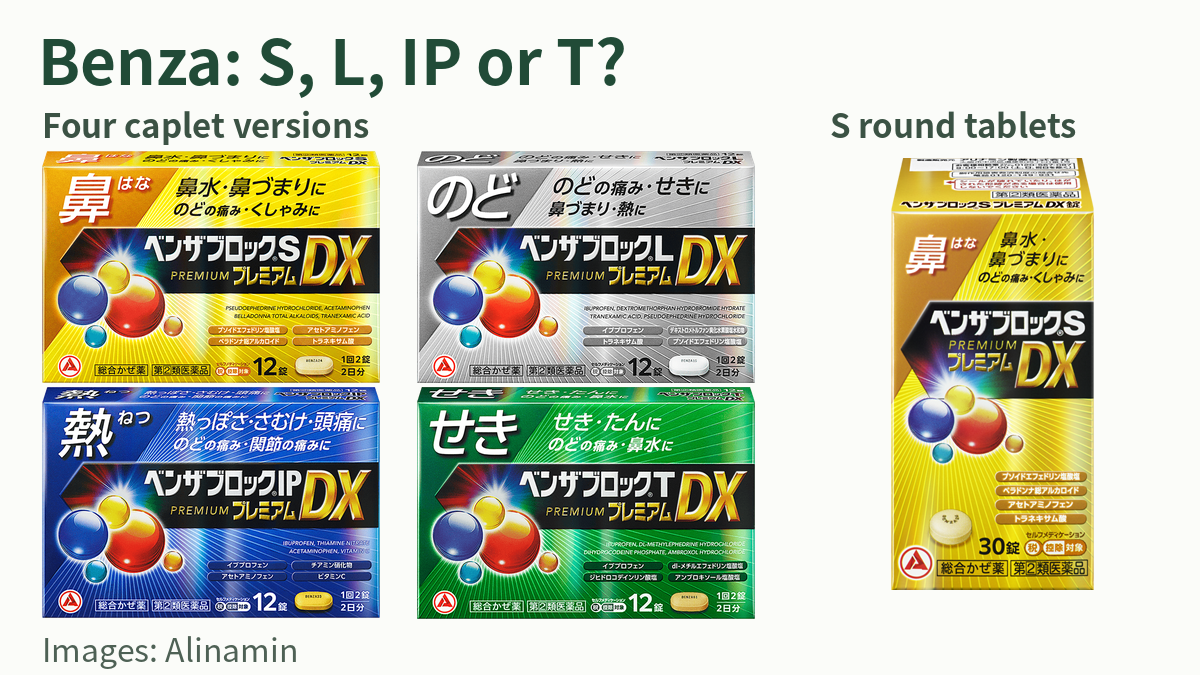
Look for ベンザブロックSプレミアムDX, ベンザブロックLプレミアムDX, ベンザブロックIPプレミアムDX or ベンザブロックTプレミアムDX. Each formula also has a bottle of round tablets with 錠 added at the end of its name.
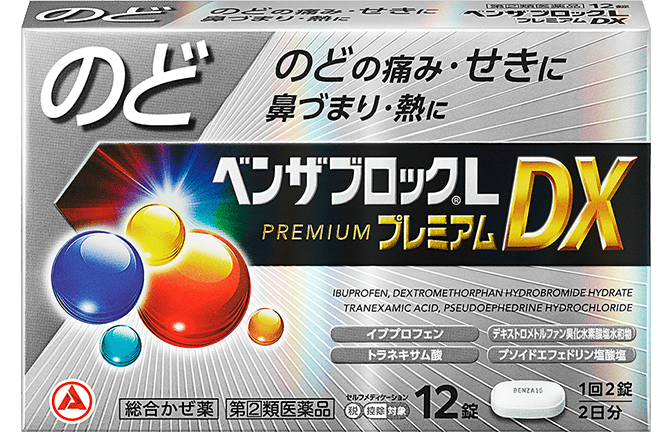
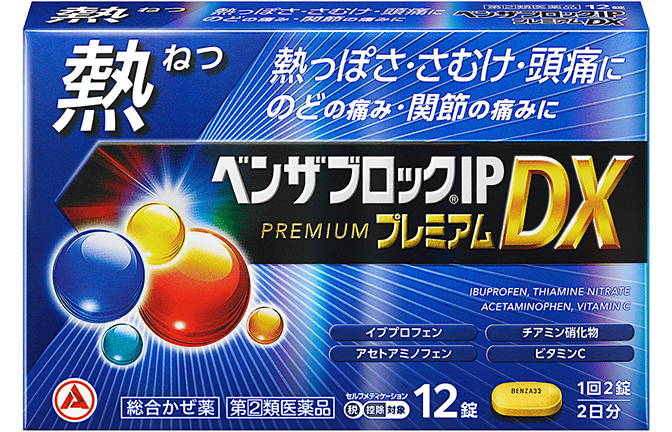
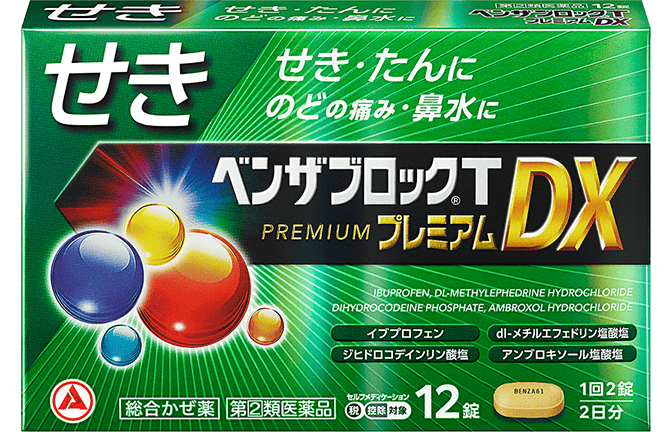
These official images show the four caplet versions in blister packaging. Images: Alinamin Pharmaceutical / official Benza website. Use colour to locate a box, then read its full name and dosage form.
Regular S, L and IP, and the YASUMO range, are separate products. Their instructions cannot be taken from this comparison. If an older shopping guide mentions S Plus or Sプラス, check the current package again rather than assuming it has the Premium DX formula.
What actually changes between the formulas?
The quantities below are the full labelled daily amounts for ages 15 and over, not amounts per dose or instructions for combining ingredients yourself. Milligrams of different drugs do not provide a strength ranking.
S: nose-focused ingredients, with important exclusions
S combines dexchlorpheniramine, pseudoephedrine and belladonna alkaloids for nasal symptoms. Its pain/fever ingredient is paracetamol (acetaminophen), 900 mg daily. It also contains cough and phlegm ingredients and tranexamic acid, so this is still a multi-symptom cold medicine.
Do not use S if you have diagnosed high blood pressure, heart disease, a thyroid disorder or diabetes, or difficulty urinating caused by an enlarged prostate. Being ibuprofen-free does not make it suitable for everyone with a long-term condition. In addition to the shared combination warnings, S must not be taken with gastrointestinal pain/antispasmodic medicines or oral tranexamic-acid products. Other oral anticholinergic medicines require consultation.
L: sore-throat emphasis, including ibuprofen and tranexamic acid
L contains 600 mg of ibuprofen and 750 mg of tranexamic acid daily. Its other ingredients include dextromethorphan, bromhexine, guaifenesin, pseudoephedrine, an antihistamine and caffeine.
L has the same high-blood-pressure, heart, thyroid, diabetes and enlarged-prostate urination exclusions listed for S. Do not use L while receiving medical treatment for a stomach/duodenal ulcer, blood disorder, liver disease or kidney disease, or while taking zidovudine. Do not add another oral tranexamic-acid medicine, including products bought for a different purpose.
IP: fever, chills and headache, with two pain/fever ingredients
IP contains 360 mg of ibuprofen plus 180 mg of paracetamol daily. It also contains mequitazine, dextromethorphan, dl-methylephedrine, glycyrrhizic acid and vitamins, among its ingredients.
Two pain/fever ingredients do not make IP universally best. The smaller paracetamol figure is not a reason to add another painkiller. Although IP does not use S/L’s pseudoephedrine formula, people with high blood pressure, heart or thyroid conditions, diabetes, or liver/kidney disease must still consult before use. Do not treat it as an automatic substitute.
T: cough and phlegm, with a distinct breastfeeding warning
T contains dihydrocodeine phosphate 24 mg, dl-methylephedrine hydrochloride 60 mg and ambroxol hydrochloride 45 mg daily. It also contains ibuprofen 600 mg, an antihistamine, caffeine and vitamins.
T’s leaflet says not to take it while breastfeeding, or to avoid breastfeeding if taking it. Ask a healthcare professional about a suitable option rather than planning a feeding interruption yourself. Consult first if you have impaired breathing, obstructive sleep apnoea, obesity or bronchial asthma. Do not use T while receiving medical treatment for a stomach/duodenal ulcer, blood disorder, liver or kidney disease, heart disease or high blood pressure, or while taking zidovudine.
All four can cause drowsiness. Caffeine does not cancel the no-driving warning, and T should not be used as a sleep aid.
Two caplets or three tablets? Check the form
Each letter comes in a caplet version in blister strips and a round-tablet version in a bottle. Within the same letter, the labelled daily active-ingredient totals match, but the amount in each individual tablet differs.
| Wording and packaging | Amount per dose, ages 15+ |
|---|---|
| Premium DX, カプレットタイプ: blister-strip caplets | 2 caplets |
| Premium DX錠, 錠剤タイプ: bottled round tablets | 3 tablets |
Both forms are taken three times daily, preferably within 30 minutes after meals. Swallow without chewing, with water or warm water. Neither is for children under 15. Push each caplet out of its blister before swallowing; never swallow the packaging. Do not mix the forms or alternate them to increase the amount taken.
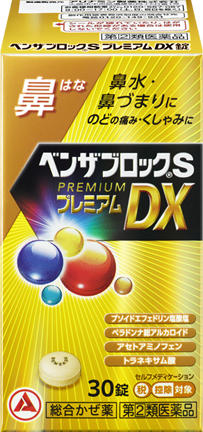
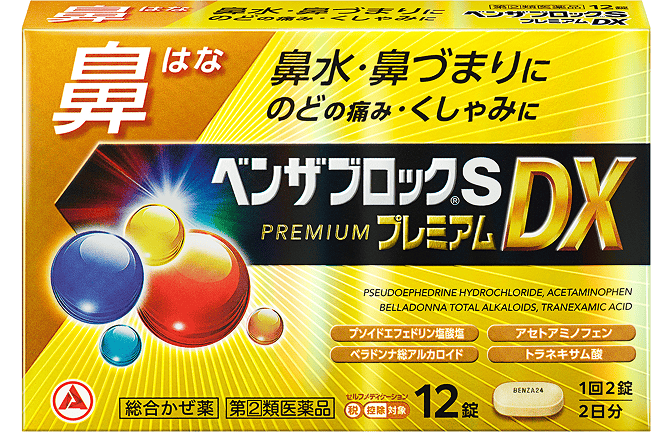
S is shown here to illustrate the bottle version with 錠 at the end of the name. L, IP and T also have their own bottle versions. Image: Alinamin Pharmaceutical / official Benza website.
When to stop and get help
For all four, stop and consult a doctor, pharmacist or registered medicine seller if symptoms have not improved after five or six doses. That means doses, not days.
L, IP and T also have a maximum of five days. Their leaflets particularly flag fever lasting three days or more, or fever that returns. The five-day limit does not mean you should wait that long after five or six unsuccessful doses. S prohibits prolonged continuous use; it is not an open-ended option.
Stop and seek advice if a rash, nausea/vomiting, palpitations, difficulty urinating or other suspected adverse effects develop. Breathing difficulty, altered consciousness, a severe skin reaction, black stools or vomiting blood warrant immediate medical attention. Stop and consult if constipation, dry mouth or drowsiness persists or worsens; S additionally flags blurred vision.
Before buying, disclose glaucoma, high fever, urinary difficulty, medicine allergies, older age, pregnancy, treatment and any liver, kidney, digestive, clotting or other long-term health problems. The exact “do not use” and “consult first” lists differ. This guide does not replace checking the full leaflet for your product.
Questions that come up at the shelf
Can I take S in the morning and switch to T at night?
Do not build your own rotation. Ingredients and effects overlap. If symptoms change, show a pharmacist the full name, dose and time of everything taken that day before deciding whether to switch.
Is Benza better than Pabron or Lulu?
The useful comparison is between exact formulas and their restrictions. If you are also considering those shelves, my Pabron tablet comparison and Lulu Attack guide explain their different versions. They are alternatives to investigate, not medicines to combine with Benza.
Can I take it in advance to prevent a cold?
No. Keep the original box and leaflet, and check the expiry date and suitability when symptoms occur. The manufacturer advises using the medicine promptly, aiming for within six months after opening the inner foil bag for caplets or opening the bottle for round tablets, without exceeding the printed expiry. This is a storage instruction, not permission to take it for six months.
At the counter, start with your most troublesome symptom. Then check the exact name, your other medicines and medical history. Finally, check whether your particular box says two caplets or three tablets per dose.