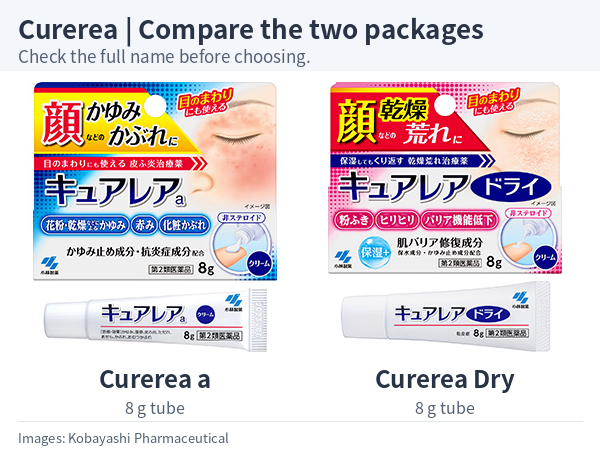

Hi, I’m Irene, a Taiwan-born, Japan-licensed pharmacist working in a Japanese drugstore. The two Curerea boxes look very similar, but the useful question is what is happening to your skin. Let’s check the symptom and safety limits before choosing a tube.
The quick choice
- Curerea a: consider this version for its labelled itching, eczema, dermatitis and contact-irritation uses. Its formula combines non-steroidal anti-inflammatory ingredients with an antihistamine.
- Curerea Dry: consider this version for dry, rough skin that falls within its labelled uses. It contains heparinoid, an antihistamine and gamma-oryzanol. Check its additional restrictions first, especially atopic dermatitis and bleeding disorders.
- Unexplained or repeatedly returning facial symptoms: show the affected area and your current medicines to a pharmacist or doctor rather than selecting by the picture of a face alone.
Both are Japanese Category 2 OTC medicines, sold in 8 g tubes. Neither formula contains a steroid. They still have different treatment purposes, directions and stop-and-consult intervals.
Recognize the two packages
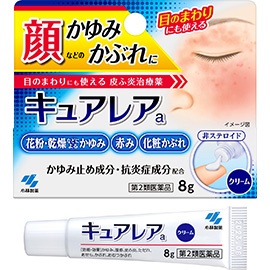
Look for キュアレアa on the standard product. Its package highlights itching and irritation, and the tube also carries the small “a”.
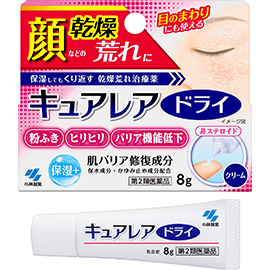
The other box and tube say キュアレア ドライ, with “Dry” shown in Japanese as ドライ. The face illustration appears on both, so use the full product name to distinguish them.
| What to compare | Curerea a | Curerea Dry |
|---|---|---|
| Main choice in this guide | Itching, eczema/dermatitis and contact irritation | Dry, rough skin |
| Active ingredients per 100 g | Ufenamate 5 g; diphenhydramine 1 g; glycyrrhetinic acid 0.3 g | Heparinoid 0.3 g; diphenhydramine 0.5 g; gamma-oryzanol 1 g |
| Directions | Apply an appropriate amount several times daily, after cleaning the affected area | Rub in an appropriate amount once to several times daily, or apply it spread on gauze |
| If symptoms do not improve | Stop and consult after about 1–2 weeks | Stop and consult after 5–6 days |
| Important extra restriction | Check the shared consultation conditions below | Do not use with current atopic dermatitis, hemorrhagic blood disorders, or when even slight bleeding could have serious consequences |
The quantities above describe the formula in 100 g of medicine, not the amount to put on your skin. Twice the diphenhydramine concentration does not establish that one product is the better choice for every rash.
What each formula is intended to do
Curerea a: itching and inflammation
Ufenamate and glycyrrhetinic acid are anti-inflammatory ingredients; diphenhydramine is an antihistamine that helps relieve itching. The complete labelled uses are itching, eczema, dermatitis, skin erosions, prickly heat, contact irritation and diaper rash.
There is an important qualification here: severe weeping or erosions require consultation before use, even though erosions appear in the indication list. The list does not mean that every sore or rash is suitable for self-treatment.
Curerea Dry: dryness and roughness
Heparinoid helps the skin retain moisture, while the maker describes gamma-oryzanol as supporting sebum secretion. The product also contains diphenhydramine. It is a cream with a different medicinal formula, so choose it for the relevant skin problem rather than treating it as a richer version of Curerea a.
Its labelled uses include rough fingers; thickened skin on elbows, knees, heels and ankles; cracks and chapping of hands and feet; dry skin, including dry skin in children; chilblains without erosions; skin lumps or tightness after wounds or burns excluding the face; and swelling, muscle pain or joint pain after bruises or sprains.
For this comparison, the practical focus is dry, rough skin. The maker additionally says not to use Dry on scabs, mucous membranes, bleeding wounds, or facial wound/burn marks. Those restrictions matter when dryness has been scratched open.
The safety difference to check before buying
Do not use Curerea Dry if you currently have atopic dermatitis, even if it is mild. Its leaflet calls for appropriate treatment under a doctor. Separately, if a doctor has diagnosed you with atopic dermatitis in the past, consult a doctor, pharmacist or registered salesperson before using Dry. A past diagnosis and a current condition are two separate instructions on the label.
Dry is also unsuitable for people with hemorrhagic blood disorders, such as hemophilia, thrombocytopenia or purpura, and for anyone in whom even slight bleeding could have serious consequences. The leaflet explains that it may inhibit blood coagulation and promote bleeding.
For either product, get advice before use if you are being treated by a doctor, have had allergic symptoms from medicines, or have severe weeping or eroded skin. Children must use either product under a parent’s or responsible adult’s supervision. For a baby or a young child, ask a pharmacist to check the symptom and application site before choosing.
If you have atopic dermatitis, do not simply switch to Curerea a because Dry is excluded. Have your treatment checked rather than assuming the other package is appropriate.
Can they be used around the eyes?
The manufacturer describes both as usable on the skin around the eyes. That requires care: these are external skin medicines, and must not get into the eyes. An unexplained eyelid problem is a good reason to seek advice before applying a cream so close to the eye.
If either medicine gets into an eye, rinse it immediately with water or lukewarm water. If symptoms are severe, see an ophthalmologist. The face image on the box is not a reason to put cream inside the eyelid or into the eye.
How to use the chosen product
- Check the exact name and expiry date. Read the leaflet in your own package and confirm that the affected skin and your health conditions fit its instructions.
- Apply to the affected area only. For Curerea a, clean the area first, then apply an appropriate amount several times a day. For Dry, rub in an appropriate amount once to several times a day; its label also permits spreading the medicine on gauze and applying it to the affected area. Use externally and keep it out of the eyes.
- Watch how your skin responds. Stop immediately and consult with the package if a rash/redness, itching or swelling appears. With Curerea a, the listed reactions also include stinging, a hot sensation or dryness.
- Use the correct review point. If there is no improvement, stop and consult after about 1–2 weeks for Curerea a or 5–6 days for Dry. These are review points for lack of improvement, not instructions to keep applying through a reaction.
- Close and store the tube properly. Keep it tightly capped in a cool, dry place out of direct sunlight and children’s reach. Do not transfer it to another container. Keep Dry away from flames; it can occasionally yellow clothing it touches.
Irene’s takeaway
When you pick up these boxes, first check the symptom, then the restrictions, then the name on the tube. Curerea a addresses its itching/inflammation indications; Dry addresses its dryness/roughness indications and has additional atopic-dermatitis and bleeding restrictions. If the cause is unclear or the skin keeps flaring, a pharmacist or doctor can help you decide what the next step should be.
Official sources
Product information checked on 14 October 2026. Follow the leaflet supplied with the product you buy.
- Kobayashi Pharmaceutical: Curerea a product information and Japanese leaflet
- Curerea a Japanese package leaflet
- Kobayashi Pharmaceutical: Curerea Dry product information
- Curerea Dry Japanese package leaflet
- Curerea Dry: formulation and application-area precautions
- Official Curerea a English reference leaflet
- Official Curerea Dry English reference leaflet