Blood in the stool, fever, sudden severe diarrhoea or significant abdominal symptoms? Get medical advice before taking Pishat. Suspected food poisoning or an intestinal infection is a reason to check the cause, rather than simply suppress diarrhoea. Bloody diarrhoea, repeated vomiting that prevents drinking, or dehydration that persists despite oral rehydration needs urgent care. Sudden severe abdominal pain or confusion needs emergency assessment.
Take small, frequent sips if you feel sick. Ask a pharmacist about an oral rehydration solution to replace lost water and salts. A tablet that needs no water does not remove your need for fluids.
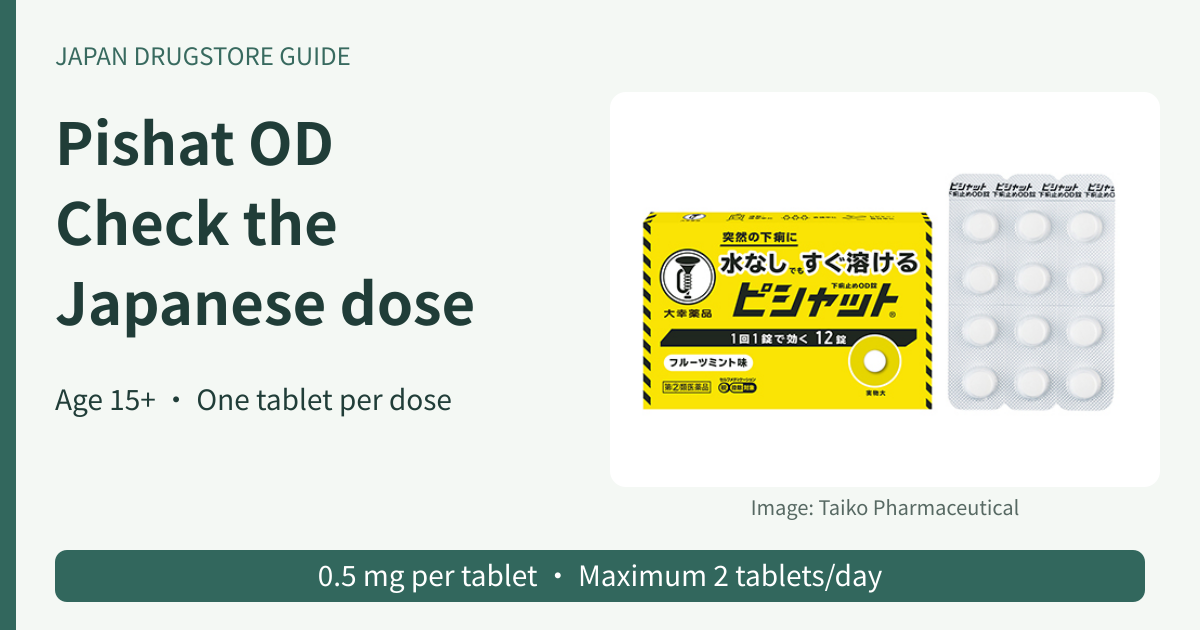
If self-treatment is appropriate, Japan’s Pishat OD (ピシャット下痢止めOD錠) has a particularly easy dose to misread: age 15 and over, one tablet per dose, no more than two tablets a day, at least four hours apart. Each tablet contains 0.5 mg of loperamide hydrochloride. Do not import an overseas Imodium dosing schedule.

I’m Irene, a Taiwan-born, Japan-licensed pharmacist working in a Japanese drugstore. For this yellow box, I would start with the exact dose and your plans for the day: taking it means no driving and no alcohol around the dose.
Japanese product information checked: 19 October 2026.
Which Pishat is this?
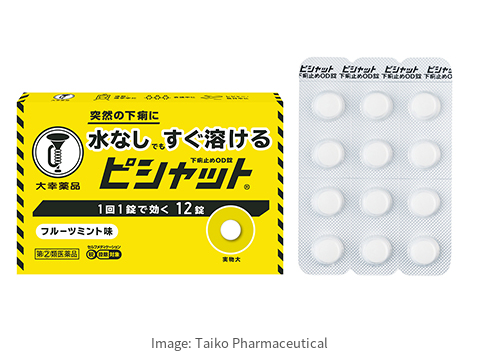
This guide covers the current Japanese 12-tablet, designated Class 2 OTC medicine. The manufacturer’s Traditional Chinese reference leaflet calls it PISHUT; some travel guides use Pishat. The Japanese name on the box is the safest way to match the product.
The approved uses are diarrhoea from overeating, excessive drinking, or becoming chilled while sleeping. “Chilled” does not mean a viral cold, and these indications do not make it an all-purpose treatment for infectious diarrhoea. Do not take it in advance to prevent symptoms before a train ride or meal.
One tablet is 0.5 mg, not 2 mg
- Age 15 and over: one tablet at a time.
- Daily limit: two doses, two tablets in total. That is 1 mg of loperamide hydrochloride for the whole day.
- Interval: leave at least four hours between doses.
- Once diarrhoea stops: stop taking it. There is no course to finish.
- Under 15: do not use this product.
The official ingredient panel lists 1 mg in two tablets; dividing that total gives 0.5 mg per tablet. It is not 1 mg in each tablet. If you are used to an overseas 2 mg loperamide product, do not increase the number of Pishat tablets to match it, or follow an overseas initial-dose or after-each-loose-stool schedule. Use this Japanese pack’s directions.
How to take an OD tablet
OD means orally disintegrating. Let the tablet dissolve in your mouth and swallow it, or take it with water or warm water. The format describes how it is taken; it does not promise instant relief or absorption through the mouth. Do not take an extra tablet early because symptoms have not stopped.
Push the tablet out through the foil of the blister first. Swallow only the tablet, never the blister packaging, which can injure the oesophagus. Keep the medicine in its original packaging, in a cool, dry place away from sunlight and children. Do not transfer it to another container or use it beyond the expiry date.
Is it the same as water-free Stoppa?
No. Pishat contains loperamide hydrochloride, which reduces intestinal movement and fluid secretion. Stoppa EX and L EX use scopolia extract and berberine tannate; L EX adds peony extract. A similar mouth-dissolving format does not make their ingredients, daily limits or restrictions interchangeable.
The Biofermin antidiarrheal tablets and powder are different formulas too. Do not stack antidiarrheal brands or improvise substitutions. Show the pharmacist everything you have already taken.
Who must avoid it, and who needs advice first?
Do not take Pishat if you are under 15, have previously had an allergic reaction to this product or an ingredient, or have phenylketonuria (PKU). It contains aspartame, an L-phenylalanine compound.
While taking it, do not use gastrointestinal pain-relieving antispasmodic medicines. Ask the pharmacist to check other medicines, including any other diarrhoea treatment.
Do not drive or operate machinery after taking it: drowsiness can occur. Do not drink alcohol before or after taking it. Its indication for diarrhoea after excessive drinking is not permission to combine it with alcohol; the leaflet gives no universal “safe after this many hours” interval.
Consult a doctor, pharmacist or registered OTC medicine seller before use if you:
- Are receiving medical treatment, are older, or have a history of medicine-related allergy.
- Are pregnant, might be pregnant, or are breastfeeding.
- Have an anal condition or another condition where constipation must be avoided.
- Have fever with diarrhoea, bloody stools or persistent mucus.
- Have sudden severe diarrhoea, or diarrhoea with abdominal pain, bloating or nausea. Suppressing it can worsen some illnesses.
Also seek clinical advice rather than self-treating with loperamide if severe diarrhoea follows antibiotics, an inflammatory bowel condition is flaring, or you are constipated or have a swollen abdomen. These are general loperamide safety cautions; foreign age limits and doses do not replace this Japanese label.
When to stop and seek help
Stop and seek advice promptly for a rash, redness, itching, loss of appetite, abdominal pain, nausea, bloating, constipation, abdominal discomfort, vomiting or dizziness after a dose. The leaflet also says to stop and consult if constipation or drowsiness persists or worsens. Take the leaflet with you.
Rare serious reactions need immediate medical attention:
- Anaphylaxis: symptoms soon after a dose such as hives or itching, hoarseness, sneezing, an itchy throat, breathing difficulty, palpitations or clouded consciousness.
- Severe skin reactions (Stevens–Johnson syndrome or toxic epidermal necrolysis): high fever, red eyes or eye discharge, sore or eroded lips, sore throat and widespread rash/redness that persists or rapidly worsens.
- Intestinal-obstruction-like symptoms: severe abdominal pain, no passing of gas, vomiting, or marked constipation with abdominal swelling.
If symptoms have not improved after two to three days of use, stop and consult. That label review point is not a waiting period for blood, fever, dehydration, worsening symptoms or severe pain. Those need earlier assessment.
My counter check would be: the exact yellow box, age 15+, one tablet, enough fluids, and no driving or alcohol. Convenience only helps when the medicine fits the episode.
Sources
This guide explains the Japanese product; it does not diagnose the cause of diarrhoea. Follow the leaflet in your pack and individual professional advice.