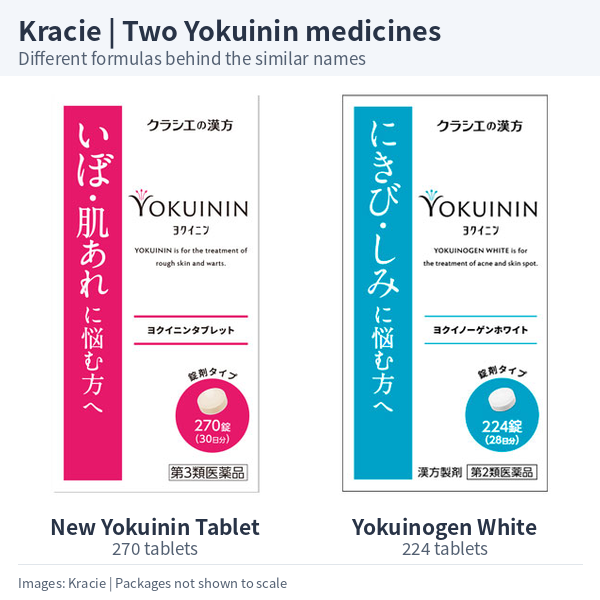

I'm Irene, a Japanese-licensed pharmacist working in a Japanese drugstore. I was born in Taiwan and moved to Japan at around age 10. When you see “YOKUININ” on these two packs, start with the symptom and the full medicine name: the pink and blue packs contain different formulas.
The quick choice: check what you are treating
- For warts or rough skin: New Yokuinin Tablet Kracie is the single-herb extract medicine whose Japanese label lists those two uses. Have an uncertain skin growth checked before treating it yourself.
- For acne or pigmentation described as “shimi” on the Japanese label: Yokuinogen White is a Kampo combination with specific constitution and accompanying-symptom requirements. Read those conditions below with a pharmacist before choosing it.
- For general beauty supplementation: neither is a food supplement. “White” does not make the blue pack a routine skin-whitening vitamin.
Buying the one with the larger extract number is not a useful shortcut. These medicines contain different extracts, made from different quantities and combinations of crude drugs.
Recognise the current packages
New Yokuinin Tablet Kracie: the pink box
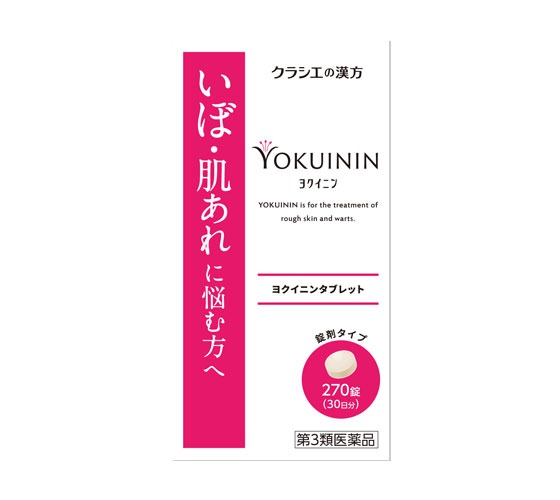
Look for 新ヨクイニンタブレットクラシエ. This is a Japanese Class 3 OTC medicine, sold in 135- and 270-tablet packs. The pictured current box contains 270 tablets, or 30 adult days at the labeled dose.
Yokuinin is the medicinal material made from coix seed with the seed coat removed. This product contains a yokuinin extract; its approved uses are warts and rough skin. Its current active-ingredient list does not include vitamin E. A beauty-shopping description of a different or older product should not replace this box's label.
Yokuinogen White Tablets: the blue pack
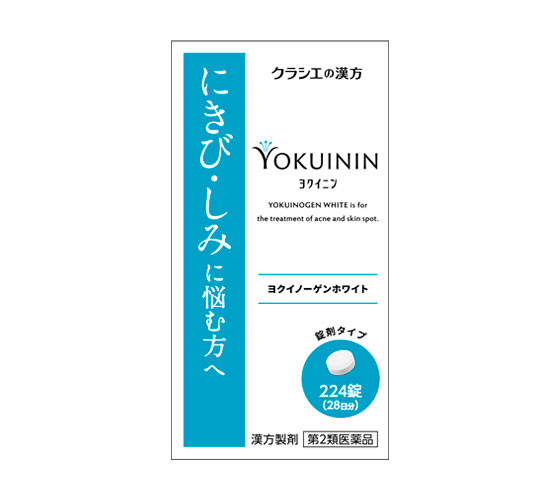
Look for ヨクイノーゲンホワイト錠. This is a Japanese Class 2 OTC medicine, sold in 112- and 224-tablet packs. The pictured 224-tablet pack provides 28 adult days at the labeled dose. The tablets are film-coated.
Its formula is Keishibukuryogan-ka-yokuinin, a combination of cinnamon bark, poria, moutan bark, peach kernel, peony root and yokuinin. The label's intended user has relatively good physical strength and sometimes experiences symptoms such as lower abdominal pain, shoulder stiffness, a heavy head, dizziness, or flushing with cold feet.
For people fitting that description, the listed indications are acne, shimi pigmentation, rough hands and feet (eczema or dermatitis of the hands and feet), irregular menstruation, and “chi-no-michi-sho.” The last Japanese label term covers mental and physical symptoms, such as anxiety and irritability, associated with female hormonal changes around menstruation, pregnancy, childbirth, the postpartum period or menopause. It is not a diagnosis to make from a shopping list; pregnancy is a reason to consult before use.
Compare the formulas on the correct daily basis
| Product | Active extract in the labeled adult daily amount | Starting crude drugs | Adult daily tablet count |
|---|---|---|---|
| New Yokuinin Tablet | Yokuinin extract 1,000 mg | Yokuinin 20 g | 9 tablets |
| Yokuinogen White | Keishibukuryogan-ka-yokuinin extract powder 1,800 mg | Cinnamon bark, poria, moutan bark, peach kernel and peony root 2 g each; yokuinin 5 g | 8 tablets |
Irene's label-reading tip: White's 1,800 mg includes the whole combination extract. It is not 1,800 mg of yokuinin, and it is not a measure of being “stronger” than the 1,000 mg single-herb product. The useful comparison is the indicated condition, formula and suitability for the person taking it.
How many tablets, and when?
Both products are taken with water or lukewarm water before meals or between meals. “Between meals” means between eating times, not while eating. Their tablet counts and daily frequencies differ.
| Age | New Yokuinin Tablet: tablets per dose | Yokuinogen White: tablets per dose |
|---|---|---|
| 15 years and older | 3 tablets, 3 times daily | 4 tablets, 2 times daily |
| 7–14 years | 2 tablets, 3 times daily | 3 tablets, 2 times daily |
| 5–6 years | 1 tablet, 3 times daily | 2 tablets, 2 times daily |
| Under 5 years | Do not use | Do not use |
- Confirm the exact product name and the user's age before counting tablets. For children, first check that the condition and formulation are appropriate; a labeled age does not establish the diagnosis.
- Use that product's dose and frequency. Children must take it under a parent or guardian's supervision.
- Keep the original packaging securely closed: tighten a bottle cap or seal a pouch's zip closure. Store tablets in a cool, dry place away from sunlight and children. Do not transfer them to another container, handle them with wet hands or use them after expiry. Discard the transport packing inside the New Yokuinin Tablet bottle after first opening.
- If symptoms have not improved after about one month, stop and consult a doctor, pharmacist or registered OTC seller, taking the box or leaflet with you. Seek advice earlier for worsening or concerning symptoms.
Who should check with a professional first?
For both products, the Japanese labels say to consult before taking them if you are receiving medical treatment, are pregnant or may be pregnant, or have previously developed a rash, redness, itching or other allergic symptoms from medicines or similar products.
White has an additional precaution for people who are physically weak or have reduced strength. This matters because its approved use is tied to a particular constitution. Show the pharmacist your other medicines and supplements, including any other Kampo or yokuinin product; do not assume two similarly named skin products should be combined.
Stop either medicine and consult immediately if a rash, redness or itching appears. New Yokuinin Tablet also lists stomach discomfort; White lists loss of appetite. Stop and consult immediately for the symptom listed for your product. Either medicine can cause diarrhea; stop and consult if it persists or worsens.
Have a skin growth assessed if you are worried about it, if it bleeds or changes appearance, is very large or painful, repeatedly returns, or is on the face or genitals. This general advice is separate from the Japanese product indications. A month-long trial is not a reason to postpone assessment of a changing lesion.
A useful final check at the shelf
For the pink box, the key words are いぼ・肌あれ, meaning warts and rough skin. For White, check both the Kampo formula and the constitution/symptom conditions, not just the words acne or pigmentation. If you cannot confidently match the problem to the label, bring the package to a pharmacist or have the skin problem assessed before buying.
Official sources and image credits
Japanese product information and current package images checked on 14 October 2026. Follow the label on the product you purchase.
- Kracie: New Yokuinin Tablet, ingredients and directions
- Kracie: New Yokuinin Tablet Japanese package information
- Kracie: Yokuinogen White, indications and directions
- Kracie: Yokuinogen White Japanese package information
- Kracie: explanation of yokuinin extract amounts
- NHS: when a wart or skin growth needs medical advice
Product photographs: Kracie official product pages.