
I'm Irene, a Japanese-licensed pharmacist working in a Japanese drugstore. I was born in Taiwan and moved to Japan at around age 10. With POCARI SWEAT, a familiar blue logo can hide two useful differences: what is in the product, and how much one container actually holds.
Choose the format first, then compare the label
- Want the regular bottled drink? Choose Japanese POCARI SWEAT in a PET bottle. The 500 mL bottle compared here contains 125 kcal and 31 g of carbohydrate, calculated from its per-100 mL label.
- Prefer a lighter-tasting drink with fewer calories at the same bottle size? ION WATER has 55 kcal and 13.5 g of carbohydrate per 500 mL, also calculated from its label. It contains sugars; it is not sugar-free water.
- Prefer a pouch with a jelly texture? POCARI SWEAT Jelly is a 180 g pouch containing 55 kcal and 13.3 g of carbohydrate. Its portion is not equivalent to a 500 mL bottle.
These are ordinary food-and-beverage choices. They are not a reason for everyone to add electrolyte drinks to their day, and they should not be treated as interchangeable with an oral rehydration product recommended for dehydration.
Three packages to recognise
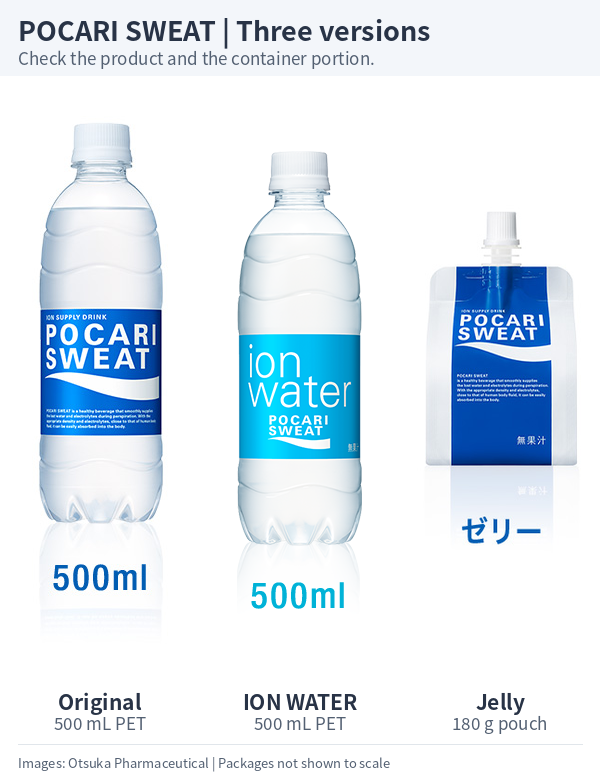
Regular POCARI SWEAT: blue-label 500 mL PET bottle
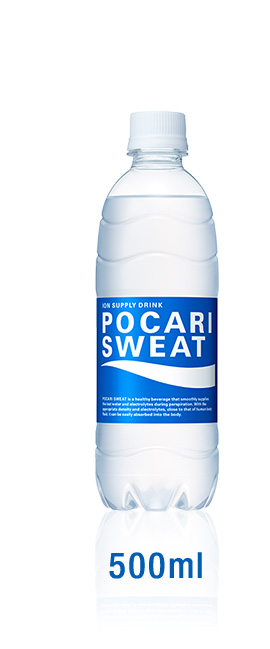
Look for ポカリスエット and check the bottle size. The Japanese PET formula contains sugar, high-fructose glucose syrup, fruit juice, salt and added electrolytes. It is a non-carbonated soft drink.
The figures here apply to the PET bottle. Do not copy them onto a Japanese can: the current regular canned versions list 27 kcal per 100 mL, while the PET bottle lists 25 kcal.
POCARI SWEAT ION WATER: pale-blue 500 mL PET bottle
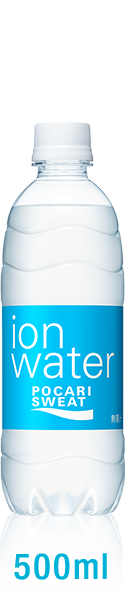
Look for ion water and イオンウォーター. Otsuka describes a less-sweet taste and a lighter finish. Its ingredient list still includes high-fructose glucose syrup, fruit juice and sugar, along with monk-fruit extract and stevia sweetener.
A lighter taste does not mean zero carbohydrate. If carbohydrate intake matters to your diet, use the number on the label rather than the pale colour of the packaging.
POCARI SWEAT Jelly: 180 g spouted pouch
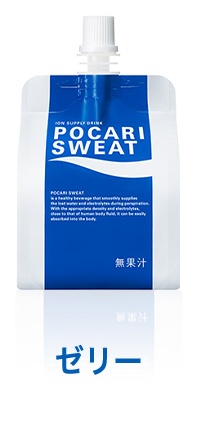
Look for JELLY, ゼリー and 180 g. The ingredients include agar and thickening polysaccharides in addition to sugars, fruit juice, salt and electrolytes. It is labelled as a jelly beverage, rather than a protein snack or a meal.
This is also a different product from POCARI SWEAT Ice Slurry. Do not assume every blue spouted pouch is meant to be frozen.
Compare per container without losing the serving basis
The two bottle labels are printed per 100 mL. Their whole-bottle figures below are calculated by multiplying by five. Jelly's label is already per one 180 g pouch. Grams of jelly and millilitres of drink are different measures; the columns are a shopping comparison, not equal-volume servings.
| Item and basis | Regular PET, 500 mL | ION WATER PET, 500 mL | Jelly, 180 g |
|---|---|---|---|
| Energy on the printed label | 25 kcal per 100 mL | 11 kcal per 100 mL | 55 kcal per pouch |
| Carbohydrate on the printed label | 6.2 g per 100 mL | 2.7 g per 100 mL | 13.3 g per pouch |
| Salt equivalent on the printed label | 0.12 g per 100 mL | 0.10 g per 100 mL | 0.24 g per pouch |
| Energy in the whole container | 125 kcal, calculated | 55 kcal, calculated | 55 kcal |
| Carbohydrate in the whole container | 31 g, calculated | 13.5 g, calculated | 13.3 g |
| Salt equivalent in the whole container | 0.60 g, calculated | 0.50 g, calculated | 0.24 g |
| Protein and fat | Both 0 g per 100 mL | Both 0 g per 100 mL | Both 0 g per pouch |
| Declared designated allergens | None applicable | None applicable | None applicable |
The tables report carbohydrate, not a separately declared total-sugars value. “None applicable” in the allergen field refers to the manufacturer's designated-allergen disclosure, not a guarantee that every ingredient suits every person. Check your own package and ingredient restrictions.
Irene's comparison tip: a 500 mL ION WATER bottle and a 180 g Jelly pouch both have 55 kcal, but they are not the same amount or form of fluid. Choose a pouch because you want that format, not because an equal calorie number makes it equivalent to a bottle.
How to use and store them
- Confirm the full product name, container size and best-before date. These three are ready-to-use products; there is no powder to dilute or measure.
- Choose an amount that fits your activity, meals and any dietary instructions. There is no universal daily bottle target in this comparison. If you have been told to limit fluid, salt, carbohydrate or potassium, ask your healthcare professional how the exact product fits that plan.
- For bottled POCARI, Otsuka says to finish it the same day if you have drunk directly from the bottle. If you pour into another container without drinking from the bottle, refrigerate the remainder and finish within about 2–3 days. Choose a size you can finish promptly. Follow the Jelly pouch's own opening and storage instructions.
- Store unopened products as directed on the pack, avoiding direct sunlight and heat. Do not freeze the bottled drink in its container. Otsuka also does not recommend warming the Jelly because its texture can change.
Where the beverage comparison stops
POCARI SWEAT, ION WATER and POCARI Jelly should not be substituted for a specifically recommended oral rehydration product. For example, Otsuka describes OS-1 as a separately regulated food for dietary management of dehydration. The shared manufacturer and presence of electrolytes do not make these products interchangeable.
If you are choosing because someone is unwell or may be dehydrated, seek healthcare advice about the person's condition rather than choosing solely by sweetness or calories. This guide does not provide treatment amounts, a child's fluid plan or clearance to use Jelly for swallowing difficulties.
For an ordinary purchase, the useful final check is regular or ION WATER, bottle or Jelly, and the whole-container amount. Read the Japanese package you are buying rather than assuming that another country's POCARI formula is identical.
Official sources
Japanese product information checked on 14 October 2026. Bottle totals are arithmetic from the manufacturer labels, not separately printed serving recommendations.