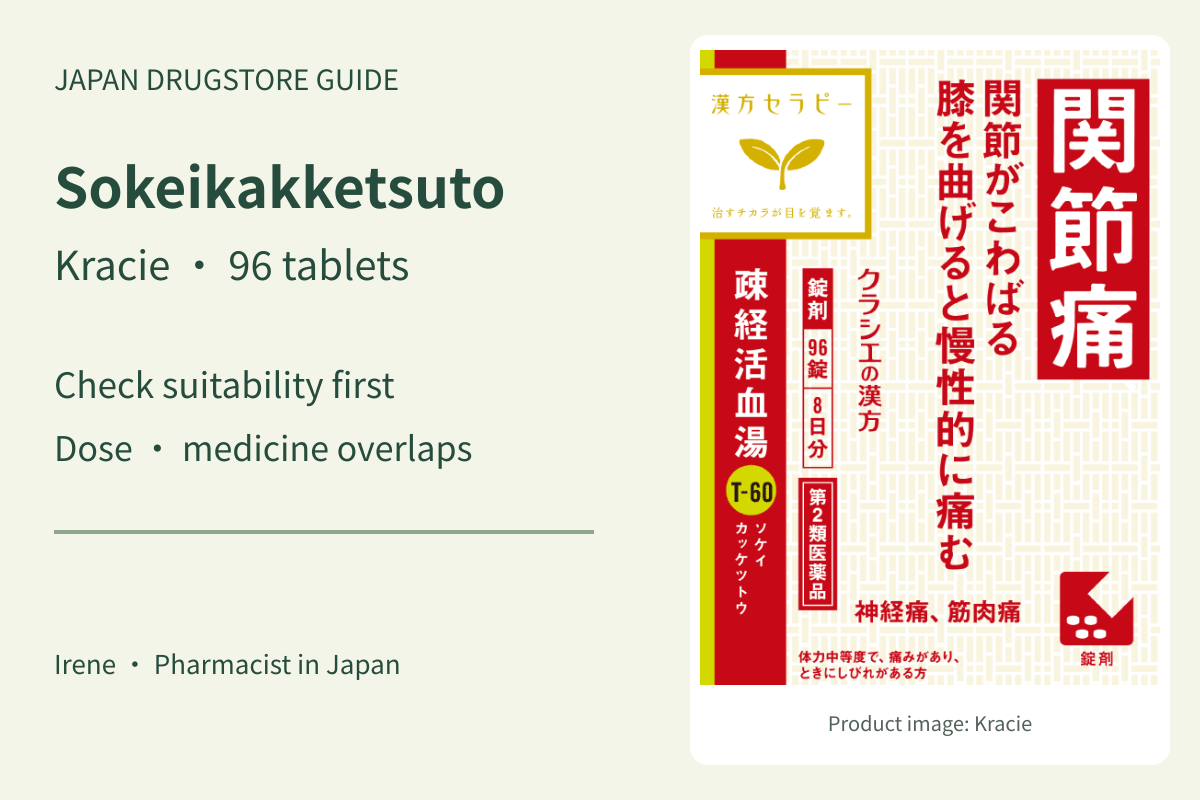
Choose Kracie Sokeikakketsuto by its labelled symptoms and constitution, then check the tablet count. This Japanese Class 2 OTC medicine is labelled for joint pain, neuralgia, lower back pain and muscle pain in people with moderate physical strength who have pain, sometimes with numbness. Tired legs after sightseeing alone are not enough to establish that it is suitable.

I’m Irene, a Taiwan-born pharmacist licensed in Japan and working in a Japanese drugstore. Before choosing this pack, I’d start with how long the pain has lasted, whether there is numbness, and what medicines you already take. Those details matter more than the largest tablet count.
Japan-market product. Checked on October 19, 2026. This guide identifies the 96-tablet pack, JAN 4987045049293.
- Three checks before buying
- Recognise the 96-tablet pack: eight adult days
- Dose: four tablets, three times daily for ages 15+
- Seventeen crude drugs: 3,000 mg is the daily extract
- Four groups who must consult before use
- When to stop: do not push through to one month
- Pain or numbness that needs medical care first
- At home: keep the original pack dry
- Official labels and medical references
Three checks before buying
- Looking specifically for Sokeikakketsuto? Match the complete Japanese product name: 疎経活血湯エキス錠クラシエ. The formula name on the front is 疎経活血湯.
- Have a weak stomach and tend to get diarrhoea, or are receiving medical treatment? Consult a doctor, pharmacist or registered OTC medicine seller in Japan before taking it.
- Sudden severe pain, a hot swollen joint, or new or worsening numbness or weakness? Get medical assessment first. See the urgent warning signs below.
“Moderate physical strength” is a Kampo constitution criterion, not an age range, step count or pain score. If you are unsure how it applies, ask a pharmacist to review your symptoms and medical history. This product is not labelled to prevent aches before a trip. Nor does being an herbal medicine establish that it is safer or more suitable than an ordinary painkiller.
Recognise the 96-tablet pack: eight adult days
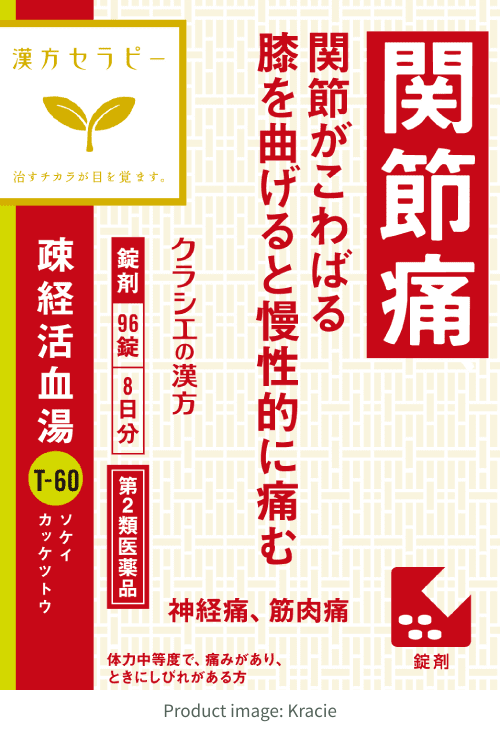
Look for 漢方セラピー, 疎経活血湯 and “96錠” or “8日分”. The full sales name is 疎経活血湯エキス錠クラシエ. 96 tablets divided by the adult daily total of 12 gives eight days; it does not mean taking 12 at once or that everyone should complete eight days.
A different tablet count does not by itself mean a different strength. If someone requested another size, check the complete name, adult daily extract amount and directions. This guide does not rank pack sizes by effectiveness or transfer these directions to another brand, a powder or a prescription medicine.
Dose: four tablets, three times daily for ages 15+
| Age | Per dose | Frequency |
|---|---|---|
| 15 and over | 4 tablets | 3 times daily |
| 7–14 | 3 tablets | 3 times daily |
| 5–6 | 2 tablets | 3 times daily |
| Under 5 | Do not take | |
Take with water or lukewarm water before or between meals. Kracie’s general Kampo guidance describes before meals as about 30–60 minutes beforehand and between meals as about two hours after eating. “Between meals” does not mean during a meal. Children must take it under adult supervision; a child with joint problems should be medically assessed rather than given this for travel fatigue based on the dose table.
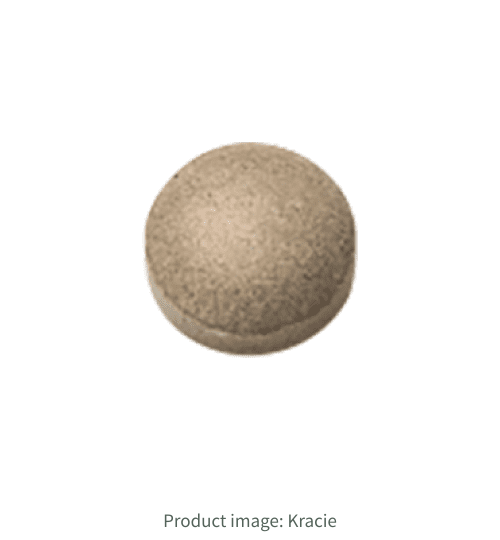
The photograph helps identify the tablet appearance; use the age table to count a dose. The adult total is 12 tablets across three doses, never all at once.
Seventeen crude drugs: 3,000 mg is the daily extract
The adult daily amount of 12 tablets, each weighing 353 mg, contains 3,000 mg of Sokeikakketsuto extract powder. The following are the crude-drug starting amounts used to make that daily extract, not amounts per tablet or extra herbs to take:
- Rehmannia root, Japanese angelica root, peach kernel, cnidium rhizome, poria sclerotium and atractylodes rhizome: 1.0 g each
- Achyranthes root, gentian root, citrus peel, notopterygium rhizome, clematis root, sinomenium stem and rhizome, and saposhnikovia root: 0.75 g each
- Angelica dahurica root and licorice root: 0.5 g each
- Peony root: 1.25 g
- Ginger: 0.25 g
This is one fixed herbal formula. More ingredients do not establish a better result for every type of pain. Crude-drug weights, extract weight and total tablet weight describe different things; adding them together is not a useful measure of strength.
Full Japanese ingredient identifiers and excipients
For checking the original label, the 17 identifiers in the same order are: Jio, Toki, Tonin, Senkyu, Bukuryo, Byakujutsu; Goshitsu, Ryutan, Chinpi, Kyokatsu, Ireisen, Boi, Bofu; Byakushi, Kanzo; Shakuyaku; Shokyo.
Excipients: talc, magnesium stearate, carmellose calcium (CMC-Ca), carmellose sodium (CMC-Na), silicon dioxide, polyoxyethylene polyoxypropylene glycol and hypromellose. Have a pharmacist check the actual pack if you have a relevant allergy history.
Four groups who must consult before use
The Japanese leaflet asks you to consult a doctor, pharmacist or registered OTC medicine seller if you are receiving medical treatment; are pregnant or may be pregnant; have a weak digestive system and tend to get diarrhoea; or have previously developed a rash, redness, itching or a similar allergic reaction to medicines or other products.
If breastfeeding, ask first too. This follows Kracie’s general Kampo advice, which considers the medicine, duration of use, and the mother’s and baby’s circumstances. An herbal formula is not automatically suitable during pregnancy or breastfeeding.
Check licorice duplication before adding another medicine. This formula uses 0.5 g of licorice root in its adult daily extract. Other Kampo products, cold remedies or medicines containing licorice or glycyrrhizin-related ingredients may overlap. Show the pharmacist your prescriptions, OTC medicines and supplements. Do not add a second Kampo formula or replace existing treatment on your own.
When to stop: do not push through to one month
- Rash, redness, itching, loss of appetite or stomach discomfort after taking it: stop immediately and consult a doctor, pharmacist or registered seller, bringing the leaflet. These may be adverse reactions.
- No improvement after about one month: stop and consult with the leaflet. This does not mean every pain can safely wait a month.
An additional general licorice warning: Japan’s PMDA warns that medicines containing licorice or glycyrrhizin can cause pseudoaldosteronism. Increasing limb heaviness, numbness, tightness or stiffness together with weakness, cramps or muscle pain should not be dismissed as the original aches. Stop taking the product and contact a doctor or pharmacist promptly.
Pain or numbness that needs medical care first
- Arrange assessment: pain that affects everyday activities or sleep, keeps returning or is getting worse. New or worsening numbness or weakness also needs assessment rather than a self-diagnosis of “neuralgia”.
- Get urgent help: a hot, swollen joint; pain with fever, shivering or feeling unwell; or back pain that starts severely or worsens rapidly.
- Seek emergency care: back pain with numbness or weakness in both legs, loss of feeling around the genitals or anus, difficulty passing urine or loss of bladder/bowel control; pain after a serious accident; or joint pain that prevents walking or bearing weight.
These are general medical warning signs, separate from the medicine’s one-month review rule. Seek help sooner if you are concerned. A shopping guide cannot diagnose the cause of your pain.
At home: keep the original pack dry
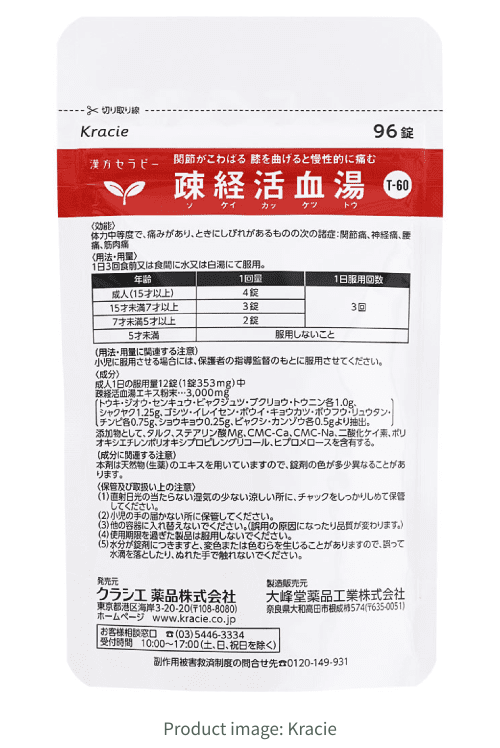
Store in a cool, dry place away from sunlight and children, closing the pouch securely after use. Do not transfer tablets to another container, handle them with wet hands or use them after expiry. Natural extracts can cause slight colour variation, but moisture can also cause discolouration or mottling. Ask a pharmacist if tablets have become wet or their appearance seems questionable.
The shared leaflet also gives instructions for bottle and four-tablet sachet formats: close bottles tightly and discard the transport packing material after opening; fold the opening of a partly used four-tablet sachet and do not take the remainder after more than two days. Those instructions apply only if you actually have that format. A four-tablet sachet does not mean that every age group takes four tablets.
My buying order: check for medical warning signs → match the full Sokeikakketsuto name → review constitution, current medicines and licorice overlap → confirm your dose. That is more useful than choosing the biggest pack.
Official labels and medical references
- Kracie: 96-tablet product information
- Kracie: current packages and tablet images
- Kracie: complete Japanese leaflet
- Kracie: general Kampo questions and timing
- Kracie: Kampo during pregnancy and breastfeeding
- Kracie: combining medicines
- PMDA: pseudoaldosteronism patient guidance
- NHS: back-pain warning signs
- NHS: joint-pain warning signs
This guide helps identify Japanese products and understand their labels. It does not replace individual diagnosis, medical advice or the complete leaflet supplied with your purchase.