Lumin A 100γ is not an automatic upgrade from 50γ. Both are Japanese Class 3 over-the-counter medicines. They contain the same active ingredient at different amounts per tablet, but their approved uses also differ. If you are looking for an everyday supplement for the whole family, neither should go into your basket on that basis.

I’m Irene, a Taiwan-born, Japan-licensed pharmacist working in a Japanese drugstore. This guide helps you identify the right pack once its suitability has been checked. If you do not yet know what is causing your symptoms, asking first and buying neither is a sensible choice.
Information checked: 19 October 2026. This guide covers the Japanese products, using the current manufacturer pages and Japanese leaflets.
- Choose your next step before choosing a strength
- Match the full name, not just the box colour
- The same ingredient does not make the labels interchangeable
- How do the approved uses differ?
- Directions once suitability has been checked
- Checks before use, and when to stop
- Leave the shop with three clear answers
- Official sources and medical information
Choose your next step before choosing a strength
- A doctor or pharmacist has already checked which version suits you: match the full name and 50γ or 100γ first, then choose a pack size. Do not switch just because another box has the larger number.
- You are considering it for new tiredness, a skin problem or tingling: explain the symptoms, how long they have lasted and your current medicines to a healthcare professional. The label differences below cannot establish a diagnosis.
- You have no particular symptoms and want general wellness or an “immune boost”: routine use for that purpose is not recommended here. Neither label includes preventing colds, infections or COVID-19. These are medicines, not everyday nutritional supplements.
Match the full name, not just the box colour
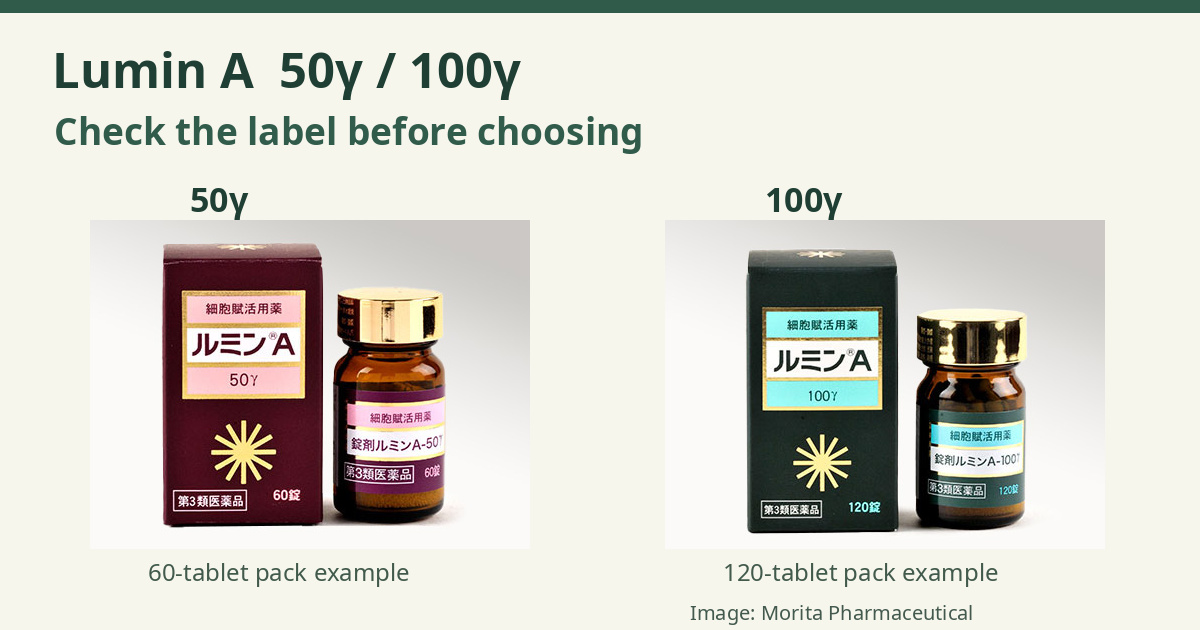
Lumin A-50γ
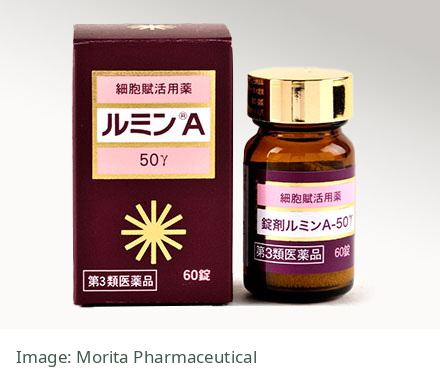
Japanese pack name: 錠剤ルミンA-50γ. This example contains 60 tablets, with 50 micrograms of the active ingredient in each tablet.
Lumin A-100γ
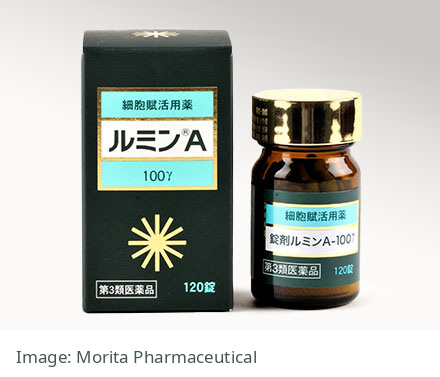
Japanese pack name: 錠剤ルミンA-100γ. This example contains 120 tablets, with 100 micrograms of the active ingredient in each tablet.
Look for Lumin A or ルミンA. Several box designs exist for the same strength; the brand manufacturer confirms that these are manufactured and marketed by Nagase Viita. A purple or green box, or a large letter A, is not enough to identify the medicine.
The photographs show pack examples from Morita Pharmaceutical’s official product page, not every design or size. That page currently lists 60, 120 and 400 tablets for 100γ, and 60 tablets for 50γ. In “100γ, 400 tablets,” 100 identifies the per-tablet ingredient amount and 400 is the number of tablets in the pack. It does not mean 400 micrograms per tablet or a recommended 400-day course. Images are not to scale, and this guide does not guarantee shop stock.
The same ingredient does not make the labels interchangeable
Both contain one active ingredient: cryptocyanine O.A. complex, written on the Japanese label as クリプトシアニンO.A.コンプレックス. The amount per tablet is 50 μg in 50γ and 100 μg in 100γ. The unit μg means micrograms, not milligrams. This is not iron or a B-vitamin formula, and the A in the name should not be read as vitamin A.
Both leaflets list the same inactive ingredients: gum arabic, talc and sodium bicarbonate. If you have an ingredient-allergy concern, show the complete pack and leaflet to a pharmacist.
Two 50γ tablets and one 100γ tablet contain the same total amount of active ingredient, but that calculation does not make their labelled uses identical. Check each product’s directions and suitability separately. Do not combine the two versions to increase the dose.
How do the approved uses differ?
The following are selected examples of Japanese label wording, intended to help distinguish the packs. They are not a symptom-based self-diagnosis tool or a complete translation of the indication lists.
- Uses listed for 50γ but not for 100γ
- Allergic conditions, loss of appetite, fatigue, anaemia and general physical weakness. Their presence on the label does not establish that 50γ is appropriate for every cause of tiredness or allergy symptoms.
- One use listed for 100γ but not for 50γ
- Acute and chronic eczema. Itching or blisters alone do not confirm eczema.
- Categories listed for both
- General wounds, burns, frostbite, acute pus-forming conditions and peripheral nerve disorders. These broad terms cannot tell you what care a wound, infection or numbness needs.
The complete indication lists remain those in each product’s Japanese leaflet. The full 100γ list also contains a fungal-skin-disease term; do not assume an itchy, blistering or peeling foot is ordinary eczema. Athlete’s foot is a fungal infection with specific antifungal treatments. Ask a pharmacist or doctor to assess the problem rather than choosing from a pack description.
The important boundary: a condition being named on a medicine’s label does not confirm your diagnosis or make the product a replacement for appropriate care. The pack’s “cell-activating medicine” wording should not be expanded into a promise to repair every cell, boost everyone’s immune system or prevent disease.
Anaemia, infection and numbness need particular care
- Possible anaemia: tiredness, palpitations or looking pale are not enough to diagnose it. A clinician may need blood tests and further checks to identify the cause. Lumin A is not an iron supplement; do not substitute it for an existing anaemia treatment plan.
- A wound that is red, swollen, increasingly painful or producing pus, especially with fever or feeling unwell: seek prompt medical advice. Uncontrolled bleeding, a large or deep wound, loss of sensation or difficulty moving the area need urgent medical attention. Oral Lumin A should not replace cleaning, dressing or necessary infection treatment.
- New or persistent numbness: have the cause assessed. Sudden one-sided weakness or numbness, facial drooping or speech difficulty calls for local emergency medical help immediately, even if it quickly goes away.
Directions once suitability has been checked
- The usual labelled directions for both
- One tablet once a day, on an empty stomach, with warm or cool water. This is not one tablet with each meal.
- What counts as an empty stomach?
- The manufacturer’s FAQ gives a guide of at least 30 minutes before food or at least two hours after food. Take the tablet with water rather than swallowing it dry.
- The two-tablet provision
- Both leaflets also state that if an effect is not apparent, take two tablets per dose. The frequency remains once daily. This is not a recommendation for everyone to start with two. If symptoms are not improving, ask a pharmacist to reassess the problem and directions rather than increasing the dose yourself, adding an extra dose or combining strengths.
- Children under three
- Do not give either product, because of the risk of choking. Children aged three or older must still take it under a parent’s or guardian’s supervision to prevent a tablet lodging in the throat. Meeting the age limit does not make routine use appropriate for every child.
The manufacturer also warns that taking more does not necessarily make it work more readily or faster. The leaflets do not specify a set number of days before changing to two tablets; do not invent your own dose-increase schedule.
Checks before use, and when to stop
Anyone who is pregnant, may be pregnant or is receiving medical treatment must consult a doctor, pharmacist or registered OTC medicine seller before taking either version. If you are breastfeeding, use other medicines or supplements, or are unsure about your medical history, seek an individual suitability check too. Do not stop or reduce prescribed treatment on your own.
- Increased wound discharge, loss of appetite or fever after taking it: these may be adverse effects. Stop immediately and take the leaflet to a healthcare professional. Do not treat them as “detox” or a normal sign of repair.
- No improvement after about one month: stop and consult. This is not an instruction to wait a month before seeking help. Worsening, unexplained or concerning symptoms need earlier assessment.
Store in a cool, dry place away from direct sunlight and children. Keep the original container, do not transfer the tablets elsewhere, and do not use after the expiry date. Use promptly after opening. Do not swallow the desiccant inside the bottle. The manufacturer specifically warns that it may come out with tablets from the 60-tablet bottles of both strengths, so check what you have poured out.
Leave the shop with three clear answers
- Why am I taking it? Suitability and the intended use have been checked; it is not simply an everyday wellness purchase.
- Which exact medicine is it? Match 50γ or 100γ before choosing the tablet count. Colour is only an extra clue.
- How will I take it, and when will I stop? Once daily, on an empty stomach, with the adverse-effect and no-improvement boundaries in mind.
If those answers are still unclear, show the pack photograph to a pharmacist first. It is fine to leave without a large bottle of medicine you are unsure you need.
Official sources and medical information
- Nagase Viita: Japanese Lumin A product information and packaging
- Full Japanese 50γ leaflet and 100γ leaflet, both revised April 2024
- Manufacturer FAQ: timing, children, other medicines and stopping advice
- Morita Pharmaceutical: current pack sizes and product photographs
- NHS: anaemia assessment, wound care, stroke symptoms and athlete’s foot, for general care and referral principles.
Product photographs are from Morita Pharmaceutical’s official product page. This guide explains Japanese product identification and labels; it cannot replace individual medical care. Read the complete leaflet supplied with the pack you buy.