
I'm Irene, a Japanese-licensed pharmacist working in a Japanese drugstore. I was born in Taiwan and moved to Japan at around age 10. When choosing a drink to go with a travel-day meal, I would start with the flavour you want, then turn the carton over. The big vegetable pictures do not tell you everything about its contents.
The quick choice: fruity, rich tomato or lower-carbohydrate tomato
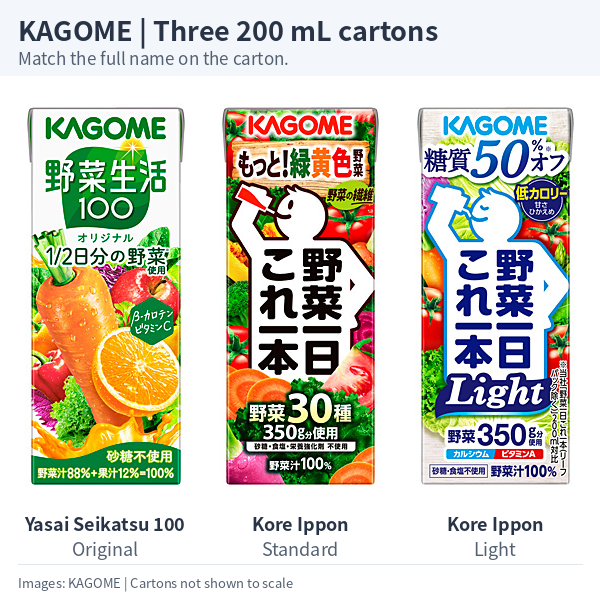
This guide compares three Japanese-market 200 mL cartons:
- Want a fruity carrot-based drink? Choose Yasai Seikatsu 100 Original. It blends vegetables with fruit and declares orange and apple allergens.
- Want a richer tomato flavour? Choose Yasai Ichinichi Kore Ippon, the standard carton. It has more labelled fibre than Light, although the ranges vary.
- Want the lower-carbohydrate option within this comparison? Choose Kore Ippon Light. It has 6 g of available carbohydrate and 32 kcal per 200 mL. It still contains sugars, and “Light” does not mean every nutrient is the same as the standard version.
A vegetable drink can be a convenient addition to a meal. It does not replace eating vegetables or provide every component of the vegetables used to make it. Neither “100” nor “one day's vegetables” makes it a complete meal.
Recognise the exact cartons
Yasai Seikatsu 100 Original: vegetables plus fruit
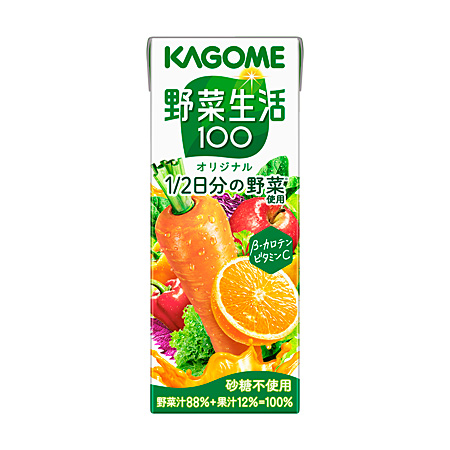
Look for 野菜生活100 オリジナル, with carrot and orange pictures. Its current formula contains 88% vegetable juice and 12% fruit juice, using 20 vegetables and four fruits. The fruit ingredients are apple, grape, orange and lemon; the vegetable list starts with carrot. The ingredient list also includes citric acid, flavouring and vitamin C.
KAGOME announced a staged renewal from mid-March 2026, changing the vegetable proportion from 70% to 88%. If you remember an older 70/30 label, check your actual pack rather than applying its old nutrition figures to this one.
Yasai Ichinichi Kore Ippon: the standard tomato-based version
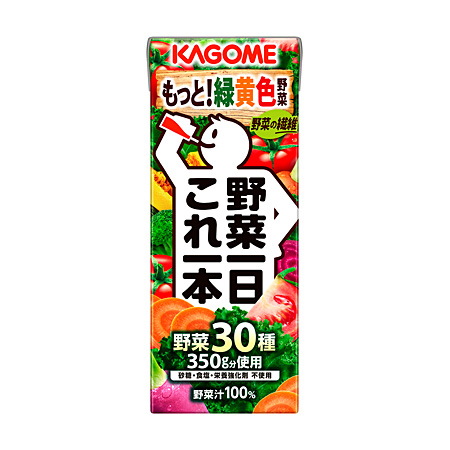
Look for 野菜一日これ一本 without “Light.” The manufacturer describes a rich tomato flavour. Tomato comes first in the ingredient list, followed by other vegetables; lemon juice is also included. It uses 30 vegetables and is sold as a 100% vegetable juice, with no added sugar, salt or nutrient fortification.
This is a useful choice when you want the tomato-based version and are comparing fibre: its label lists 1.4–2.9 g per carton. It should not be treated as the nutritional equivalent of a plate of vegetables.
Kore Ippon Light: check the blue “Light” lettering
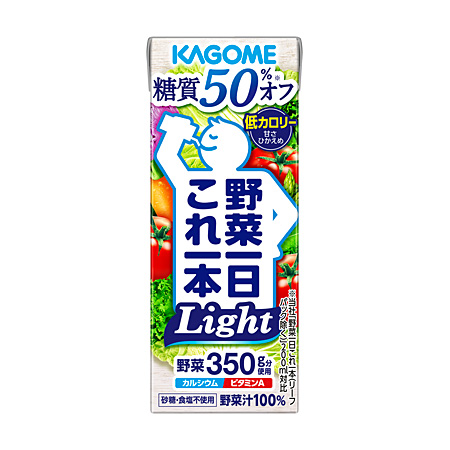
Look for 野菜一日これ一本 Light and the blue “糖質50%オフ” wording. The manufacturer describes a lighter tomato taste. Chinese cabbage is the first ingredient, followed by tomato and other vegetables; lemon juice is included. This is a different vegetable blend, not merely the standard drink in a blue carton.
Its “50% off” claim compares available carbohydrate (糖質) with the standard 200 mL Kore Ippon, excluding Leaf Pack: 6 g versus 12 g. It does not mean sugar-free, half of every nutrient, or half the carbohydrate of every KAGOME drink.
Compare the same 200 mL amount
All figures are per one 200 mL carton, not per 100 mL. Ranges below are the ranges declared by the manufacturer.
| Label item per 200 mL | Original | Standard Kore Ippon | Kore Ippon Light |
|---|---|---|---|
| Energy | 65 kcal | 61 kcal | 32 kcal |
| Protein | 0.8 g | 2.1 g | 1.7 g |
| Total carbohydrate (炭水化物) | 16.0 g | 14.2 g | 6.8 g |
| Available carbohydrate (糖質) | 15.1 g | 12 g | 6 g |
| Sugars (糖類) | 13.0 g | 9.7 g | 4.9 g |
| Dietary fibre | 0.3–1.5 g | 1.4–2.9 g | 0.3–1.3 g |
| Salt equivalent | 0.01–0.5 g | 0–0.4 g | 0–0.3 g |
| Declared allergens | Orange, apple | None of the listed allergens | None of the listed allergens |
Irene's label-reading tip: Japanese labels distinguish 糖質 from 糖類. 糖質 is carbohydrate excluding dietary fibre; 糖類 is the sugars category, such as glucose, fructose and sucrose. Do not translate both as “sugar” when comparing packs.
“No added sugar” describes what was not added during manufacture. It does not remove the sugars naturally present in vegetables and fruit. The sugars row is therefore worth reading even when the front says 砂糖不使用. Likewise, “no added salt” does not mean the salt-equivalent figure must be zero.
What do 175 g and 350 g of vegetables actually mean?
Original uses 175 g of vegetables per 200 mL. Standard Kore Ippon and Light each use 350 g. These describe the amount of vegetables used as raw materials, not the amount of intact vegetables you eat or a guarantee of all their nutrients.
KAGOME explicitly says vegetable drinks do not contain every component of the original vegetables. The sensible travel-meal approach is to use the drink as an addition and still choose vegetable dishes when you can. There is no need to drink extra cartons to “catch up” by multiplying the front-of-pack vegetable weight.
A practical check before you open it
- Match the full name and 200 mL size. The brand also has cans, concentrated smaller cartons, Leaf Packs and other varieties; their formulas and serving figures may differ.
- Check the ingredients and allergens on your actual pack. Original declares orange and apple. The other two declare none of the manufacturer's listed allergens, which is not a guarantee against every possible food allergy.
- If you have kidney disease, check with your treating doctor before choosing these drinks. KAGOME specifically flags kidney disease and the need to check potassium restrictions with your doctor. More generally, compare the full drink with any individual dietary advice; do not assume Light automatically fits your carbohydrate, potassium or fluid limits.
- Follow the pack's storage instructions. For small drinks such as these 200 mL cartons, KAGOME recommends finishing them on the day they are opened; do not carry an opened carton into the next day's sightseeing.
For a quick shelf decision, remember fruity Original, rich-tomato standard, lower-carbohydrate Light. Then check the back label and choose it as part of the meal, with realistic expectations about what juice can provide.
Official sources
Product information checked on 14 October 2026. Figures apply to the exact Japanese 200 mL products above.
- KAGOME: Yasai Seikatsu 100 Original, 200 mL
- KAGOME: Yasai Ichinichi Kore Ippon, 200 mL
- KAGOME: Yasai Ichinichi Kore Ippon Light, 200 mL
- KAGOME: Original's 2026 formula renewal
- KAGOME: Kore Ippon brand information and cautions
- KAGOME: Understanding vegetable juice and carbohydrate labels
- KAGOME: How long to keep drinks after opening