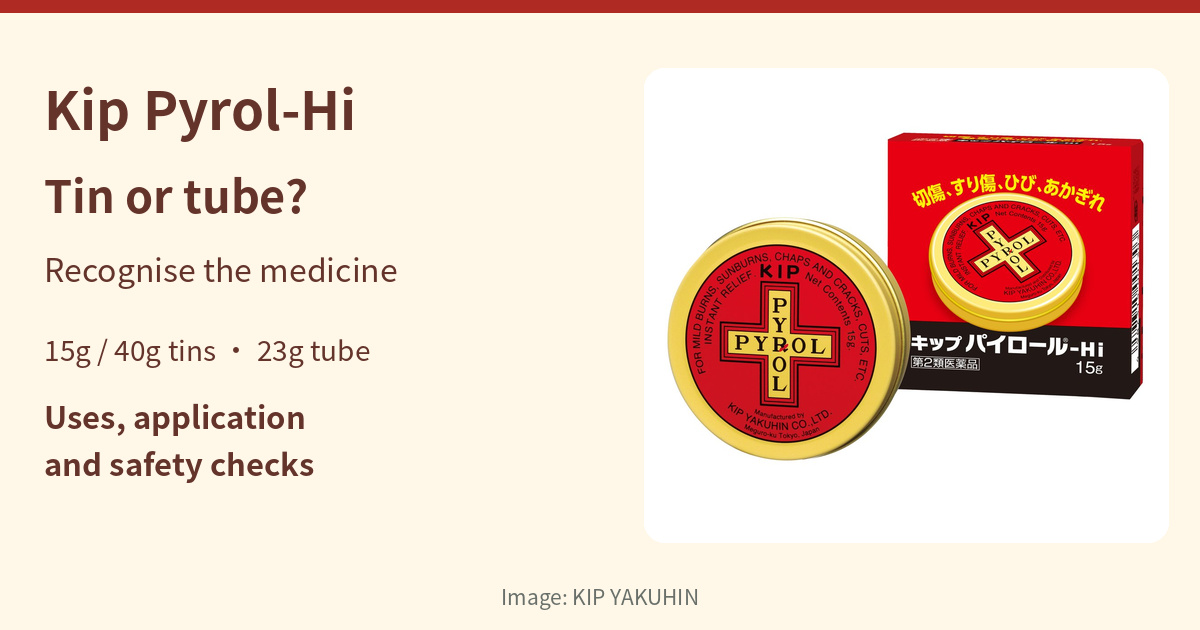
The yellow-and-red Kip Pyrol-Hi tin contains a medicine with specific skin-care uses. The current Japanese 15g and 40g tins and 23g tube have the same formulation. Choose the tube if you prefer squeezing out ointment, or a tin if you prefer a wide opening. First, check whether the skin problem is suitable for this medicine.

I’m Irene, a Taiwan-born, Japan-licensed pharmacist working in a Japanese drugstore. This little tin is easy to recognise. Let’s look beyond the design so you can identify the product, understand its uses and know when an injury needs medical care.
Checked: 19 October 2026. This guide covers the Japan-market product キップパイロール-Hi, a Japanese Class 2 OTC medicine. It contains no steroid.
Start with your purpose: small cuts, scrapes, cracked skin or shaving irritation may fit the label, subject to the precautions below. Everyday moisturising, scar fading and whole-face skin care are not labelled uses. Deep wounds, pus or serious burns need medical assessment.
Recognising the tin and tube
Look for the full Japanese name, キップパイロール-Hi, alongside KIP PYROL. The manufacturer’s Traditional Chinese site also mentions a nickname meaning “cross medicine.” The cross alone is not enough to identify the product.
15g and 40g tins: the same medicine in different amounts
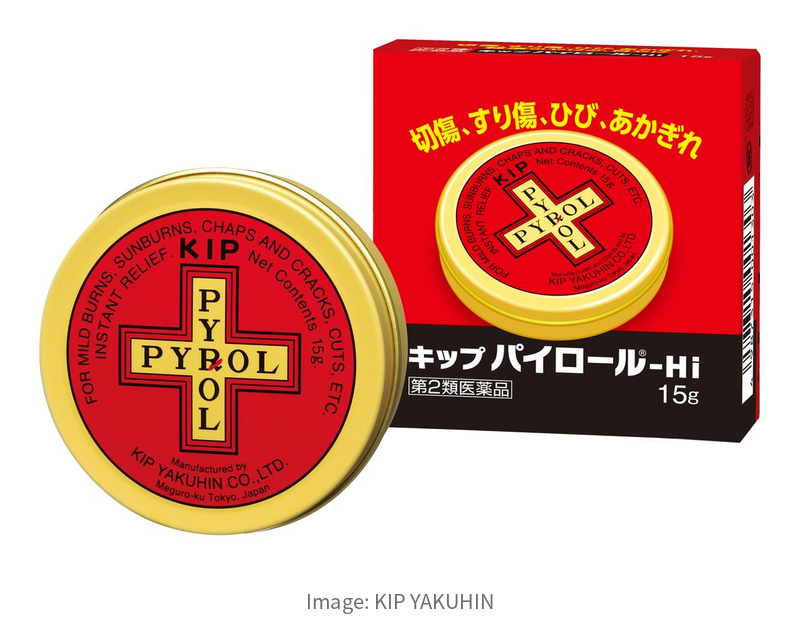
The 15g carton is shown above with the tin. The carton is mainly red and black; the tin has a yellow rim, red lid and cross design. Both tin sizes have 第2類医薬品, meaning Class 2 medicine, on the carton.
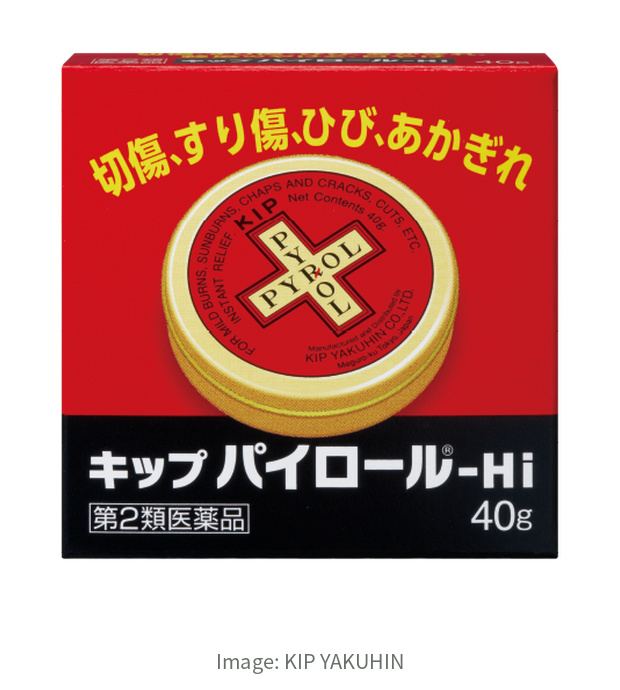
On the 40g carton, check the weight at the lower right. A larger tin does not contain a stronger version. These images show package identification, not relative physical size.
23g tube: a squeeze-out option
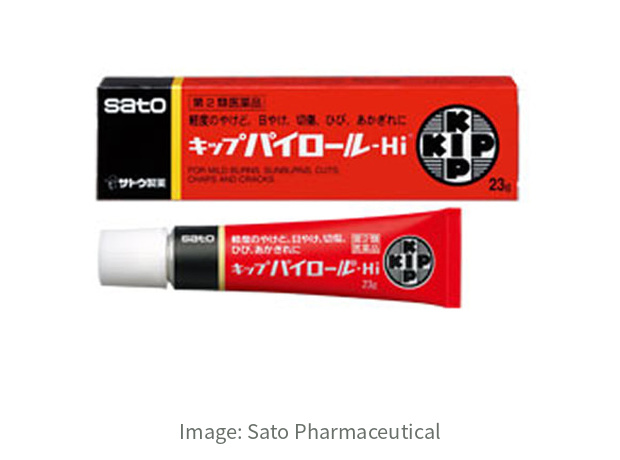
The tube and its carton carry the sato logo; Sato Pharmaceutical distributes this format. It is still Kip Pyrol-Hi with the same formulation and directions. A different container does not create a different treatment strength.
The official catalogue also lists a 500g bottle. This guide focuses on the smaller tins and tube. Choose an amount you are likely to need and check the expiry date; availability of every size at any particular shop is not guaranteed.
Four active ingredients, including zinc oxide
The amounts below are per 100g of ointment, not the amount to apply at one time:
- Isopropylmethylphenol
- 0.1g
- Zinc oxide
- 6.018g
- Phenol
- 0.444g
- Salicylic acid
- 0.056g
The manufacturer describes an antiseptic ointment, with zinc oxide providing protective and astringent effects. Steroid-free does not mean allergy-free. Other ingredients include paraffin, white beeswax, lanolin, methyl salicylate, petrolatum and fragrance. Tell the pharmacist about previous reactions to medicines or ingredients.
The presence of salicylic acid does not make this a wart, exfoliating or acne treatment. Likewise, petrolatum in the base does not make the finished medicine interchangeable with plain petrolatum. Use the product’s own indication list.
What is it labelled for? Can it go on the face?
The Japanese label covers minor burns, cuts, scrapes, chapped or cracked skin, shaving irritation, and inflammation from sunburn, including reflected sunlight on snow. It does not list scar prevention, scar fading, whole-face skin care or treatment of every type of eczema or insect bite.
The manufacturer’s FAQ allows use on suitable small facial wounds, but not in the eyes, mouth or other mucous membranes. That is not a reason to spread it over the whole face as a moisturiser. Facial burns are different and need urgent medical care, as explained below.
Pus is a reason to seek care. Although the product information mentions both dry and moist affected areas, severe weeping or erosion requires advice before use. Increasing redness, swelling or pain, pus, dirt remaining after cleaning, fever or feeling unwell calls for prompt medical assessment.
How much, and how often?
- Check the injury first. For a suitable small cut or scrape, stop any bleeding and clean the wound. Uncontrolled bleeding, a very deep wound or an embedded object needs immediate medical attention.
- Apply an appropriate amount to the affected area, or spread it on gauze and apply that. The leaflet does not give a universal gram amount or length to squeeze out.
- The manufacturer’s FAQ suggests around 3–4 applications a day. The leaflet itself does not set a fixed daily frequency. This guidance is not a course everyone must complete regardless of the wound.
- Use externally only and close the container after use. Avoid eye contact. If ointment enters the eye, rinse immediately with water or lukewarm water; seek an eye doctor if symptoms are severe.
For first opening of the tube, the leaflet says to press the projection on the cap into the tube opening to pierce the seal. Check the instructions on your own pack. Tin or tube, the same local-application principles apply.
If you wanted a product that dries into a film, see the separate guide to Japanese liquid bandages and their wound restrictions. Kip Pyrol-Hi is an ointment; liquid-bandage drying, water-contact and removal instructions do not apply to it.
Cool a burn first: ointment is not first aid
For a heat burn or scald, start with 20 minutes under cool running water. Do not apply ointment, oils or butter first. Remove nearby clothing or jewellery only if it is not stuck to the skin, and do not burst blisters. First aid and the choice of any later skin treatment are separate decisions.
“Minor burns” on the Japanese label does not mean you can judge burn depth from pain alone. Very large or deep burns, burns on the face, genitals or buttocks, and chemical or electrical burns require immediate emergency medical help. Seek medical advice if a child has been burned or you are unsure what to do. Do not delay cooling or care while shopping for ointment.
Children and pregnancy
Children: the manufacturer’s FAQ states no formal age restriction but recommends use from age 1. The leaflet requires adult guidance and supervision. A child’s rash or injury still needs to fit the labelled uses. For a baby under 1, ask a doctor or pharmacist before choosing it.
Pregnancy: the manufacturer’s FAQ says it can be used during pregnancy. The labelled uses and precautions still apply. If you are receiving medical treatment, have a large affected area or are unsure about the problem, ask first rather than relying on the steroid-free claim.
When to ask first, and when to stop
Before use, consult a doctor, pharmacist or registered OTC seller if you are receiving medical treatment, have previously had an allergic reaction to medicines or other substances, have a large affected area, severe weeping or erosion, a deep wound or a severe burn. For the emergency warning signs above, seek medical care directly.
- If rash, redness or itching appears after use, stop immediately and seek advice with the leaflet.
- If there is no improvement after 5–6 days, stop and consult. This means days, not applications.
- Worsening symptoms or suspected infection need earlier assessment; do not wait for the 5–6-day point.
Keep the original container tightly closed, away from sunlight, heat and humidity, and out of children’s reach. Do not decant it or use it after expiry. The manufacturer also advises storing it horizontally so that ointment will not spill if it melts in high temperatures.
My shopping order: confirm a suitable minor problem, check allergies and precautions, then choose the container. Remembering what the ointment is for is more useful than remembering the tin alone.
Official information and first-aid references
- Kip Pyrol-Hi official Japanese product information and manufacturer’s Traditional Chinese page
- Sato Pharmaceutical: formulation and pack sizes
- Japanese package leaflet (PDF, both pages)
- Manufacturer FAQ: steroids, age, frequency, pregnancy and application areas
- NHS: burns, scalds and urgent warning signs
- NHS: cuts, grazes and signs of infection
- NHS 111 Wales: why pain alone cannot indicate burn severity
This guide helps you identify a Japanese product and understand its label. It does not replace an individual diagnosis or the full instructions supplied with your pack.