I’m Irene, a Taiwan-born, Japan-licensed pharmacist working in a Japanese drugstore. With OS-1, I would first check whether oral rehydration has been recommended, then choose a format you can use correctly.
Which OS-1 format makes sense?
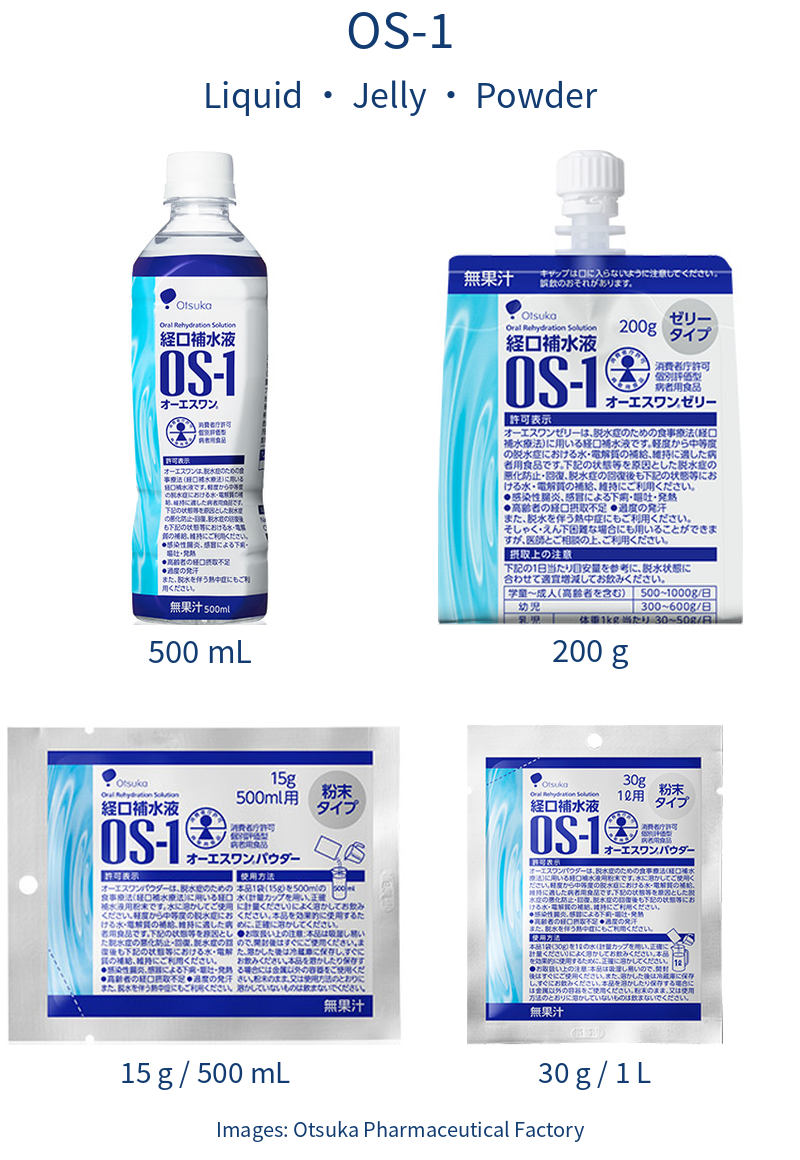
- Ready to drink without measuring: the liquid comes in 300 mL and 500 mL bottles. Choose the amount that fits the advice you have received.
- Prefer a jelly texture: OS-1 Jelly is a 200 g spouted pouch. It is not equivalent to a whole 500 mL bottle. If chewing or swallowing is difficult, ask a doctor before using it.
- Need a compact powder format: choose it only when you have drinking water, a measuring cup and a non-metal container. One 15 g sachet needs 500 mL of water; one 30 g sachet needs 1 L. The preparation steps below matter.
All three are foods for medical dietary use in dehydration, not OTC medicines or everyday sports drinks. This comparison covers the original versions, not apple-flavoured products.
Do not delay care to compare packages. Severe dehydration needs medical assessment. In suspected heat illness, inability to drink independently or loss of consciousness means calling an ambulance immediately. Do not force a drink or jelly into someone who cannot safely swallow.
When is OS-1 intended to be used?
The Japanese label describes dietary management of mild to moderate dehydration: supplying and maintaining water and electrolytes when dehydration is associated with diarrhoea, vomiting or fever from infectious enteritis or a common cold; insufficient oral intake in older people; or excessive sweating. It also includes heat illness accompanied by dehydration, and maintaining water and electrolytes in the listed circumstances after recovery from dehydration.
The label says to use OS-1 when directed by a doctor as dietary therapy, following guidance from a doctor, pharmacist, nurse, registered dietitian or registered medicine seller. Otsuka says there is no special purchase restriction, but recommends medical instructions for use because the underlying illness may need treatment. Drinking more does not cure that illness.
This guide cannot determine whether you are dehydrated or set your treatment amount. Ask for an individual plan, especially for a baby, child, older person or someone with ongoing illness. If you are simply choosing a regular beverage, see my POCARI SWEAT, ION WATER and Jelly comparison.
Liquid and jelly: the texture changes, not the purpose
Liquid: 300 mL or 500 mL, ready to use
Look for OS-1 and the Japanese name オーエスワン. The current smaller bottle is 300 mL. Drink the ready-made liquid as supplied: do not dilute it or mix it with juice, coffee or other drinks. Changing the sugar–electrolyte balance can affect absorption. Use water or plain warm water to take medicines, rather than OS-1.
Jelly: a 200 g pouch, with its own ingredients
Look for オーエスワンゼリー and 200 g. Otsuka describes a texture that spills less easily and tastes less salty than the liquid; that is a format advantage, not a lower-sodium claim. The manufacturer states that one 200 g pouch provides the same water-and-electrolyte replenishment effect as 200 mL of liquid OS-1.
That does not make one pouch equal to a 500 mL bottle. Grams and millilitres remain different label units. Nor does a jelly label establish safe swallowing for every person: the manufacturer specifically requires consultation with a doctor for chewing or swallowing difficulties.
The formulas are not ingredient-for-ingredient identical. The liquid includes glucose and fructose; Jelly includes glucose and gelling polysaccharides. Both contain sucralose, while Jelly also lists acesulfame potassium. The powder uses maltodextrin and pullulan, with sucralose and thaumatin. Check the actual ingredient list if you need to avoid a particular ingredient.
Powder: measure the water first
OS-1 Powder is labelled オーエスワンパウダー. Choose the sachet by its required water amount, not by the size of the bottle you happen to be carrying.
- Measure drinking water accurately in a measuring cup: 500 mL for one whole 15 g sachet, or 1 L for one whole 30 g sachet. Use a non-metal container with enough room for mixing.
- Add the whole matching sachet to that measured water. Do not add powder first and then merely top the mixture up to a 500 mL or 1 L mark.
- Stir until completely dissolved, then drink promptly. Do not swallow the powder dry or drink an incorrectly prepared mixture.
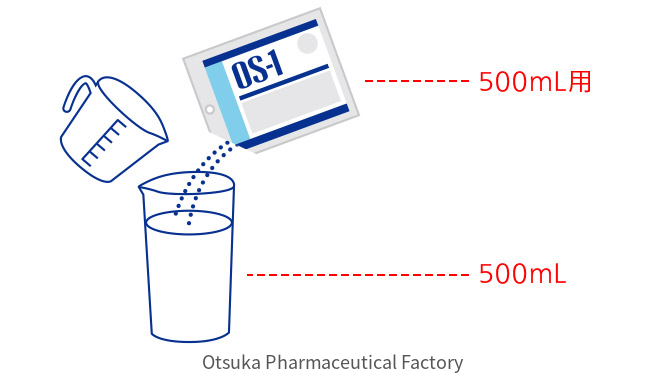
The illustration shows the 15 g sachet for 500 mL of water. The 30 g sachet requires 1 L of water. The official instructions use a whole sachet; do not estimate half a sachet or adjust the concentration to taste.
Use the powder immediately after opening because it absorbs moisture. The current product instructions say to drink promptly after dissolving; the linked English leaflet also specifies refrigeration after mixing. Use non-metal containers for both mixing and storage. Do not assume a metal flask is suitable simply because it is a drinks bottle.
When prepared as instructed, Otsuka says the powder has the same sugar–electrolyte composition and replenishment effect as liquid OS-1. It still requires water and accurate preparation; it is not an instant substitute when someone urgently needs help.
Salt, potassium and fluid restrictions matter
OS-1 supplies meaningful amounts of salt and potassium. If you have been told to restrict sodium, potassium, fluid or carbohydrate, or receive dietary guidance for kidney disease, high blood pressure or diabetes, check with your treating clinician before use. A smaller pouch is not automatically suitable.
500 mL liquid bottle
50 kcal; carbohydrate 12.5 g; salt equivalent 1.46 g; potassium 390 mg.
200 g Jelly pouch
20 kcal; carbohydrate 5 g; salt equivalent 0.584 g; potassium 156 mg.
“Salt equivalent” is not the same number as sodium in milligrams. The 500 mL liquid bottle contains 575 mg of sodium, corresponding to its 1.46 g salt equivalent. There is no reason to drink OS-1 routinely when you are not dehydrated.
After opening: keep the formats straight
- Liquid: drink promptly after opening. If some remains, recap and refrigerate; Otsuka’s opened-product FAQ gives 24 hours as a guide for finishing. Do not leave an opened bottle at room temperature or freeze the bottle. If transferring liquid OS-1, use a non-metal container.
- Jelly: contents may spurt when opened. Recap, refrigerate and consume promptly; do not freeze or heat it, because its texture can break down. Some liquid separation can occur depending on handling and storage.
- Powder: open only when ready to mix, use the correct measured water and drink promptly after dissolving. Keep any prepared solution refrigerated in a non-metal container; do not use the bottle FAQ as permission to prepare it far in advance.
For purchasing, Otsuka lists drugstores, pharmacies and some hospital outlets for OS-1. Its powder FAQ lists the Otsuka Plus-1 online shop, with the 1 L powder also sold at some drugstores. Do not assume both powder sizes are stocked at every pharmacy or ordinary convenience store.
Irene’s final check: confirm that OS-1 is appropriate for the person, then check the exact format, pack size and handling instructions. For powder, the key purchase is a sachet plus the ability to measure its water correctly.
Official sources
- Otsuka Pharmaceutical Factory: Liquid: current label and ingredients
- Otsuka Pharmaceutical Factory: Jelly: current label and handling
- Otsuka Pharmaceutical Factory: Powder: current label and handling
- Otsuka Pharmaceutical Factory: Powder preparation
- Otsuka Pharmaceutical Factory: Powder English leaflet: complete preparation sequence
- Otsuka Pharmaceutical Factory: Liquid and Jelly differences
- Otsuka Pharmaceutical Factory: Correctly prepared powder composition
- Otsuka Pharmaceutical Factory: Dietary restrictions and underlying conditions
- Otsuka Pharmaceutical Factory: Use when not dehydrated and sodium/potassium restrictions
- Otsuka Pharmaceutical Factory: Buying OS-1 and medical guidance
- Otsuka Pharmaceutical Factory: Do not dilute or mix ready-made OS-1
- Otsuka Pharmaceutical Factory: Taking medicines
- Otsuka Pharmaceutical Factory: After opening
- Otsuka Pharmaceutical Factory: Non-metal containers
- Otsuka Pharmaceutical Factory: Where to buy
- Otsuka Pharmaceutical Factory: Powder availability
- Japan MHLW: emergency action for suspected heat illness