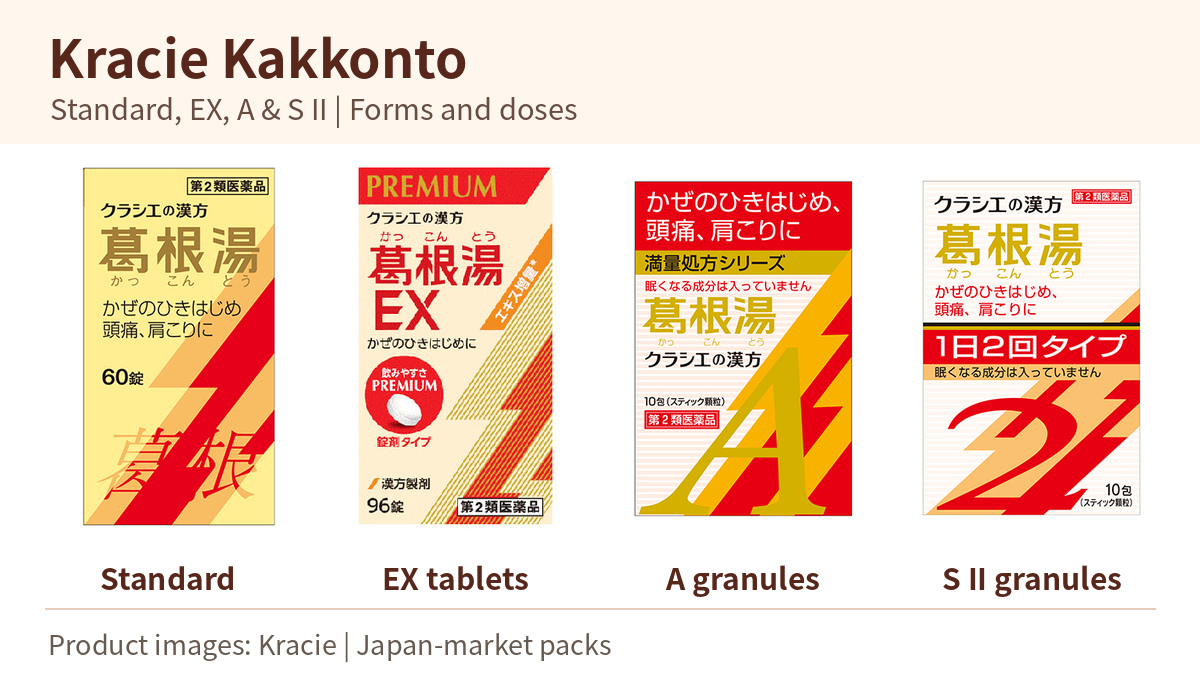
Prefer tablets to herbal granules, but unsure what “EX,” “A,” “S II” or “満量” means? These four Kracie Kakkonto products differ in daily extract amount, dosing frequency and children’s doses, as well as form.
Sources checked: 12 October 2026. This guide covers products sold in Japan and uses their current Japanese leaflets, including the August 2026 safety revision. An official listing does not confirm stock at a particular shop.

I’m Irene, a Taiwan-born, Japan-licensed pharmacist working in a Japanese drugstore. Let’s first check whether Kakkonto is suitable, then make the tablet-versus-granule choice easier.
- Check suitability before choosing a box
- The four adult regimens at a glance
- Same seven herbs, different daily amounts
- Age-based doses: use the correct product’s instructions
- Taking and carrying it correctly
- Avoid overlapping cold medicines and herbal formulas
- When to stop: five or six doses, not days
- Quick questions before buying
- Sources
Check suitability before choosing a box
All four products are labelled for people with moderate or greater physical strength. For an early cold, the indication also specifies no sweating. These conditions need individual assessment; being at the start of a cold alone does not establish suitability. If you are already sweating noticeably, feel frail or are unsure, ask a pharmacist first.
Before use, consult a doctor, pharmacist or registered OTC medicine seller if you are under medical treatment; pregnant or possibly pregnant; older; frail; prone to digestive trouble or excessive sweating; have previously developed a rash, redness or itching from medicines; have swelling or difficulty urinating; or have high blood pressure, heart disease, kidney disease or a thyroid disorder. If breastfeeding, seek advice too.
Shortness of breath, chest pain or worsening symptoms call for medical assessment rather than another box of cold medicine.
Once suitability is confirmed:
- Prefer tablets? Compare Standard and EX. Both require four tablets per adult dose, three times a day. EX adds a film coating and contains more extract per day.
- Comfortable with granules and wondering about “満量”? Look at A. Its full-formula claim refers to the adult daily amount of three sachets.
- Prefer two doses a day? Check S II and its own age-based instructions. Do not use A’s schedule for it.
Other labelled uses include head cold, rhinitis, headache, stiff shoulders, muscle pain, and hand or shoulder pain, with the same physical-strength condition. This guide focuses on choosing the form and following its instructions.
The four adult regimens at a glance
These are the labelled doses for ages 15 and over. Extract amounts are per day, not per tablet or sachet, and are not an effectiveness ranking.
| Product | Daily Kakkonto extract / formula proportion | Adult regimen |
|---|---|---|
| Standard tablets | 2,600 mg; half formula | 4 tablets, 3 times daily |
| EX tablets | 3,467 mg; two-thirds formula | 4 tablets, 3 times daily |
| A granules | 5,200 mg; full formula | 1 sachet, 3 times daily |
| S II granules | 3,900 mg; three-quarter formula | 1 sachet, 2 times daily |
All four are taken before meals or between meals with water or warm water.
Standard tablets: an alternative to granules
Full Japanese name: 葛根湯エキス錠クラシエ. The selected official page lists 60- and 120-tablet packs; the image shows the 60-tablet box.
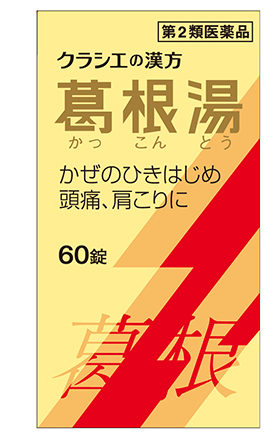
The adult daily dose of 12 tablets contains 2,600 mg of extract, labelled as half formula. Tablets avoid the granule format, but should not be assumed to be tasteless. Do not increase the tablet count to match another product’s extract amount.
EX tablets: film-coated, with the same tablet count
Full Japanese name: 「クラシエ」漢方葛根湯エキスEX錠. Listed pack: 96 tablets.
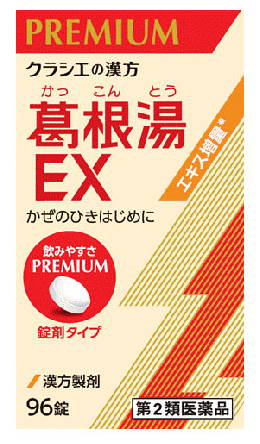
The film coating reduces the herbal smell and taste. Adults still take four tablets three times daily. Those 12 tablets contain 3,467 mg of extract, or two-thirds formula. The coating is a practical distinction if taste bothers you; the EX label does not establish better results or suitability for everyone.
A granules: what “full formula” means
Full Japanese name: 葛根湯エキス顆粒Aクラシエ. Listed pack: 10 sachets, each containing 2.0 g of granules.
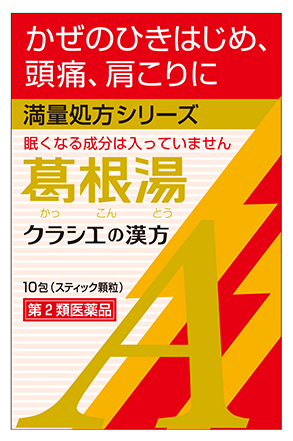
Three adult sachets provide 5,200 mg of extract per day. Kracie explains “満量” as the full extract obtained from the daily crude-herb quantities specified in the Japanese Pharmacopoeia preparation method it describes. It is not a reason to choose A automatically for a worse cold.
S II granules: two doses a day
Full Japanese name: 「クラシエ」漢方葛根湯エキス顆粒SⅡ. Listed pack: 10 sachets, each containing 2.25 g of granules.
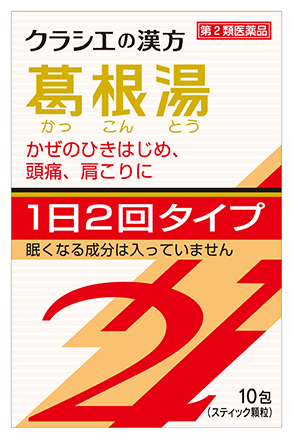
Two adult sachets provide 3,900 mg of extract per day, or three-quarter formula. Fewer daily doses do not mean less daily extract than Standard tablets. Do not change its schedule to three times daily.
Same seven herbs, different daily amounts
All four contain extracts of pueraria root, ephedra herb, jujube, cinnamon bark, peony root, licorice and ginger. The crude-herb quantities and daily extract amounts differ.
For example, the daily ephedra/licorice starting quantities are 2 g/1 g for Standard, 2.67 g/1.33 g for EX, 4 g/2 g for A and 3 g/1.5 g for S II. These are herb quantities used for extraction, not milligrams of ephedrine or glycyrrhizin.
Half formula does not mean half the benefit, and full formula is not automatically the best fit. Do not double Standard tablets or combine Kakkonto products to reach a different formula proportion.
Age-based doses: use the correct product’s instructions
Standard and EX tablets
Both: three times daily, before or between meals.
| Age | Amount per dose |
|---|---|
| 15 and over | 4 tablets |
| 7–14 years | 3 tablets |
| 5–6 years | 2 tablets |
| Under 5 years | Do not use |
A granules
Three times daily, before or between meals.
| Age | Amount per dose |
|---|---|
| 15 and over | 1 sachet |
| 7–14 years | 2/3 sachet |
| 4–6 years | 1/2 sachet |
| Under 4 years | Do not use |
S II granules
Twice daily, before or between meals.
| Age | Amount per dose |
|---|---|
| 15 and over | 1 sachet |
| 7–14 years | 2/3 sachet |
| 4–6 years | 1/2 sachet |
| 2–3 years | 1/3 sachet |
| 3 months to under 2 years | 1/4 sachet; see the under-1 restriction below |
| Under 3 months | Do not use |
S II’s leaflet prioritizes medical assessment for infants under one year and permits use only when unavoidable. Its infant dose is not a recommendation to self-treat a baby. All children need parental supervision; ask a pharmacist if you cannot measure a fractional sachet confidently.
Taking and carrying it correctly
- Kracie defines “before meals” as about 30 minutes before eating and “between meals” as two to three hours after eating. “食間” does not mean during a meal. Take with water or warm water rather than tea, juice or milk.
- Never take two doses together to make up for a missed dose, or increase the dose because it is not helping.
- For partly used A or S II sachets, fold the opening closed for storage and do not use the remainder after two days. Both contain lactose; discuss concerns about inactive ingredients with a pharmacist.
- Keep tablets tightly closed in their original bottle and avoid touching them with wet hands. Store all four away from sunlight, heat, moisture and children. Do not transfer them to another container or use them after expiry.
- Pack size is not a treatment course. Early-cold use has a much earlier reassessment point than “finish the box.”
Avoid overlapping cold medicines and herbal formulas
Ephedra and licorice also occur in other medicines. Combining products can increase adverse effects. Show a pharmacist the full names of any cold remedies, pain/fever medicines, other Kampo products and prescription medicines before adding Kakkonto.
Kracie specifically advises against combining Kakkonto with Shoseiryuto (小青竜湯). If you take blood-pressure medicine, get advice first because ephedra and licorice may affect blood pressure.
For help identifying a different family of combination cold medicines, see the Benza Block Premium DX comparison. It is a separate product guide, not advice to take them together.
When to stop: five or six doses, not days
All four leaflets specify:
- Early cold, head cold or headache: stop and consult a doctor, pharmacist or registered OTC medicine seller if there is no improvement after five or six doses.
- Other labelled uses: stop and consult if there is no improvement after about one month. Seek advice before prolonged continuous use. Do not wait a month if symptoms worsen.
- New rash, redness, itching, nausea, loss of appetite or stomach discomfort: stop immediately and seek advice, taking the leaflet with you.
Stop and obtain immediate medical care for possible serious reactions:
- Increasing limb heaviness, numbness, tightness or stiffness with weakness or muscle pain may indicate pseudoaldosteronism or myopathy.
- Yellow skin or eyes, brown urine, marked tiredness, appetite loss, fever, itching or rash may be signs of liver dysfunction.
- Widespread red skin, blisters on red areas, or persistent or rapidly worsening high fever and sore throat may indicate erythema multiforme. This warning was added in the August 2026 revision.
You do not need every listed symptom to seek help. Do not automatically treat new fever or sore throat as more of the original cold.
Quick questions before buying
Does Kakkonto prevent colds or cure flu?
These products’ cold indication concerns early symptoms under specific conditions. Infection prevention and curing influenza are not labelled indications. Herbal medicines can cause serious adverse effects; suspected flu or another infection needs appropriate assessment.
Can I use these doses for S, FC, the liquid or KIDS?
No. S granules, FC tablets, Kakkonto Liquid II and KIDS have separate names and instructions. Check the exact product. Different pack counts of Standard tablets are not separate formulas either.
What should I check last at the shelf?
Confirm suitability and medicine overlaps, choose the form and schedule, then match the full Japanese name and age-based dose. The useful choice is one you can take correctly.
Sources
- Kracie: Standard tablets and Japanese leaflet
- Kracie: EX tablets and Japanese leaflet
- Kracie: A granules and Japanese leaflet
- Kracie: S II granules and Japanese leaflet
- Kracie: 25 August 2026 safety revision, Kampo cold-medicine FAQ and medicine-combination FAQ
- NHS: Common cold and when to seek medical help
This guide supports product selection and correct use; it does not replace individual medical advice. Read the full leaflet supplied with your product before taking it.