A skirt is clinging to your legs and you want a quick fix. First decide whether you should spray it at all. This guide helps you check the outer fabric and lining, understand when physical fabric catching makes this spray ineffective, and use Japanese Eleguard on suitable fabric from about 20 cm away. It is a clothing-care spray, not a skin or hair product.

I’m Irene, a Taiwan-born pharmacist qualified in Japan. This guide follows official Japanese product information, not a hands-on performance test.
Which materials should you rule out first?
Check the garment before testing the spray
Stop: excluded materials
Silk, rayon, Tencel and other water-sensitive materials; leather, fur; kimono and other Japanese-style garments.
Also exclude anything that can be neither washed nor dry-cleaned.
Do not spray. A hidden-area test cannot make these suitable.
Other fabrics: confirm both layers
Check the outer fabric, the lining you intend to spray, and the care label.
Material or care requirements unknown? Pause and confirm suitability before spraying.
Only for an otherwise suitable garment: test an inconspicuous area for staining or colour change before wider use. If the test leaves a mark or colour change, do not continue.
Where not to spray
- Not on skin or hair. This is a clothing-care product.
- Not on plastic items or a shredder. Spraying a door directly does not solve the problem either.
- Not in a clothes dryer, or onto electrical appliances, furniture surfaces or floors. Wipe off accidental deposits promptly.
The official directions also cover suitable fabric curtains, upholstery and car seats. That does not permit spraying leather upholstery or the surrounding hard surfaces. Ventilate when using it inside a car.
Still clinging? More spray is not always the answer
Lion explains that insufficient application can reduce effectiveness for some fabric combinations. But when the cause is materials physically catching on each other rather than static electricity, Eleguard will not help. Check the cause and the labelled directions instead of repeatedly soaking the same area. This product is not a repair for a snagging lining.
Spray the fabric, from about 20 cm away
Before spraying, read all three points and the aerosol precautions below. Complete the fabric and hidden-area checks first.
About 20 cm: can to fabric
Spray evenly on the parts that rub together, including the relevant inner fabric surfaces. The shaded fold above means fabric, not skin. Do not spray close to one spot or concentrate the spray there.
Wearing the garment? Only you spray it
Never ask someone else to spray clothing on you, or spray clothing another person is wearing. Lion warns of occasional static sparks that can scorch the fabric. Do not spray skin or hair.
Keep spray and wet fabric away from fire
Avoid inhaling the spray. Do not use near flames or other ignition sources. Keep sprayed fabric away from them until dry. Read the aerosol precautions below before use.
The flammable aerosol warning matters
Lion lists LPG and dimethyl ether as this product’s propellants. The following fire precautions also draw on the Aerosol Industry Association of Japan’s general aerosol safety guidance: do not use near flames or fire, or use large amounts in a room where a flame is in use. Keep the can away from direct sunlight, heaters and locations that can reach 40°C or higher, including a hot car. Never throw the can into a fire, even if you think it is empty. Keep it out of reach of infants and others who may use it unintentionally, including people with dementia.
Use up the contents before disposal. Any release of remaining gas must be outdoors in a well-ventilated place away from fire, without inhaling the gas; follow the product’s directions and local disposal rules. The 160 ml can’s gas-release cap is not fitted to the 75 ml version; do not assume their disposal mechanisms are the same.
Identify the Japanese product before buying
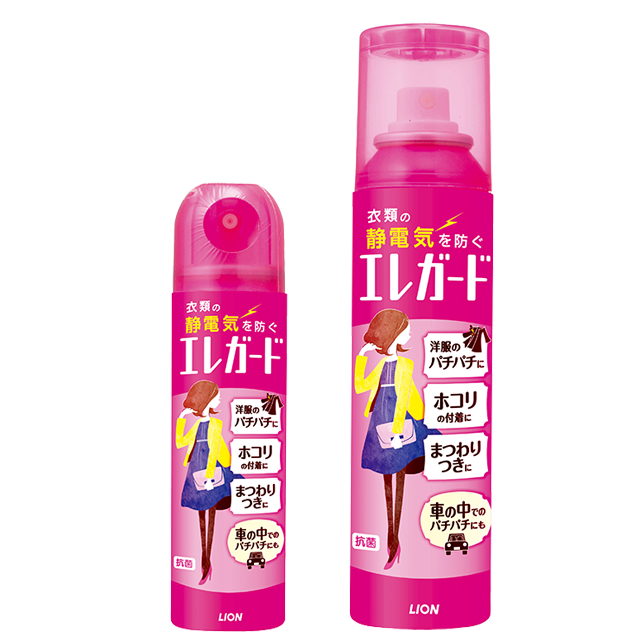
- Small: 75 ml, JAN 4903301370260.
- Large: 160 ml, JAN 4903301370277.
The size choice is about volume, not a claim that the larger can is stronger. It is lightly fragranced, not fragrance-free. Japanese drugstore listings confirm availability online, not stock at every branch. If your garment is excluded, buying a smaller can does not make it suitable.
Sources and scope
Research checked 27 October 2026; fabric, application and fire guidance rechecked 28 October 2026. Product-specific directions come from Lion; general aerosol fire precautions are identified separately above. We have not verified the complete back label of the latest physical Japanese pack. Read all directions and warnings on the can you buy; this guide is not a complete label translation.
- Lion: product, directions and cautions
- Eleguard FAQ: excluded materials and uses
- Lion FAQ: why fabric may still cling
- Lion: size-specific disposal directions
- Lion: general storage precautions for aerosols
- Lion: inner-fabric application and wearer-only spraying
- Aerosol Industry Association of Japan: general aerosol safety guidance, not this product’s complete back label
Cover product photograph: Lion Corporation. Image rights remain with Lion; this is not Irene’s photograph. Match the product name and capacity, not the apparent can size alone.