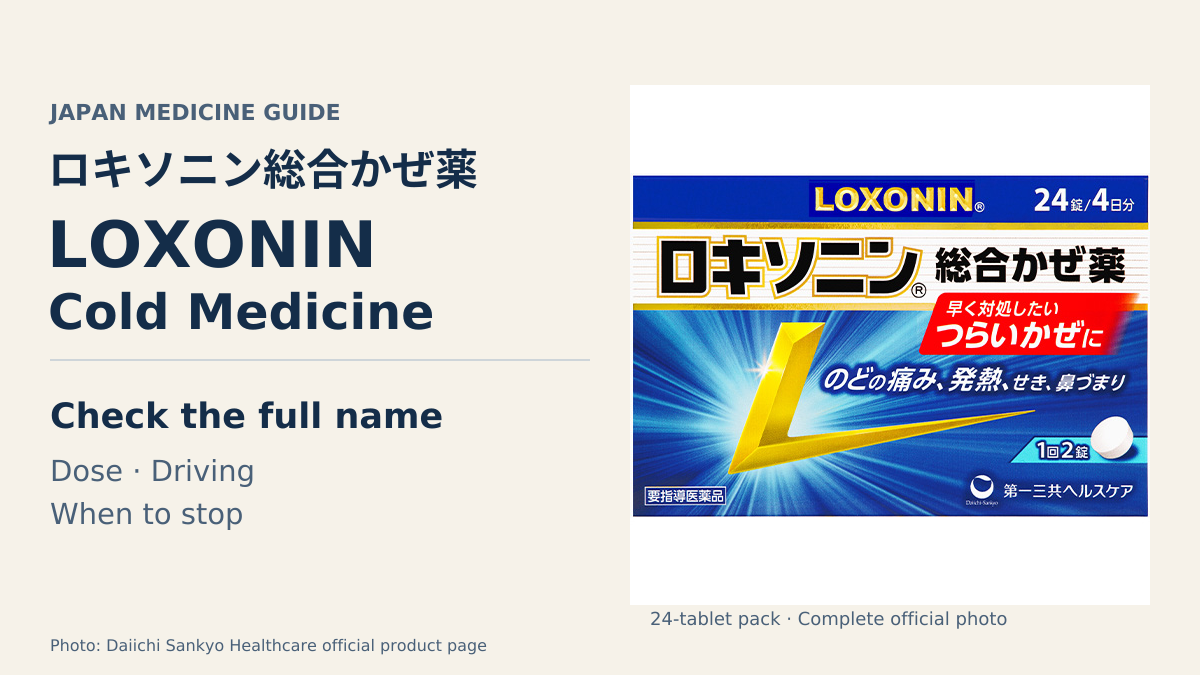
A shopping note says “LOXONIN cold tablets”, but the Japanese shelf has both ロキソニンS and ロキソニン総合かぜ薬. Match the full name before reading the dose. This guide covers the second product, Daiichi Sankyo Healthcare’s LOXONIN Common cold medicine. It has five active ingredients; the plain-S “one tablet” instruction does not apply.
- Look for 総合かぜ薬 in the full name. This is the combination cold medicine, separate from the pain/fever medicine ロキソニンS.
- Check suitability before the two-tablet instruction. Ages 15+: two tablets per dose, three times daily, preferably within 30 minutes after meals, with water or warm water. Do not use under 15.
- Do not drive or operate machinery after taking it. Do not combine it with prohibited medicines, including other cold or pain/fever medicines. Do not keep taking it just to finish the box.
Seek immediate medical care for breathing difficulty, vomiting blood, black tarry stools, severe abdominal pain or a severe allergic reaction. If symptoms worsen or serious problems develop, do not wait for the “5–6 doses” or “5 days” thresholds below.
Japanese-market information checked: 11 November 2026. This guide follows the May 2026 Japanese leaflet. It helps explain the label and does not replace individual medical assessment or a pharmacist’s checks.
Read 総合かぜ薬, not just LOXONIN or the box colour
The full Japanese name is ロキソニン総合かぜ薬. The manufacturer’s English leaflet calls it LOXONIN Common cold medicine. Use the complete Japanese name when identifying the product in a shop.
Its Japanese indication is relief of common-cold symptoms: runny or blocked nose, sneezing, sore throat, cough, phlegm, chills, fever, headache, joint pain and muscle pain. This is symptom relief, not prevention of colds or suppression of the virus.
- ロキソニン総合かぜ薬
- The combination cold medicine covered here. Five active ingredients; classified as 要指導医薬品, a medicine requiring a pharmacist’s explanation before purchase.
- ロキソニンS
- A separate pain/fever medicine with one active ingredient, loxoprofen sodium hydrate. It is Class 1. For the wider range, see the six-type oral LOXONIN pain-medicine guide.
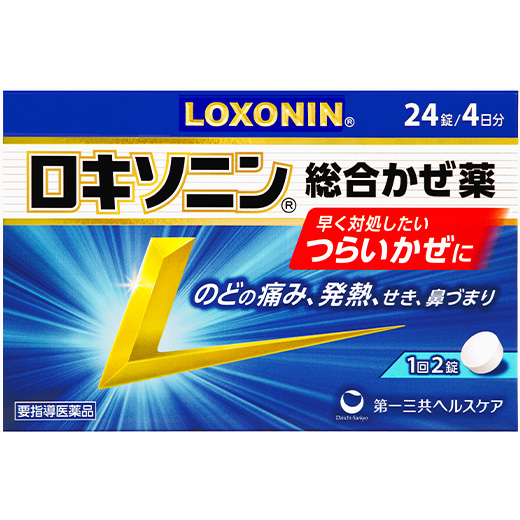
The manufacturer also lists a 12-tablet pack of this cold medicine. “12 tablets” alone therefore cannot distinguish it from plain S. Use the full name, medicine category and ingredients; count and colour are only supporting clues.
The manufacturer’s product-specific influenza FAQ adds: seek medical care as soon as possible if you suspect influenza; do not take this product if a medical institution has diagnosed influenza. This is a manufacturer FAQ supplement, shown separately from the leaflet’s do-not-use list below. Do not treat this as a “cold and flu” medicine.
The ingredient table uses six tablets, not one dose
The official ingredient amounts are per six tablets, the labelled daily amount for ages 15+. The list below keeps that same basis. Do not compare it directly with a plain-S table stated per one tablet.
- Loxoprofen sodium hydrate
- 204.3 mg (equivalent to 180 mg anhydrous)
Pain/fever relief. - Dihydrocodeine phosphate
- 24 mg
Suppresses coughing. - dl-Methylephedrine hydrochloride
- 60 mg
Widens the airways to ease coughing. - Bromhexine hydrochloride
- 12 mg
Helps bring up phlegm. - Clemastine fumarate
クレマスチンフマル酸塩 - 1.34 mg
An antihistamine for cold symptoms such as a runny or blocked nose.
One dose is two tablets, as explained below, not all six tablets in this ingredient table. More active ingredients do not establish that a product is stronger or more suitable for you. Check the full leaflet’s additives too if you have an allergy history.
Do not transfer plain S’s “no sedative/hypnotic ingredient” description to this cold medicine. Do not drive vehicles or operate machinery after taking this product, rather than waiting to see whether you feel sleepy. Plain S can itself cause adverse effects including drowsiness or dizziness; a product feature is not a guarantee of safety.
Two tablets per dose, six per day, 24 in the box
- Ages 15+: two tablets per dose, three times daily.
- Timing: preferably within 30 minutes after meals, with water or warm water.
- Under 15: do not use. Do not invent a smaller child’s dose.
- Removing a tablet: push it out of the PTP blister and swallow only the tablet. Swallowing the packaging can injure the oesophagus.
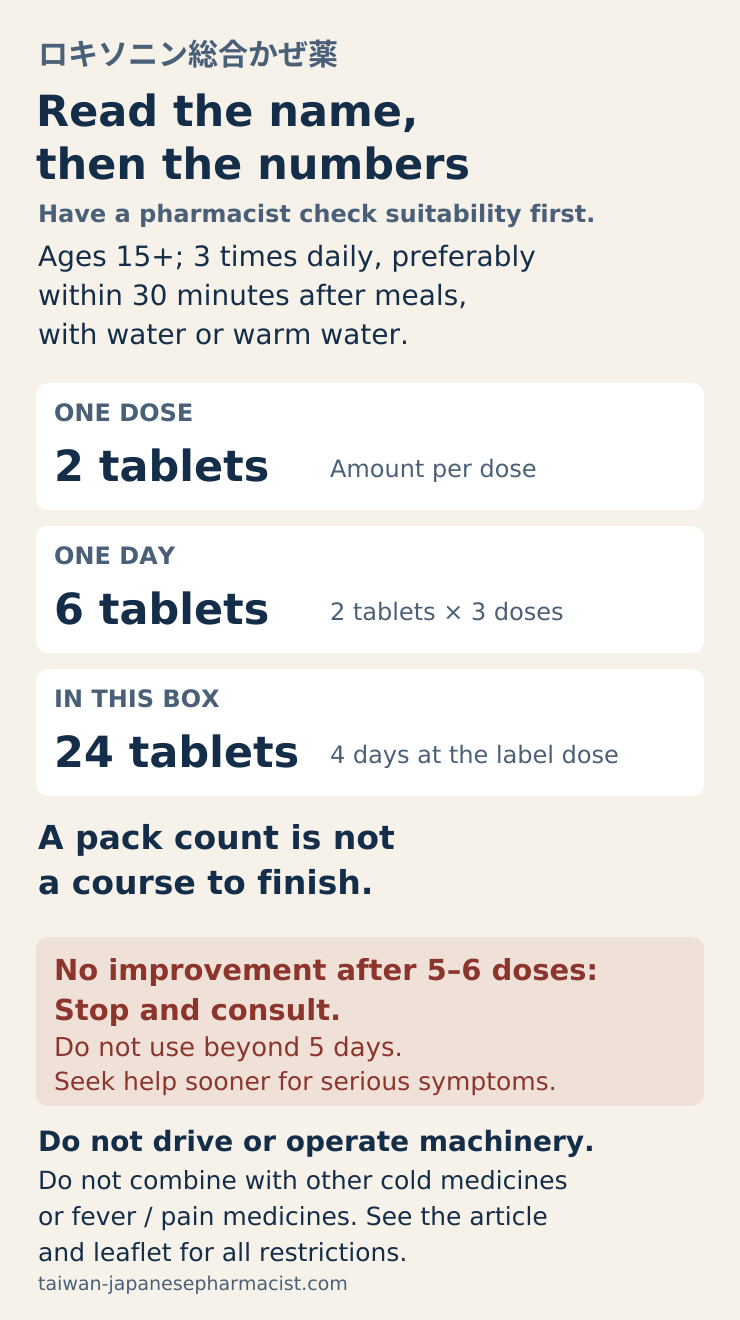
“4日分” describes the pack quantity: 24 tablets divided into two tablets three times daily gives a four-day supply. It does not mean “take it for at least four days”, “finish every tablet”, or “wait until the box is empty to assess improvement”.
Follow the instructions for the product in your hand. Do not copy plain S’s frequency, interval or tablet count. If you are unsure what you have already taken, want to switch medicines or are considering another product, show a pharmacist the packs and dose times. Do not work out a switching schedule yourself.
Check who must not use it and what cannot be combined
The leaflet’s do-not-use groups
- Anyone who has had an allergic reaction to this product or an ingredient.
- Anyone who has developed asthma after taking this product, another cold medicine or a pain/fever medicine.
- Children under 15.
- Anyone receiving medical treatment for stomach or duodenal ulcers, liver disease, kidney disease or heart disease.
- Anyone told by a doctor that they have a blood abnormality, such as reduced red cells, platelets or white cells.
- Anyone within 12 weeks of their expected delivery date.
Breastfeeding: the leaflet says not to take this product, or to avoid breastfeeding if taking it. Discuss an appropriate plan with a healthcare professional; do not interpret this as permission to continue breastfeeding as usual while using it.
Do not use these medicines while taking it
- Other cold medicines or pain/fever medicines, including plain ロキソニンS and other oral LOXONIN pain medicines.
- Sedatives or cough/expectorant medicines.
- Oral medicines containing antihistamines, such as oral rhinitis, motion-sickness or allergy medicines.
Do not drink alcohol before or after taking it; do not drive vehicles or operate machinery after use; do not exceed the dose; do not use for more than five days. A different brand, package or lack of a fever-relieving ingredient does not establish that medicines can be combined. Do not stop a prescribed medicine on your own to make room for this product; ask a pharmacist to check first.
Consult a doctor or pharmacist before use if any of these apply
- You are receiving medical or dental treatment; are pregnant or might be pregnant; are an older adult; or have had allergic reactions to medicines or other substances.
- You have high fever or difficulty urinating.
- You have been diagnosed with thyroid dysfunction, diabetes, heart disease, high blood pressure, glaucoma or bronchial asthma.
- You have been diagnosed with ulcerative colitis, Crohn’s disease, systemic lupus erythematosus or mixed connective tissue disease.
- You have been diagnosed with impaired respiratory function, obstructive sleep apnoea or obesity.
- You have a history of stomach or duodenal ulcers, liver disease, kidney disease or blood disease.
A consultation item does not cancel a do-not-use rule. For example, receiving treatment for heart disease belongs in the prohibited group, even though heart disease also appears in the consultation list. The manufacturer’s prodrug-design description does not mean “stomach-safe” or remove ulcer-related restrictions.
5–6 doses and 5 days are different limits
No improvement after 5–6 doses
Stop and consult a doctor or pharmacist, taking the leaflet with you. Pay particular attention to fever lasting three days or more, or fever that returns. “Doses” here means separate administrations, not days.
Do not use beyond 5 days
This is the maximum duration, not a course you must finish or a reason to wait until day five before seeking help. The manufacturer’s FAQ notes that prolonged use can increase the risk of adverse effects.
Possible adverse effects: do not wait for a dose count
Stop immediately and consult a doctor or pharmacist with the leaflet if you develop a rash, redness or itching; abdominal pain, stomach discomfort, loss of appetite, nausea/vomiting, bloating, heartburn, mouth ulcers or indigestion; raised blood pressure or palpitations; numbness, dizziness, headache, excitement or convulsions; difficulty urinating or blood in the urine; chest pain, fatigue, facial flushing, fever or anaemia. An excessive fall in body temperature, collapse, cold hands/feet, a peptic ulcer or swelling also require stopping and seeking advice.
Stop and consult if dry mouth, constipation, diarrhoea or drowsiness persists or becomes worse.
- Breathing difficulty, wheezing, confusion, or rapidly developing hives and a hoarse voice suggesting a severe allergic reaction.
- Vomiting blood, black tarry or bloody stools, severe abdominal pain, or marked bloating with vomiting.
- Sudden crushing chest pain and cold sweats, or sudden one-sided weakness, speech difficulty or altered consciousness.
- Persistent or rapidly worsening high fever with red eyes, sore lips, widespread rash or blisters.
- Reduced urine or widespread swelling; yellow skin/eyes; unusual bleeding or bruising; marked muscle pain/weakness with reddish-brown urine; severe headache with neck stiffness; or new/persistent breathlessness, dry cough and fever.
The leaflet also describes blood disorders, severe skin reactions, kidney injury, heart/cerebrovascular problems, interstitial pneumonia, liver dysfunction, rhabdomyolysis, aseptic meningitis, asthma and respiratory depression. This is not a complete diagnostic checklist; serious illness needs prompt medical assessment.
The user needs pharmacist guidance before purchase
This product is currently 要指導医薬品, rather than plain S’s Class 1 category. Generally, the person who will use it must buy it and receive a pharmacist’s explanation before purchase. Since May 2026, eligible medicines in this category may also be sold online after pharmacist-assessed live audiovisual counselling and the required checks. A separate “specified guidance-required” category has additional restrictions. This product is not marked in that specified category on the current official list, but that does not mean ordinary click-to-buy checkout or guarantee that every retailer offers an online service.
Its dihydrocodeine phosphate and dl-methylephedrine hydrochloride also place it within the 指定濫用防止医薬品 misuse-prevention checks. That designation is separate from its guidance-required category and its minimum age for use of 15. Although ages 15–17 meet this product’s age threshold for use, purchasers under 18 also have their name checked and cannot buy large or multiple packs of this medicine. Accurately explain your age, current medicines and relevant medicines already bought elsewhere. The Japanese-pharmacy communication guide helps you prepare. Do not assume every LOXONIN product has the same purchase requirements.
For travel, retain the outer box, leaflet and PTP blister, and check the expiry date. Store in a cool, dry place away from direct sunlight and children. Do not transfer to another container or use after expiry. Do not cut a blister into single-pocket pieces; see the PTP travel-packing guide for that separate handling precaution.
Check your plans once more: driving, cycling or operating machinery after taking this product conflicts with its no-driving instruction. Tell the pharmacist your actual plans and what you have already taken, rather than relying on “which is stronger?”
Official references and image credit
Checked on 11 November 2026. The current Japanese manufacturer and PMDA leaflets are May 2026, revision 04; the English product name was checked in the manufacturer’s same-revision English information. No media recommendation, sales ranking or claimed personal trial is used as evidence of effectiveness.
- Daiichi Sankyo Healthcare: ロキソニン総合かぜ薬, 12/24-tablet packs and JAN codes
- Manufacturer: current Japanese leaflet (May 2026 PDF) / information for users (PDF)
- PMDA: product leaflet record / current revision 04 PDF
- Manufacturer: English product information (May 2026, revision 04)
- Manufacturer: plain ロキソニンS, for identifying the separate formula
- Manufacturer FAQ: suspected or diagnosed influenza
- Manufacturer FAQ: why use must not exceed five days
- Manufacturer: buying OTC medicines / categories and online counselling
- MHLW: guidance-required medicine list (updated 22 October 2026)
- MHLW: misuse-prevention ingredients and exclusions / sales checks
Product photo and original diagram
The complete 24-tablet pack photograph is from Daiichi Sankyo Healthcare’s official product image. It supports identification of the name and label without redrawing the packaging. Image and related rights belong to their respective owners. Attribution does not establish individual reuse permission; see the manufacturer’s website terms. The label-reading diagram is Irene’s original explanation, not a manufacturer graphic.