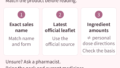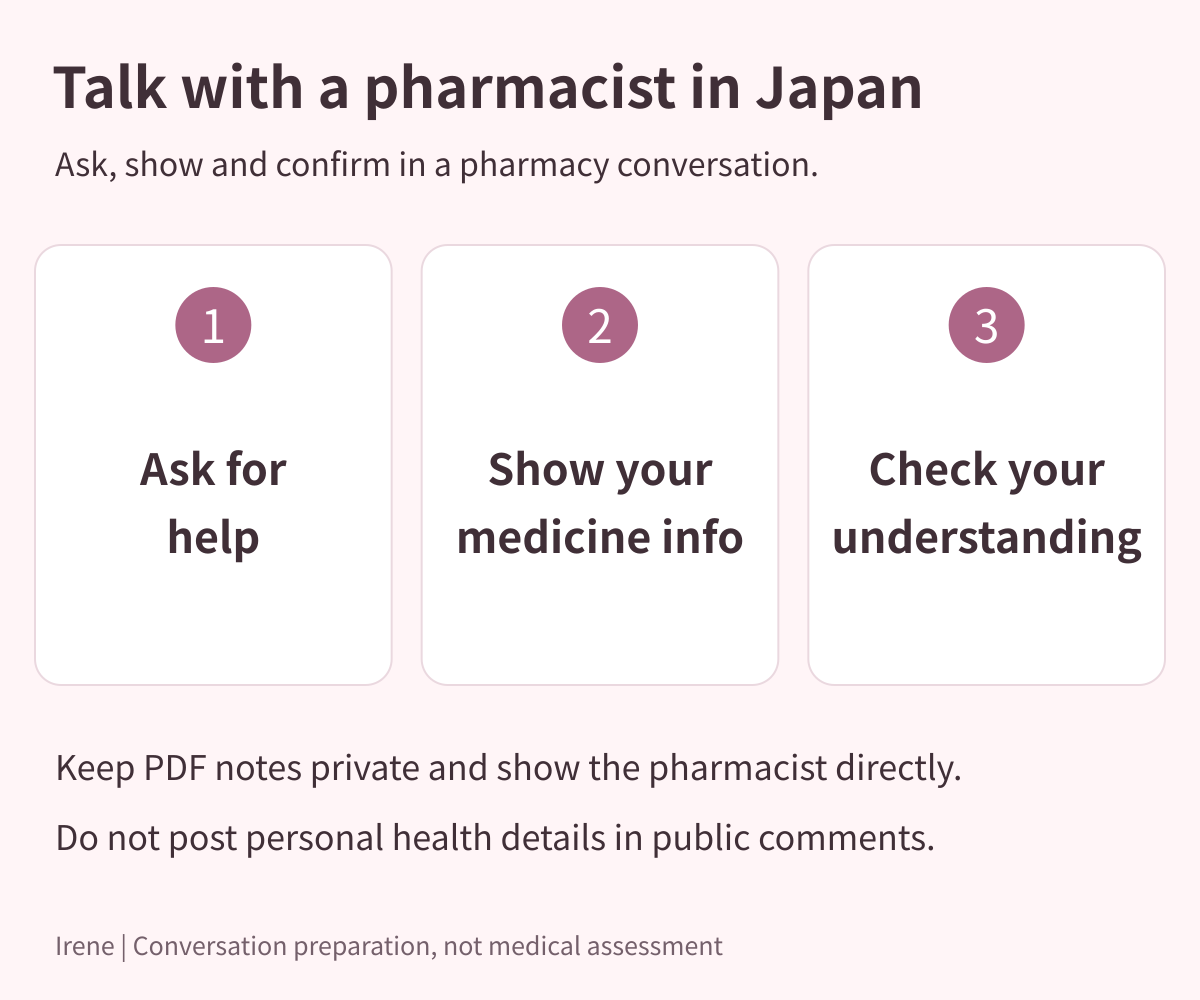
At a Japanese pharmacy, finding a product is only part of the conversation. You may also need to show what you already take, explain an uncertain answer, or ask the pharmacist to repeat instructions. This guide gives you Japanese text to point to: ask for help, show actual information, say what is unclear, then check the instructions you receive. You do not need to memorize the phrases or fill every blank.
This is a communication aid, not a diagnosis, prescription, complete medical questionnaire or clearance to use a medicine. The pharmacist may recommend medical care rather than a purchase. Do not delay urgent care to complete a card or visit a pharmacy first. If you need an ambulance in Japan, call 119. FDMA ambulance guide
- 1 Ask for helpA pharmacist and language support
- 2 Show informationActual packs, labels and medicine records
- 3 Say what is unclearUnknown answers and explanations
- 4 Check the responseWritten instructions and understanding
- Ask for a pharmacist and the language you need
- Show the actual medicine information rather than guessing a translation
- Separate an unknown answer from a past reaction or an unclear explanation
- Ask for written instructions and check them before leaving
- Use a blank prompt sheet privately with the pharmacist
Ask for a pharmacist and the language you need
Point to the appropriate sentence. Whether you can have the consultation in English or Chinese depends on the assistance available at that pharmacy at the time.
薬剤師の方に相談したいです。
I would like to speak with a pharmacist.
英語で相談できますか。
Can I have the consultation in English?
中国語で相談できますか。
Can I have the consultation in Chinese?
The Japanese term 中国語 means Chinese; it does not specifically mean Taiwanese Hokkien. If an explanation continues in Japanese, say that you do not understand it well and ask what language help is available. Slower speech alone may not resolve a language barrier.
日本語の説明がよく分かりません。ゆっくり説明してもらえますか。
I do not understand the Japanese explanation well. Could you explain slowly?
Osaka Prefecture’s pharmacy communication resource page lists English, Traditional Chinese and other resources for pharmacy health consultations, medicine explanations and recommendations to seek medical care. It does not establish that every pharmacy has multilingual staff. The phrases here are our own communication wording, not official translations from that manual.
Show the actual medicine information rather than guessing a translation
今使っている薬などの情報を見てください。
Please look at the information about the medicines and other products I currently use.
Prepare the medicine record you already have and, where practical, bring the boxes, containers and labels. If you cannot bring them, show clear, complete photos directly to the pharmacist. Include prescription and non-prescription medicines, traditional medicines or Kampo, and supplements. Add the amounts and times actually used when you know them; do not invent details to complete a list.
Do not identify a medicine solely by a tablet’s colour or shape, or assume that a similar brand name means an equivalent product. Photos may help the conversation, but cannot guarantee identification or provide every detail the pharmacist needs. The Japanese Pharmaceutical Association explains that a medication notebook records medicine names, use and allergy or adverse-reaction history and can be shown to a clinician or pharmacist. This guide does not require a new app or a photo upload.
Prepare relevant information you actually know
These optional blank labels are for your own paper, not a required online form. An empty space means information has not been supplied; it does not mean “none,” “normal” or “not applicable.” The pharmacist may ask additional questions.
- 相談したい症状・困っていること:__
- Symptoms or concerns to discuss. Describe what you experience rather than a guessed diagnosis.
- 始まった日時・その後の変化:__
- When it began and how it has changed. Separate the year, month and day rather than using an ambiguous numeric date.
- 薬を使う人の年齢:__歳
- Age of the person using the medicine, in years. This preparation sheet does not need a date of birth, passport number or contact information.
- 現在使っている薬・サプリメントなど:__
- Current medicines, supplements and other products. You can show existing records and packaging instead.
- アレルギー・以前に薬などを使った後に出た症状:__
- Known allergies and symptoms experienced after using medicines or other products. Distinguish confirmed information from a suspected connection.
- 病気や治療について伝えたいこと:__
- Conditions or treatment information to share directly with the pharmacist.
- 妊娠・妊娠の可能性・授乳について:__
- Relevant information about pregnancy, possible pregnancy or breastfeeding, shared privately with the pharmacist.
- 車の運転・機械の操作の予定:__
- Plans to drive or operate machinery. Ask the pharmacist to check restrictions for the exact medicine.
JPA’s consultation guidance covers symptoms, current medicines and relevant health circumstances. These original labels help communicate that information; they are not a complete risk screen. If a driving restriction is unclear, check the actual pack and leaflet and ask a professional. Do not independently stop or adjust prescribed treatment. PMDA’s medicine and driving FAQ
Separate an unknown answer from a past reaction or an unclear explanation
When you know when a symptom started, use this sentence and fill only what you know:
この症状は__からです。
This symptom started ____.
If you really did experience symptoms after using a medicine or another product in the past, you can tell the pharmacist with this phrase. It describes the sequence of events; it does not establish a proven cause or a diagnosed allergy.
以前、__を使った後に、__という症状が出ました。
Previously, after I used ____, I developed ____.
If you do not know a product name, time or answer to a question, point to that particular item and say:
それは分かりません。確認が必要です。
I do not know that. It needs to be checked.
Do not replace “I don’t know” with “no.” There is no need to say you understand just because asking again feels awkward. To request another explanation:
もう一度説明してもらえますか。
Could you explain that again?
Ask for written instructions and check them before leaving
使い方と注意点を紙に書いてもらえますか。
Could you write down how to use it and the precautions?
Ask about the exact medicine being discussed. If written Japanese is still unclear, say that you need language help. Receiving a sheet does not itself establish understanding.
私の理解が合っているか、確認してください。
Please check whether I have understood correctly.
Repeat the instructions you have just received in your own words, or point through them for the pharmacist to check: how to use the medicine, the amount and frequency, timing or intervals, restrictions, medicines or activities to avoid, and what to do if symptoms do not improve. The pharmacist should explain which details apply to the actual product. This article supplies no numbers to use as a personal dose.
この薬について、使用をやめる場合と、受診が必要な場合を教えてください。
For this medicine, please explain when to stop using it and when medical care is needed.
This asks about the medicine under discussion; it is not permission to stop another prescribed medicine yourself. Do not wait for a later pharmacy visit in an emergency. JPA’s information for medicine purchasers describes written explanations and checking understanding. This guide does not extend that page into a legal claim about every shop or every medicine.
Use a blank prompt sheet privately with the pharmacist
Save the phrases you need for offline viewing, or print them with blank note space on your own paper. Such a prompt sheet is not a full medical questionnaire, consent form or permission to use a medicine. Point only to phrases that reflect your situation. Use the past-reaction sentence only if that event actually happened.
Share health information directly with the pharmacist. Do not post a completed sheet, prescription or medicine-label photos in this site’s comments or send them to the site. The PDF prompt sheet is a static file with no function to send completed notes to this site or a translation service. Fill it in privately, keep it yourself and show it directly to the pharmacist.
If an important point still cannot be communicated, tell the pharmacist what remains unclear and ask what assistance or next step is available. A filled-in card is not a completed consultation.