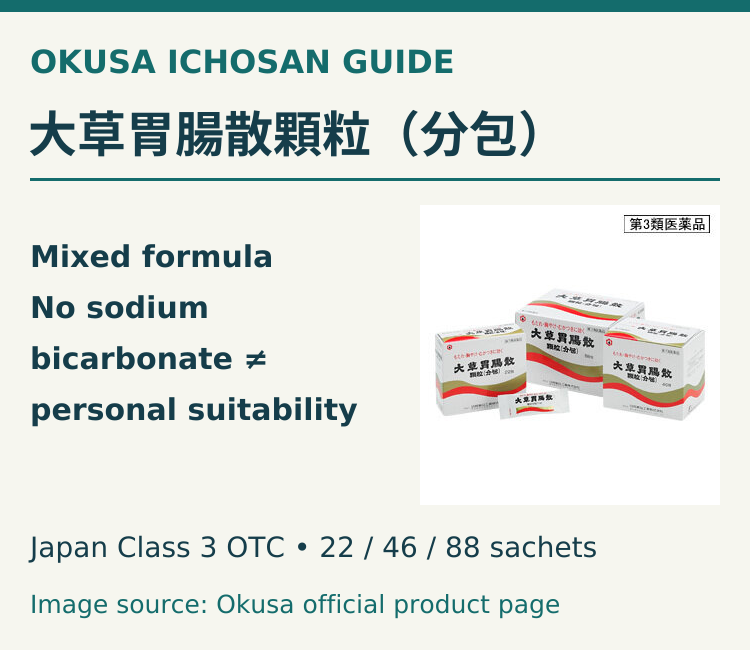
Okusa Ichosan granule sachets, 大草胃腸散顆粒(分包), combine crude-drug powders, bovine-bile extract and antacid ingredients. The whole formula is neither plant-only nor entirely unextracted powder. The manufacturer’s statement that it contains no sodium bicarbonate also does not establish zero sodium, suitability for high blood pressure or kidney disease, or safety for prolonged self-treatment.
Sources checked: November 12, 2026, Japan time. This is a checking date, not a product or leaflet revision date. This guide explains the label; it does not replace individual medical advice.
When to get medical help first
Get emergency help for sudden severe or persistent severe abdominal pain, vomiting blood or coffee-ground-like material, substantial bleeding or black sticky stools, severe breathing difficulty, collapse or abnormal responsiveness. In Japan, call 119 for a suspected emergency. Sudden chest pressure, pain or burning that does not go away, especially spreading to an arm, jaw or back, or accompanied by sweating, breathlessness, nausea or light-headedness, must not be dismissed as heartburn. Do not wait for stomach medicine to work.
Seek prompt medical assessment for pain that suddenly worsens, ongoing or recurring stomach symptoms, repeated vomiting that prevents keeping fluids down, or dehydration concerns. Do not wait for the label’s “about two weeks” point. In children, severe abdominal pain, vomiting that will not stop, or severe diarrhoea/vomiting with inability to drink and reduced alertness needs urgent attention. These examples are not exhaustive; their absence does not establish that this medicine is suitable.
These are general MHLW and NHS care warnings, not the product’s printed adverse-effect list. Sources 8–11
Identify 大草胃腸散顆粒(分包)
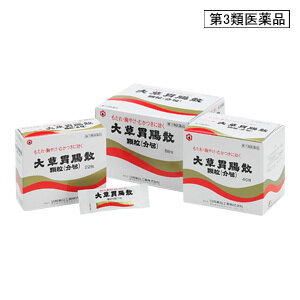
This guide covers the Japanese Class 3 OTC medicine 大草胃腸散顆粒(分包), Okusa Ichosan granule sachets. The manufacturer/marketing-authorization holder is 大草薬品株式会社 (Okusa); the seller is 日邦薬品工業株式会社 (Nippo). Do not transfer these directions to the separate loose-powder product 大草胃腸散 or another formulation.
The Japanese indications cover stomach heaviness/fullness, stomach or abdominal bloating and discomfort; poor appetite, excessive drinking or eating, belching and indigestion; stomach pain, excess stomach acid, heartburn, “胸つかえ” (a blocked sensation in the chest) and “胃弱” (weak stomach); and nausea, including after drinking or a hangover, and vomiting. These label terms do not diagnose the cause. Chest discomfort and significant vomiting need the care warnings above, not an assumption of simple indigestion.
A mixed formula, including bovine-bile extract
The label lists 11 active ingredients, including 牛胆汁エキス末, bovine-bile extract powder, alongside crude-drug powders and mineral antacids. It describes the extract as helping fat digestion and identifies oyster-shell powder, precipitated calcium carbonate and magnesium silicate as acid-neutralizing ingredients. These are labelled roles, not a guarantee of benefit for an individual.
The NIHS Japanese Pharmacopoeia name database identifies “ボレイ / 牡蛎” as Oyster Shell. This and the bovine-bile extract establish that the formula is not plant-only. The extract also rules out describing the whole formula as unextracted crude-drug powder. Animal origin alone does not establish food-allergen content or justify a new allergy prohibition or reassurance.
Every amount below is in the labelled adult DAILY amount of 3 sachets (4.5 g), not one sachet or one dose. Japanese ingredient names are retained for direct comparison with the leaflet.
| Japanese label name | Amount per 3 sachets |
|---|---|
| オウバク末(黄柏末) | 800 mg |
| オウレン末(黄連末) | 100 mg |
| ケイヒ末(桂皮末) | 240 mg |
| チョウジ末(丁子末) | 50 mg |
| ショウキョウ末(生姜末) | 100 mg |
| ウイキョウ末(茴香末) | 100 mg |
| キジツ末(枳実末) | 300 mg |
| ボレイ末(牡蛎末) | 700 mg |
| 牛胆汁エキス末 | 125 mg |
| 沈降炭酸カルシウム | 995 mg |
| ケイ酸マグネシウム | 400 mg |
The four listed additives are: l-メントール、バレイショデンプン、カルメロースCa、ポビドン. PMDA spells the third as カルメロースカルシウム (CMC-Ca); it is the same additive.
No sodium bicarbonate is a limited statement
The official product page says sodium bicarbonate, also called 重曹, is not included. That identifies an ingredient not added. The checked sources do not provide an analytical sodium measurement for the finished product, so they do not establish that it is sodium-free.
High blood pressure, salt restriction, kidney impairment and compatibility with other medicines require individual assessment. Absence of sodium bicarbonate does not support prolonged self-treatment as routine stomach maintenance. Okusa’s kidney FAQ explains that some magnesium and calcium from the antacid ingredients can be absorbed and that impaired kidney function can delay elimination and disturb the body’s salt balance. Anyone receiving treatment for kidney disease already falls under the leaflet’s consult-before-use rule. Do not read the FAQ as evidence that short-term self-use is safe.
Before use: printed rules and general advice
The leaflet specifically requires consultation before use with a doctor, pharmacist or registered medicine seller if you are receiving medical treatment or have been diagnosed with thyroid dysfunction.
Separately, as general medicine-selection advice: discuss pregnancy, breastfeeding, ingredient-avoidance needs and other medicines with a clinician or pharmacist, bringing the exact pack and a complete medicine list. Dietary or allergy concerns need product-specific advice rather than assumptions from words such as “plant-based” or “natural.”
The manufacturer’s pregnancy/breastfeeding FAQ says the product lacks ロートエキス and can be taken during pregnancy or breastfeeding. This does not establish safety for every individual or override the medical-treatment consultation rule. Its discussion of breastfeeding interruption concerns other medicines containing that extract; it is not an instruction to stop breastfeeding for this product. Class 3 status also does not mean unrestricted or risk-free use.
Label directions: after meals, three times daily
Take the age-specific amount below after meals with water or warm water, three times daily. The box count, the adult daily ingredient basis and the amount per dose are different pieces of information.
| Age | Amount per dose |
|---|---|
| 15 years and over | 1 sachet |
| 11–14 years | 2/3 sachet |
| 8–10 years | 1/2 sachet |
| 5–7 years | 1/3 sachet |
| 3–4 years | 1/4 sachet |
| Under 3 years | Do not take |
Children must take it under a parent or guardian’s guidance and supervision. If you cannot reliably obtain the stated child portion, ask a pharmacist for advice. The leaflet provides no teaspoon, equal-pile or water-dissolution measuring method; none is supplied here.
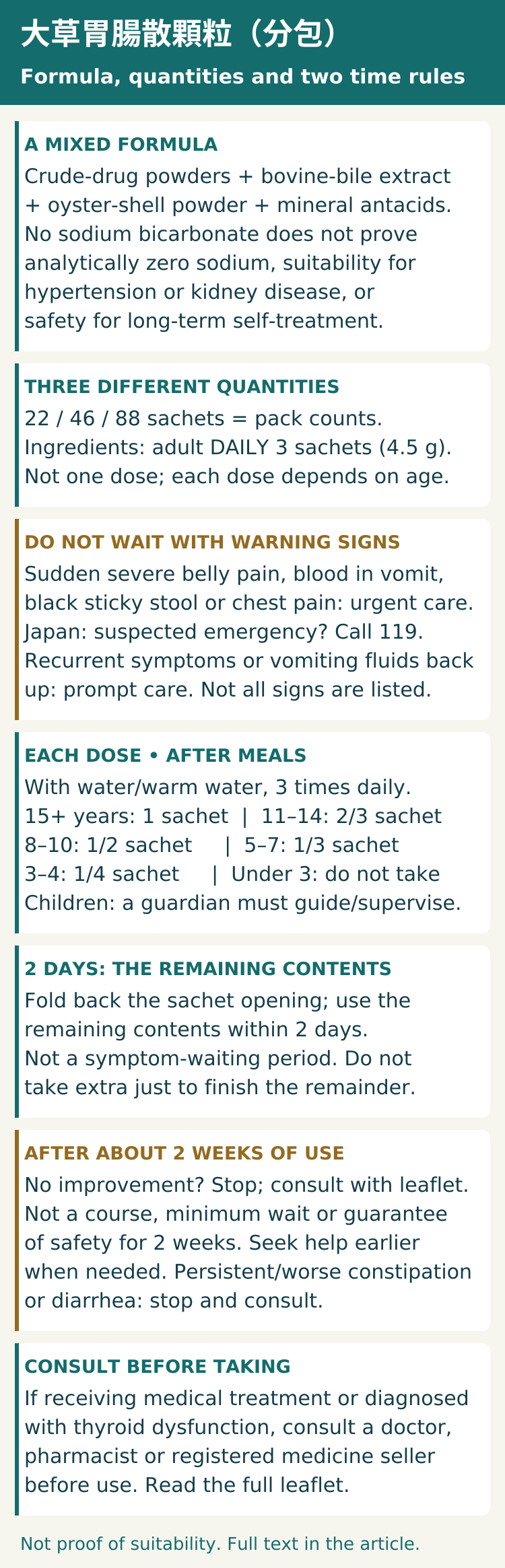
Two days for a remainder; about two weeks for non-improvement
- Constipation or diarrhoea that persists or worsens after taking it: stop and consult a doctor, pharmacist or registered medicine seller, bringing the leaflet.
- No improvement after about two weeks of use: stop and consult with the leaflet. This is not a prescribed course, a minimum trial or a two-week safety guarantee. Worsening, recurring symptoms and urgent warning signs require earlier attention.
- A remainder after dividing a sachet: fold back the opening for storage and use the remainder within two days. This is a handling rule, not a symptom-waiting period. Do not take extra medicine to finish it.
Store in a cool, low-humidity place away from direct sunlight and out of children’s reach. Do not transfer to another container. This guide does not invent an opened-box storage period or turn a box count into a treatment course.
Official references and scope
Product identity, ingredients, directions, consultation and storage rules come from Okusa and PMDA. Oyster-shell naming comes from NIHS; general care warnings come from MHLW and NHS. The photograph comes from the Okusa product page below. Sources were checked on November 12, 2026, Japan time. Also check the pack and leaflet supplied with your medicine.
- 大草薬品:大草胃腸散顆粒(分包)
- 大草薬品:大草胃腸散顆粒(分包) 説明文書(PDF)
- PMDA:大草胃腸散顆粒(分包)
- PMDA:大草胃腸散顆粒(分包) 添付文書(PDF)
- 大草薬品:Q4.腎臓病で医師の治療を受けていますが、大草胃腸薬を飲んでも大丈夫ですか?
- 大草薬品:Q1.妊娠・授乳中に胃腸薬を服用したいのですが、注意することはありますか?
- 国立医薬品食品衛生研究所:日本薬局方名称データベース「ボレイ / Oyster Shell」
- 厚生労働省:こんな時は迷わず119へ
- NHS: Stomach ache
- NHS: Diarrhoea and vomiting
- NHS: Chest pain
The NHS “Chest pain” page states a last review of August 8, 2023, with a next review due August 8, 2026, now past. It is not presented here as newly revised guidance; key emergency cautions were also checked against MHLW. A current JAN barcode, packaging-revision date and individual shop stock were not verified and are not inferred.