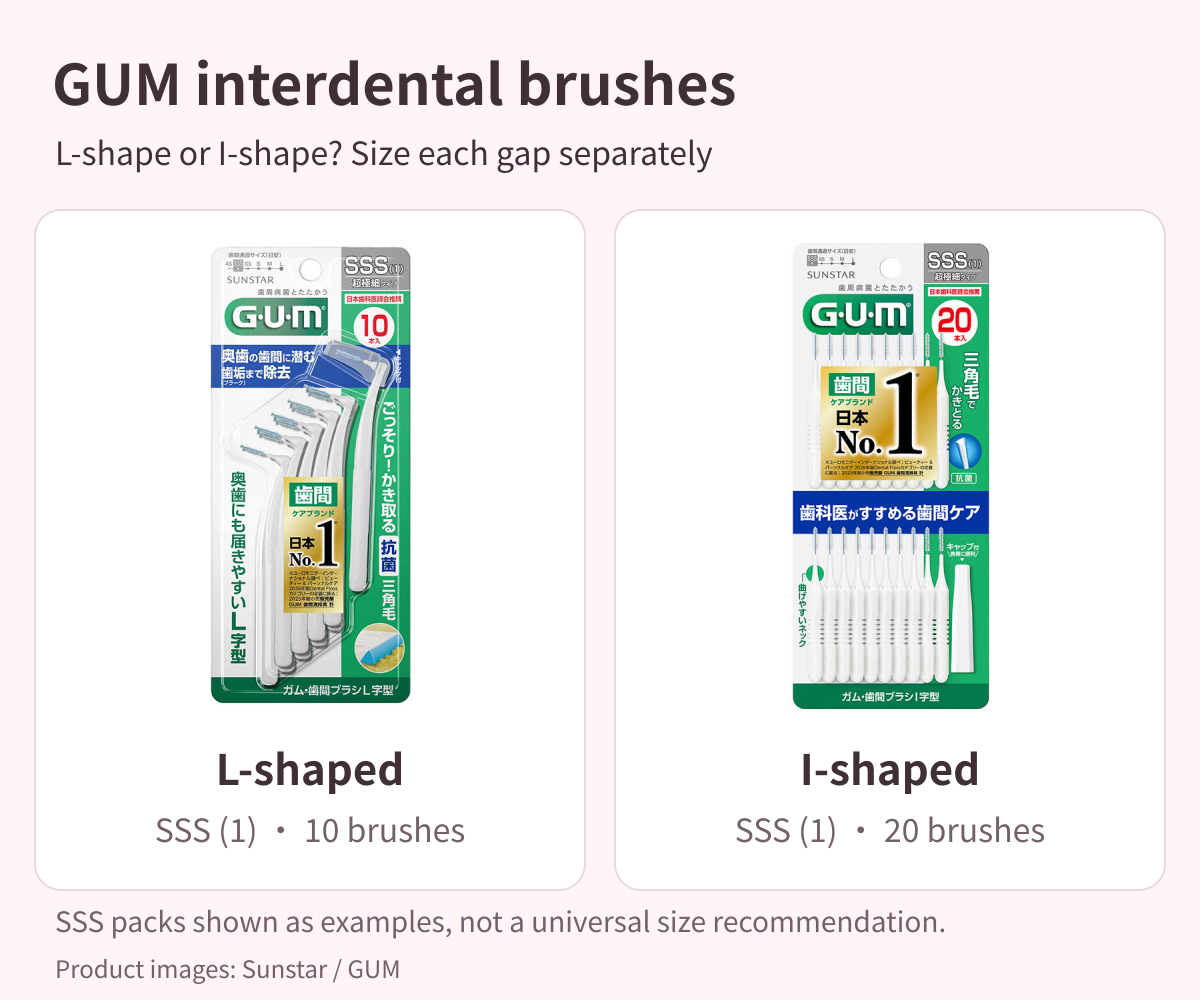
Choose the size for each space between your teeth before deciding between GUM’s L-shaped and I-shaped handles. If a brush will not enter, do not push harder. A size that fits one space may not suit the rest of your mouth.

I’m Irene, a Taiwan-born pharmacist qualified in Japan. This guide organizes the Japanese GUM labels, handle choices and replacement signs into a practical buying sequence. It does not determine your brush size or rank cleaning performance.
Japanese official information checked on 22 October 2026. This guide covers the standard ガム・歯間ブラシL字型 and ガム・歯間ブラシI字型, not the Premium 極上フィット range or soft rubber picks.
First, separate a sizing problem from an awkward angle
Sunstar advises choosing a size for the specific space: different areas of one mouth may need different sizes. A mismatch can injure teeth or gums, or cause the wire to break and be swallowed. A dentist can assess the spaces and help you choose.
- Do not force entry. The product pages describe a suitable size as one that can move without forcing or resistance once inserted.
- If the smallest size will not enter: the L-shaped page names SSSS(0), while the I-shaped page names SSS(1). Each advises using floss when that range’s smallest size will not fit. This is not an instruction to push every size into a space.
- If the size is suitable but back teeth are hard to reach: compare the handle and approach angle. An L-shape may be easier to position; it cannot make an oversized brush fit.
For spaces where your dentist recommends floss, see the separate GUM flat waxed spool and Y-handle floss guide. Choose by the needs of each space, not by the number of pieces in a pack.
Then compare the L-shaped and I-shaped handles
L-shape: a ready-angled handle
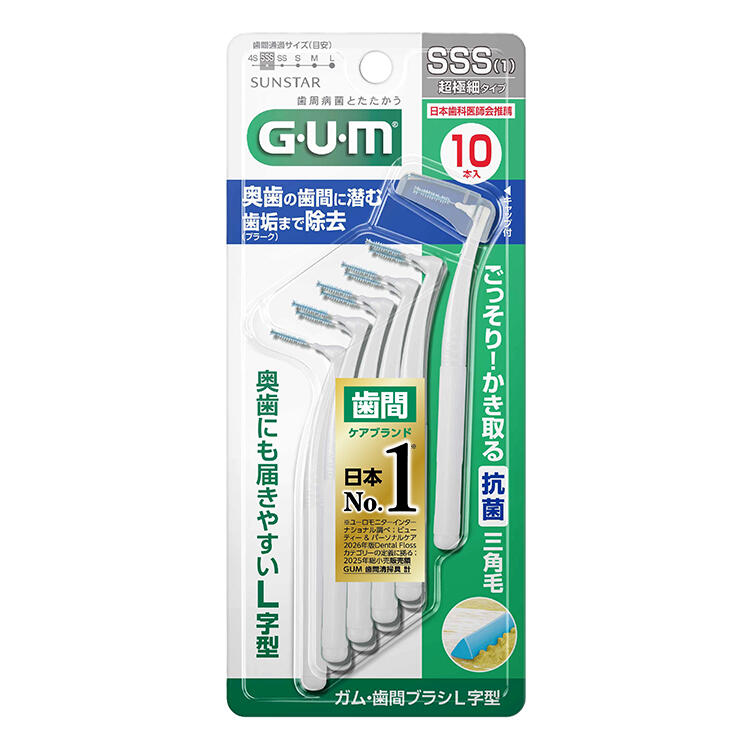
Sunstar describes the design as making back teeth easier to reach. Its use FAQ says to use the L-shape as supplied, without bending it yourself.
The range has six sizes: SSSS(0), SSS(1), SS(2), S(3), M(4) and L(5), in 10-piece packs.
Once your size is confirmed, this is a handle to consider if you would rather use a ready-made angle than adjust an I-shaped plastic neck.
I-shape: a slim handle with an adjustable plastic neck
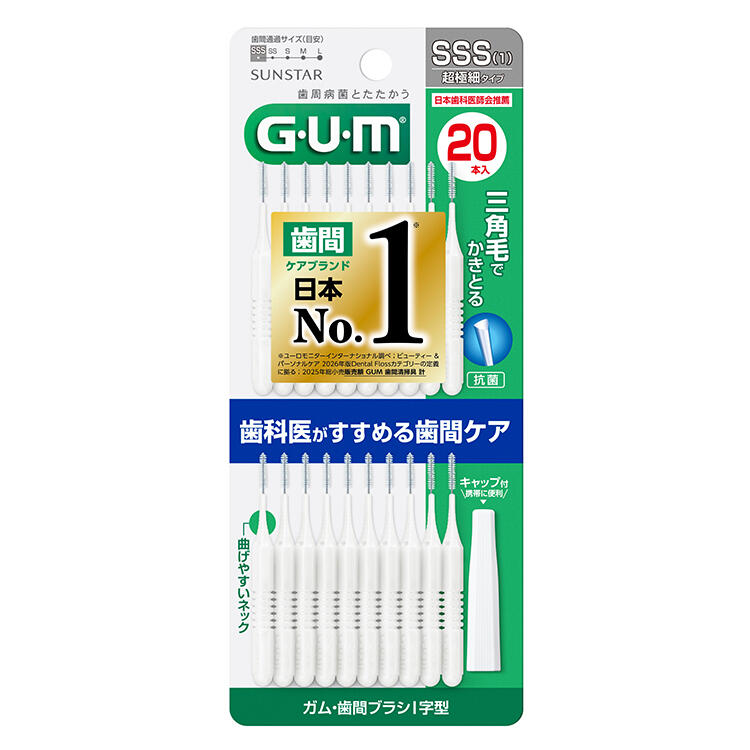
The official features include a slim handle, bendable plastic neck and storage cap. For a back-tooth angle, the instructions allow adjustment at the plastic section only, not the wire. The I-shape is therefore not limited to front teeth.
The range has five sizes: SSS(1), SS(2), S(3), M(4) and L(5), in 20-piece packs. It does not list the L-range’s SSSS(0).
If you prefer a straight handle, make sure you can identify the plastic neck and distinguish it from the metal wire before adjusting it.
Use a slow, straight approach, and never bend the wire
- Watch in a mirror. Insert a suitably sized brush slowly and straight into the space, then move it gently back and forth a few times. If it will not enter, do not push it through.
- Use the L-shape as supplied. If the I-shape needs an angle, bend from the plastic section. Do not bend the wire running through the bristles or its metal base.
- When approaching back teeth from the cheek side, Sunstar suggests not opening too wide. Keep your mouth slightly closed and use the handle to ease the inside of the cheek outward while positioning the brush. This helps with access, not with an unsuitable size.
- Move and withdraw slowly; do not yank the brush out. If positioning is difficult, ask a dental professional to demonstrate instead of repeatedly forcing it.
Rinse for reuse, but check the bristles and wire
Both product pages say these brushes can be washed and reused. Sunstar’s interdental-brush directions say to rinse your mouth afterward, wash the brush head thoroughly under running water, drain it well and let it dry before storage. Do not transfer the single-use instruction for floss to these two brushes.
How long a brush lasts depends on how many spaces you clean and how often. Sunstar’s replacement FAQ says to change it when the bristles lose their shape or the wire starts bending easily; it does not give these two models a fixed number of days.
Bleeding or pain is not a reason to push harder
Sunstar notes that bleeding can occur when starting use or when gums are inflamed, among other circumstances. It also says to consult a dentist if bleeding continues or there is pain. Bleeding is not proof that a brush is working or removing something harmful; do not force it through pain.
- Read the cautions on the actual pack before use. Similar-looking packaging does not mean every range has identical instructions.
- This guide has not verified child-specific directions or an eligible age. Parents choosing for a child, or people helping someone else clean, should take the actual product to a dental professional for individual advice. A small size does not make it a children’s product.
- Tools and technique around implants, bridges or orthodontic appliances need individual confirmation. This guide does not prescribe a standard size for those areas.
A useful question for your next dental visit: “Which spaces need an interdental brush, what size belongs in each, and where should I use floss? Can you show me the back-tooth angle with my brush?” Note the answers by location rather than remembering a single size for the whole mouth.
Sources and image notes
This guide uses the verified Sunstar Japan product pages and use FAQs, with Tokyo’s general safety advice identified separately. The complete rear-pack cautions for the two pictured SKUs were not obtained, so this is not a translation of all packaging instructions. Read the actual label before use and ask a dentist about your own oral condition.
- Sunstar: GUM L-shaped interdental brushes
- Sunstar: GUM I-shaped interdental brushes
- Sunstar: interdental brush types FAQ
- Sunstar: choosing a size FAQ
- Sunstar: use and bending instructions FAQ
- Sunstar: reaching back teeth FAQ
- Sunstar: directions, interdental-brush section
- Sunstar: replacement FAQ
- Sunstar: bleeding and pain FAQ
- Tokyo Metropolitan Government: general brush breakage and swallowing warning (18 June 2024)
Product photos come from the Sunstar pages listed above and have not been altered. They are not Irene’s own photographs. Pack sizes, counts and promotional wording shown in the images identify the products; they are not this guide’s recommended sizes or performance rankings.