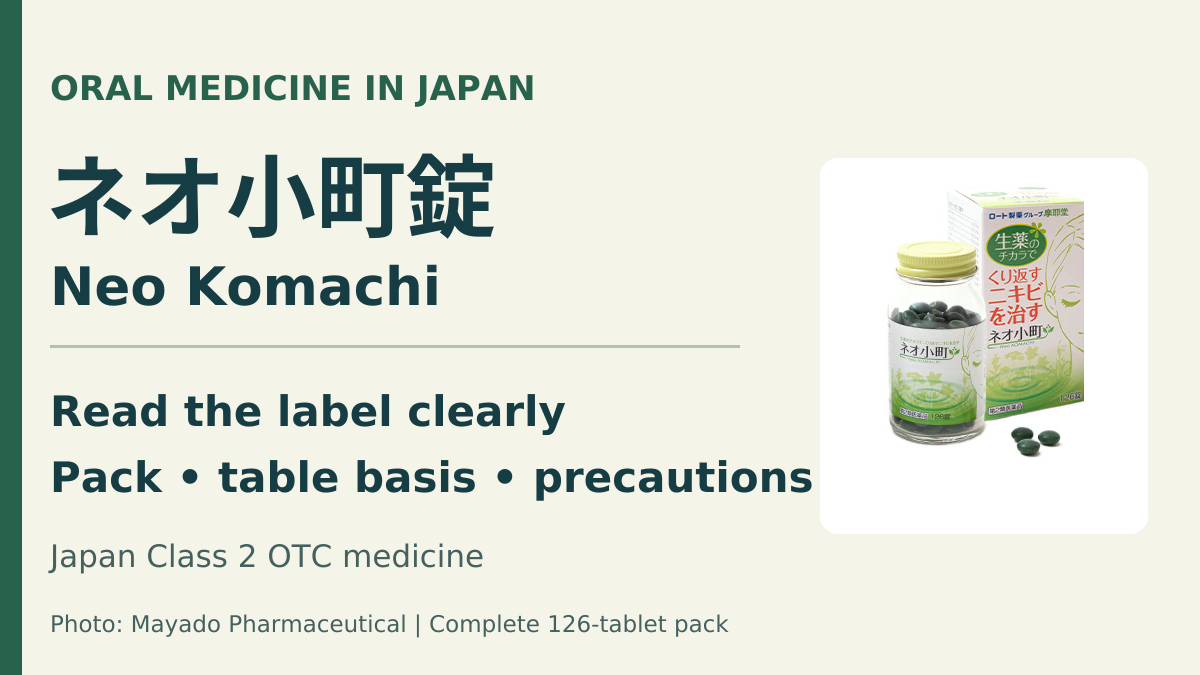
Neo Komachi tablets (ネオ小町錠) are an oral Japanese Class 2 OTC medicine. The manufacturer lists 126-tablet and 270-tablet packs. Its ingredient quantities are given per 10 tablets: that is the basis of the ingredient table, not a fixed daily dose.
This guide helps you identify the Japanese product, read its unusual dose wording and check precautions. It is not a recommendation to choose it for your skin symptoms, a comparison of which medicine works best, or a hands-on product review.
Under 5: do not take. Breastfeeding and taking this medicine must not be combined. If breastfeeding, ask a doctor or pharmacist about a suitable treatment plan and alternatives rather than interrupting breastfeeding to use a skin medicine.
Pregnant or possibly pregnant, taking a laxative, or already having loose stools or diarrhea? These are among the leaflet’s reasons to consult before use. They are not the same label category as the under-5 prohibition. The full consultation and stopping rules are below.
Japanese sources checked: November 11, 2026. The main basis is the manufacturer’s currently linked HC31D-01① leaflet, cross-checked against the matching PMDA C leaflet and product record. The check date is not a new formulation or label-revision date. English explanations here are editorial translations, not an official English leaflet.
Identify the full name and the pack count
Look for ネオ小町錠, made by Mayado Pharmaceutical (摩耶堂製薬株式会社). The front artwork may say ネオ小町 or “Neo KOMACHI.” Check the full sale name as well as the quantity on the box and bottle.
The classification is 第2類医薬品, a Japanese Class 2 OTC medicine. It is taken by mouth and contains crude drugs, vitamins and other ingredients. It is not a cream, a cosmetic, a food supplement or a vitamin-only product. Its formula should not be treated as interchangeable with a named standard Kampo prescription.
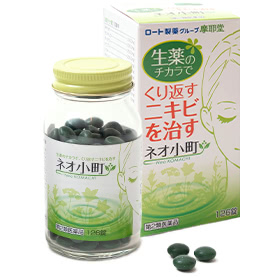
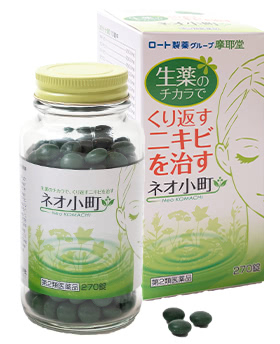
These are complete official reference photographs currently linked by the manufacturer. Packaging and stock at an individual shop may differ. Neither pack count tells you how long to take the medicine, and you do not need to finish a bottle regardless of symptoms.
Check precautions and other medicines before considering a dose
Do not take under age 5; do not combine use with breastfeeding
Children under 5 must not take it because the tablets may lodge in the throat. Do not work around this restriction by crushing, splitting or dissolving the tablets.
The leaflet says not to take this medicine while breastfeeding, or to avoid breastfeeding if taking it. Do not combine the two. A doctor or pharmacist should help choose treatment and alternatives; this guide does not advise stopping breastfeeding or give a restart interval.
The leaflet requires consultation before use in these situations
Consult a doctor, pharmacist or registered OTC medicine seller in Japan if any of the following applies:
- You are receiving medical treatment.
- You are pregnant or may be pregnant. The manufacturer’s FAQ specifically directs you to your treating doctor.
- You are physically frail, weak or have reduced strength.
- You have a weak stomach or intestines, or are prone to diarrhea because of gastrointestinal weakness.
- You have had allergic symptoms caused by medicines or similar substances.
- You already have loss of appetite, nausea/vomiting, loose stool or diarrhea.
- You are taking a laxative, listed as 瀉下薬(下剤).
Pregnancy and laxative use are consult-before-use categories in this label, not blanket contraindications. That distinction does not establish safety or permission to take it without advice. Having none of the listed factors also does not establish that the medicine suits you.
Bring the exact names of everything you take
The manufacturer FAQ warns that adding another oral Kampo or crude-drug medicine can duplicate ingredients and cause unexpected effects. Do not add Neo Komachi alongside a laxative without a pharmacist or doctor checking the combination. Do not choose it as a constipation medicine simply because it contains ダイオウ.
As a general safety step, ask a pharmacist to review all prescription and OTC medicines, topical treatments and supplements. Vitamins may overlap with other skin tablets or supplements, but the leaflet does not provide a complete interaction list. Neither a different brand nor a topical route proves a combination is suitable. Do not stop prescribed treatment to make room for this product.
Three different meanings: pack size, ingredient basis and directions
- 126 or 270 tablets: pack count
- How many tablets are in the pack. It does not define a course or an amount to finish.
- 10 tablets: ingredient-table basis
- All ingredient quantities below are stated per 10 tablets. This does not mean 10 tablets per day or per dose.
- Usual directions: read amount and frequency together
- The Japanese line uses 通常, meaning “usually,” followed by an age-and-symptom adjustment instruction. It does not define an adult age band.
The formal Japanese directions
通常1回3~5錠・1日2~3回,水又はお湯で服用してください。
なお,年齢・症状により適宜増減してください。
Usual directions: 3–5 tablets per dose, 2–3 times daily, with water or warm water; adjust according to age and symptoms. The leaflet also says to follow the directions strictly.
The adjustment wording does not tell you which schedule is appropriate for an individual. If that is unclear, ask a pharmacist or doctor rather than calculating a daily total or increasing the amount yourself.
The under-5 prohibition does not mean every child aged 5 or older can take the full usual range. No numerical child-age dose table was found in the checked manufacturer product page, linked and alternative leaflets, Neo Komachi FAQ, landing-page Q&A, or the three leaflets linked by the current PMDA record. For a child, have a pharmacist or doctor confirm suitability and dose before use, then follow the leaflet’s requirement for guardian guidance and supervision. No child schedule is supplied here.
The formal dosing line does not specify a meal time. The manufacturer’s FAQ suggests before or between meals, and after meals for a weak stomach. A weak stomach or tendency to diarrhea still requires consultation before use. Timing advice does not override the stopping rules or establish a better clinical result.
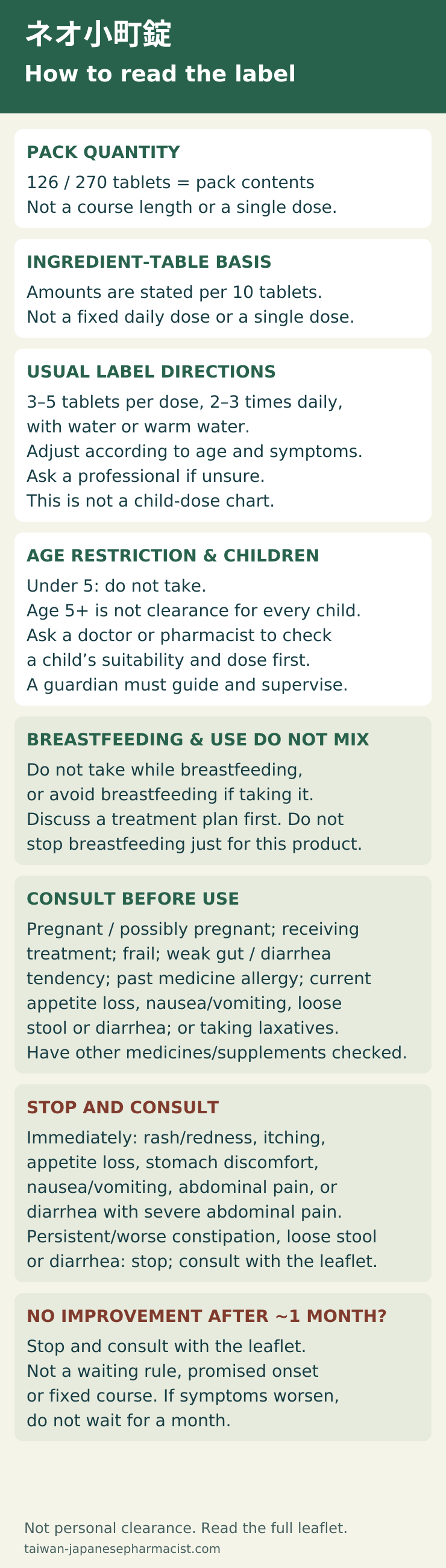
All 19 ingredient quantities are per 10 tablets
The formula lists 12 crude drugs, five vitamins, DL-methionine and calcium lactate hydrate. The crude-drug names below remain in the exact Japanese form so you can match them to the label. Botanical species and plant-part translations are not inferred from shopping descriptions.
| Label ingredient | Per 10 tablets |
|---|---|
| キキョウ | 200 mg |
| センキュウ | 200 mg |
| ダイオウ | 250 mg |
| オウゴン | 200 mg |
| トウキ | 150 mg |
| ボタンピ | 200 mg |
| ヨクイニン | 300 mg |
| ケイヒ | 150 mg |
| ケイガイ | 150 mg |
| レンギョウ | 150 mg |
| サンキライ | 200 mg |
| ニンドウ | 150 mg |
| ニコチン酸アミドNicotinamide | 100 mg |
| リボフラビンRiboflavin (vitamin B2) | 5 mg |
| ピリドキシン塩酸塩Pyridoxine hydrochloride (vitamin B6) | 20 mg |
| アスコルビン酸Ascorbic acid (vitamin C) | 200 mg |
| DL-メチオニンDL-methionine | 80 mg |
| パントテン酸カルシウムCalcium pantothenate | 25 mg |
| 乳酸カルシウム水和物Calcium lactate hydrate | 340 mg |
Calcium lactate hydrate 340 mg is the weight of that compound, not 340 mg of elemental calcium. DL-methionine is not cysteine. The numbers in this table are not converted to elemental or vitamin-equivalent amounts, and ingredient counts or weights do not rank clinical effectiveness.
The leaflet also lists the following additives without amounts: マクロゴール、ゼラチン、タルク、メタケイ酸アルミン酸マグネシウム、ステアリン酸マグネシウム、銅クロロフィリンナトリウム、アラビアゴム、白糖、セラック、ヒプロメロース、乳糖、セルロース、炭酸カルシウム、カルナウバロウ. These include gelatin, sucrose and lactose. If allergies or dietary restrictions matter, take the complete leaflet to a pharmacist; do not assume the product is allergen-free or vegan.
Read the labelled purposes without expanding them
The Japanese label lists treatment and prevention of the following conditions. These translations explain the wording; they do not diagnose your symptoms or establish that this medicine is appropriate for every rash:
- Acne and pimples/breakouts (にきび、吹出物).
- Dark spots, freckles and abnormal pigmentation (しみ、そばかす、色素異状沈着).
- Hives, eczema, dermatitis, prurigo, heat rash and itchy skin (じんましん、湿疹、皮膚炎、痒疹、あせも、皮膚そう痒症).
- Lip inflammation and cracked lips (口唇炎、口唇亀裂).
- “Allergic constitution” (アレルギー体質), a literal historic label term, not a diagnosis or a claim to cure allergies.
- Chilblains and chapped/cracked skin, among the listed conditions (しもやけ、あかぎれ等).
Here, 吹出物 is rendered as pimples/breakouts, not a bacterial-infection indication. A hot, painful or spreading lump needs assessment, as explained below.
The leaflet qualifies its acne-mark wording as 色素異状沈着, or pigmentation. That does not support repair of depressed or raised scars, permanent scar removal or skin-whitening promises. Deep lesions and scarring are reasons to seek dermatology care.
When to stop and seek advice
Stop immediately for these symptoms after taking it
The following may be adverse reactions. Stop taking the medicine immediately and consult a doctor, pharmacist or registered OTC medicine seller, taking the leaflet with you:
- Skin: rash/redness or itching.
- Digestive system: loss of appetite, stomach discomfort, nausea/vomiting, diarrhea with severe abdominal pain, or abdominal pain.
Stop if bowel symptoms persist or worsen
Constipation, loose stool or diarrhea that continues or becomes more severe also means stop and consult with the leaflet. Do not treat worsening as a reason to continue or simply keep adjusting the dose.
About one month without improvement: stop and consult
If symptoms have not improved after about one month of taking it, stop and consult with the leaflet. This is not a promised time to work, a required course or a reason to wait through worsening symptoms. A bottle size does not set the length of treatment.
When skin symptoms need medical care
The following is general medical-care guidance, separate from Neo Komachi’s adverse-reaction list. It does not identify which medicine is right for you.
- Arrange dermatology assessment for deep, hard or painful acne nodules, cyst-like lesions, recurring or worsening disease, or scars. The Japanese Dermatological Association encourages early treatment to reduce scarring; repeatedly switching OTC tablets can delay appropriate care.
- Seek urgent medical assessment for a painful hot lump, spreading redness or swelling, or fever/shivering. A possible skin infection may need treatment beyond an OTC skin tablet. Do not wait a month to find out.
- Get emergency medical help for breathing difficulty or sudden swelling of the lips, tongue or throat. This is general severe-allergy advice, not a claim that the Neo Komachi leaflet specifically names anaphylaxis.
These examples are not an exhaustive list. Their absence does not establish suitability for self-treatment.
Tests, storage and travel packing
- Urine color: riboflavin (vitamin B2) can make urine yellow. Do not use that explanation to dismiss blood, pain, fever or other unexplained urinary symptoms.
- Medical tests: vitamin C may affect urine and stool test values. Tell the testing doctor that you are taking this medicine; this guide does not give a stop-before-test interval.
- Keep the original bottle: store tightly capped in a cool, dry place away from direct sunlight and out of children’s reach. Do not transfer tablets to a different container or travel pill organizer.
- Use dry hands and close the cap properly after use.
- After first opening: remove the transport packing inside the bottle and write the opening date on both the box and bottle.
- Observe the expiry date. The leaflet says to use the contents promptly after opening for quality; it gives no fixed six-month limit. This is not a reason to take extra tablets, continue despite adverse effects or finish a bottle unnecessarily.
Related guides: keep each product’s instructions separate
For a different oral skin medicine, see the Chocola BB guide. For a topical product, see the PAIR Acne Cream W guide. Their age limits, ingredients and directions cannot be transferred to Neo Komachi. These links are not a ranking or a recommendation to combine products.
Sources and photograph credits
Primary references below were checked for the Japanese product. Manufacturer marketing explanations are not treated as independent proof of effectiveness. The sources do not replace the leaflet supplied with your own pack or an individual consultation.
- Mayado: Neo Komachi product page, classification, ingredients and pack sizes
- Mayado: currently linked leaflet, HC31D-01① (PDF)
- PMDA: Neo Komachi product and label record
- PMDA: matching HC31D-01① C leaflet (PDF)
- Mayado FAQ: Neo Komachi section, additional medicine and timing advice
- Mayado: official product introduction and package-photograph source
- Japanese Dermatological Association: what acne is
- Japanese Dermatological Association: acne symptoms
- Japanese Dermatological Association: which specialist to see for acne
- NHS: skin abscess, signs requiring assessment
- NHS: boils and when to seek medical care
- NHS: anaphylaxis, emergency severe-allergy advice
Photographs: Mayado Pharmaceutical. Complete official 126-tablet photograph and 270-tablet photograph. These are manufacturer photographs, not photographs taken by this site. Editorial diagrams and layout are original to this guide; no manufacturer endorsement is implied.