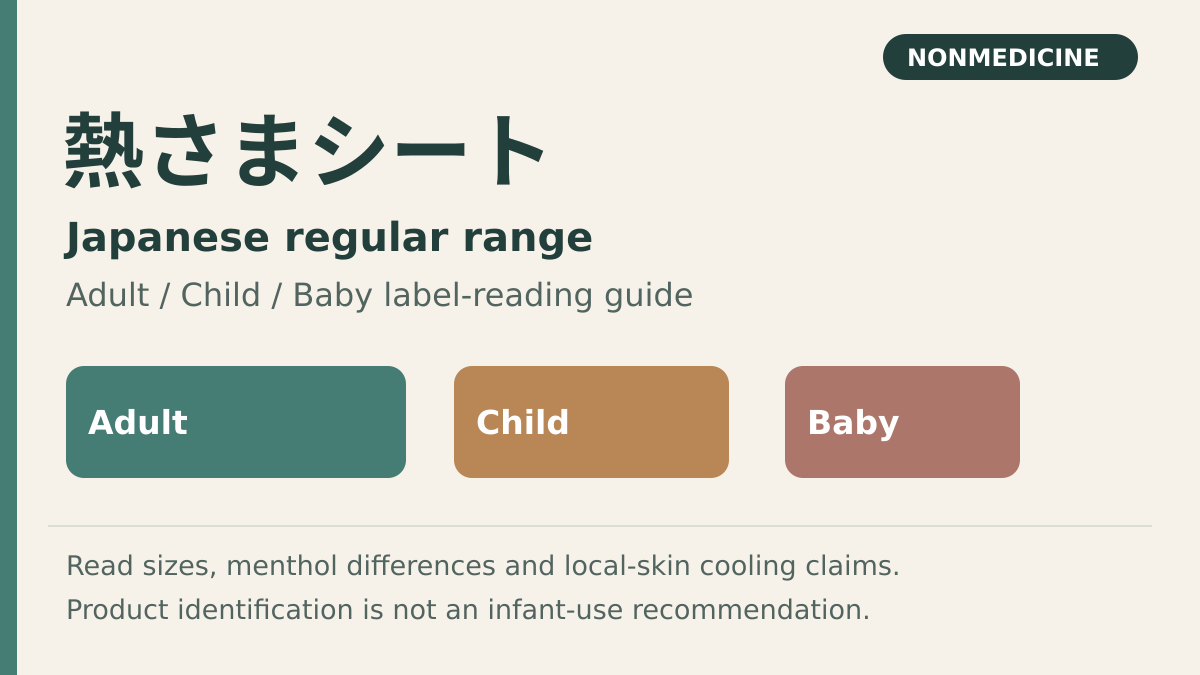
Kobayashi’s 熱さまシート (Netsusama cooling sheets) come in regular adult, child and baby versions. The differences include menthol and the stated cooling duration, as well as size. Wording such as “fever cooling sheet” can blur three separate things: feeling cool, cooling the skin of the forehead and treating a fever. Start with the exact Japanese name, then read what each claim describes.
This guide covers only the regular 大人用, こども用 and 赤ちゃん用 versions. Strong-cooling, freezer, body and eye-mask products are excluded. This is a label-reading guide, not a recommendation to use sheets on babies or a fever-treatment guide.
- Check the child’s condition before the box
- Read the Japanese names: more than a size difference
- The age labels overlap at 2; cutting does not change the formula
- What do “about 8 hours,” “4 hours” and “−2°C” mean?
- Keep these handling and storage instructions in view
- Match the version, not just the brand
- Official sources and image credits
Check the child’s condition before the box
Tokyo Metropolitan Government’s child-safety guidance does not recommend forehead cooling sheets for infants: a displaced sheet can cover the nose and mouth and cause suffocation. This is accident-prevention advice, not a Netsusama-specific legal ban. That passage does not set a numerical age cutoff to apply yourself.
Kobayashi’s baby version does carry the label “0~2才向け,” meaning a manufacturer target of ages 0–2. Read that target alongside the accident-prevention advice. A baby label, absence of menthol or caregiver supervision does not eliminate suffocation risk.
The manufacturer warns that a sheet over the nose or mouth, or placed in the mouth, may prevent breathing. Infants, young children and people who cannot manage the product reliably require careful caregiver supervision. Applying that warning, our precaution is: do not leave a sheet on someone who needs supervision when the caregiver will sleep or cannot keep watching closely. An adhesion claim about resisting removal when turning over is not permission for unattended use.
Fever warning signs take priority over cooling time
These referral warnings come from government health and emergency guidance, not the product’s age guidance or cooling tests:
- A baby under 3 months with a temperature of 38°C or higher needs urgent medical assessment.
- Unusual behaviour or responsiveness, marked lethargy even after the temperature falls, inability to drink or reduced urination, and ongoing vomiting also need urgent assessment.
- Difficult breathing, choking, a blue or unusually pale colour, a seizure, or poor responsiveness when called need emergency help. In Japan, call 119 for an ambulance.
If you suspect a child has swallowed a sheet or its contents, seek medical advice immediately and identify the exact product. Call for emergency help if the signs above are present. Cooler skin or a baby label must not delay assessment.
Read the Japanese names: more than a size difference
These are the packs and specifications shown by the manufacturer. The photographs identify the fronts only. They are not a size comparison or a substitute for the complete precautions on your own pack.
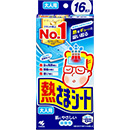
Adult | 熱さまシート 大人用
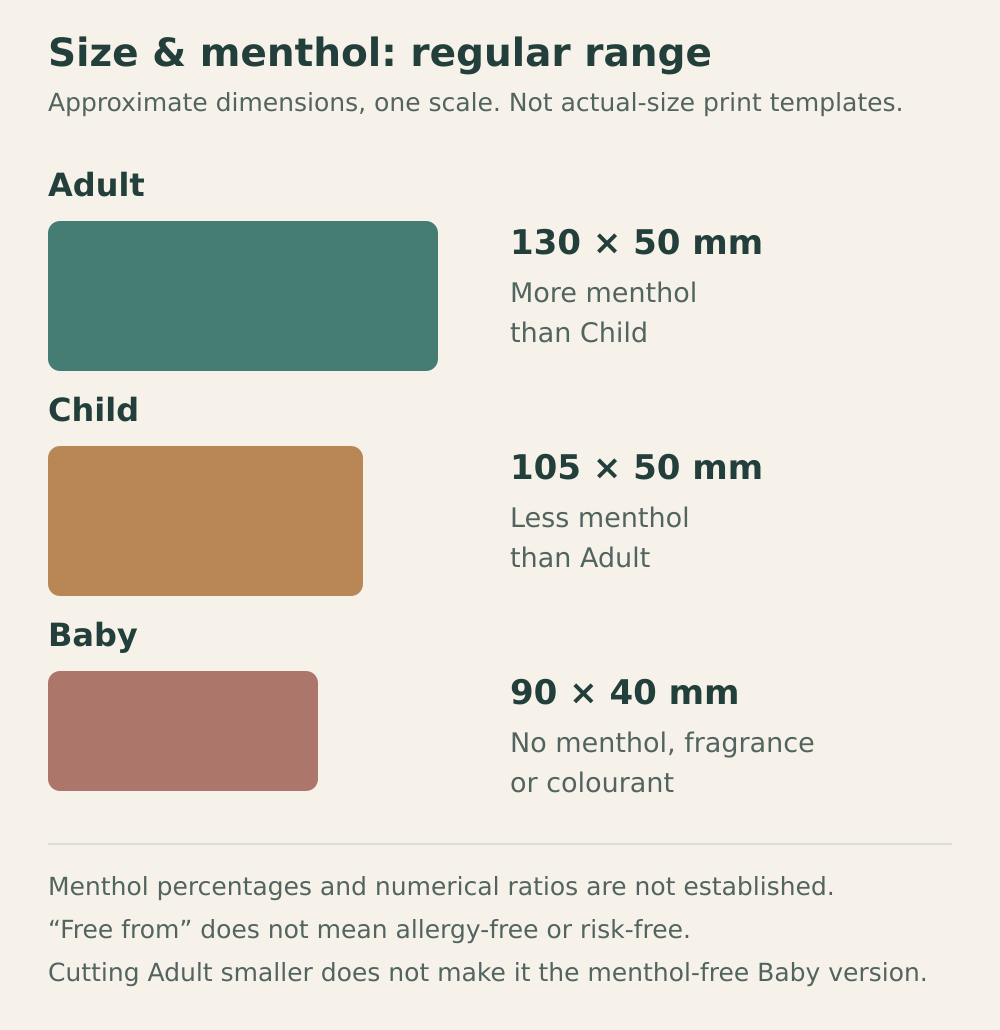
- Each sheet is approximately 130 × 50 mm.
- The manufacturer says it has more menthol than the child version. No percentage is given for a numerical comparison here.
- Manufacturer age guidance: upper primary-school age, around 10 onward.
The photograph shows a 16-sheet pack. Image: Kobayashi Pharmaceutical. The source is a 130 × 130 pixel thumbnail; it is not enlarged here for fine-print reading.
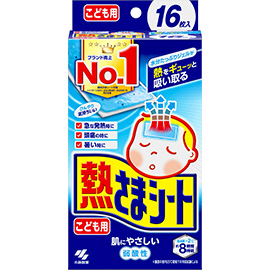
Child | 熱さまシート こども用
- Each sheet is approximately 105 × 50 mm.
- It has less menthol than the adult version, not no menthol.
- Manufacturer age guidance: from age 2.
The photograph shows a 16-sheet pack. Image: Kobayashi Pharmaceutical. This child pack is the main photograph on the regular product page; the shared brand name does not make it the adult version.
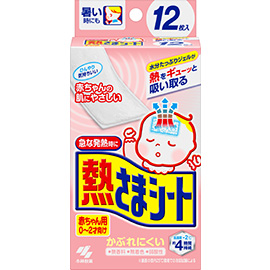
Baby | 熱さまシート 赤ちゃん用(0~2才向け)
- Each sheet is approximately 90 × 40 mm.
- It contains no menthol, fragrance or colourant; the manufacturer still lists parabens.
- “0–2” is the manufacturer’s target age, not this guide’s recommendation to use it.
Tokyo’s guidance does not recommend forehead cooling sheets for infants because of the suffocation risk if they move. The photograph shows a 12-sheet pack. Image: Kobayashi Pharmaceutical.
The adult and child quality information also lists parabens and colourant. These are disclosed formulation differences, not complete ingredient lists or evidence of allergy-free use. Kobayashi also lists 6-sheet packs for the regular adult and child versions. The photographed 16-sheet pack is not the only pack size, and does not establish stock at any shop.
The age labels overlap at 2; cutting does not change the formula
Kobayashi’s FAQ presents these ages as guidance for miscellaneous goods, rather than medicine-style age restrictions. It says “0–2” for the baby version and “from 2” for the child version, so age 2 genuinely overlaps. Do not rewrite the baby target as “under 2,” or assume a second birthday makes both versions safe for every child. If uncertain about the exact product and the child’s circumstances, take the pack to a pharmacist or clinician.
Adult-version menthol may be too irritating for infants, young children and younger primary-school children. Although Kobayashi allows trimming for fit, cutting changes the size, not the adult formula into a menthol-free baby formula. That distinction follows from the specifications and formulation differences. Trimming is not a baby-use workaround.
The FAQ says adults may use the child version. Skin, placement and individual precautions still apply; this is not a statement that it suits everyone.
What do “about 8 hours,” “4 hours” and “−2°C” mean?
The regular adult and child versions state about 8 hours; the baby version states 4 hours. In the manufacturer’s published test description, sheets are applied to the forehead indoors at 25°C. The duration concerns local skin temperature staying 2°C below its usual level.
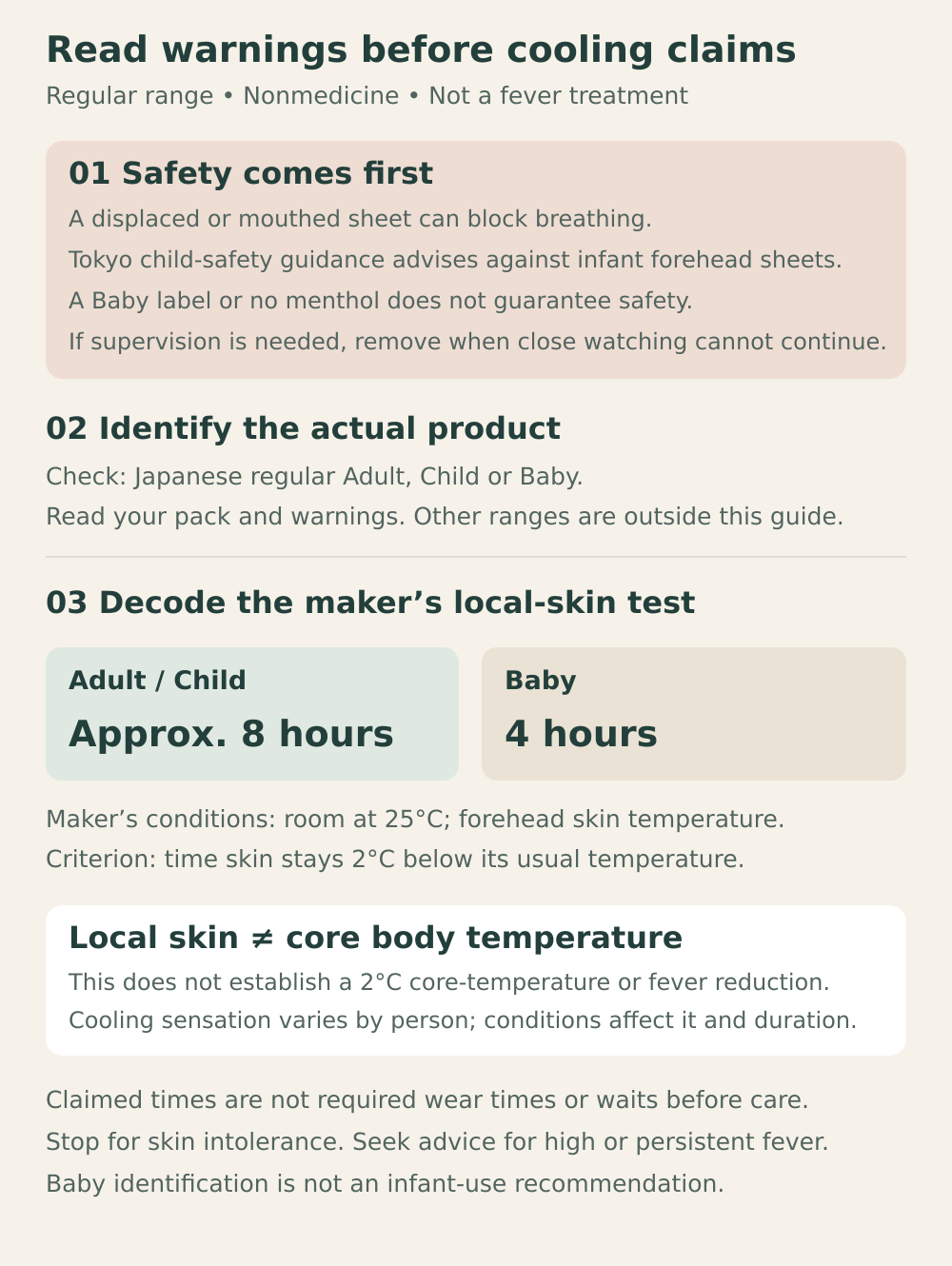
How cool a sheet feels does not necessarily match measured skin cooling. The manufacturer notes that cooling sensation varies between people, while the environment affects sensation and duration. The published explanation does not provide evidence for a guaranteed result in every user or for faster recovery from illness.
These are neither required wear times nor waiting periods before medical care. Stop for discomfort rather than keeping a sheet on to complete 4 or 8 hours. These products are not medicines; high or persistent fever needs medical advice. Kobayashi also explicitly says they cannot be used to prevent heat illness. Feeling cool does not establish that heat illness has been treated.
Keep these handling and storage instructions in view
This section summarizes the regular products’ labels. It does not change the infant accident-prevention advice above or replace an individual medical assessment.
- Check the skin and site. Avoid wounds, burns, sunburn injury, the eye area and mucous membranes. Stop for significant itching, pain, swelling, rash or other intolerance. If skin changes persist, take the product to a doctor, such as a dermatologist. Weak acidity and absence of fragrance do not guarantee skin tolerance.
- Use each sheet once. Dry sweat and remove the clear film before applying. Repeated repositioning reduces adhesion. Do not refrigerate a used sheet to reuse it.
- Close the pouch. Fold the opening twice along the marked line to limit unused sheets’ contact with air, then return it to the box. Use the remainder promptly. These pages do not give a fixed number of days after opening.
- Refrigeration is allowed; freezing is not. Keep the regular products away from high temperatures, preferably in a cool, dark place. Do not transfer the separately named freezer product’s instructions to these sheets.
- Prevent access, mouthing and bead removal. Store out of reach of children and others who may not manage the product reliably. Adult and child precautions also say not to remove the gel beads, because contents could burst into the eyes. Do not let children put a whole sheet, pieces or its contents in their mouths.
Match the version, not just the brand
This guide checks the regular Japanese versions only. It does not establish that overseas products such as “KOOLFEVER” have identical specifications. Check the complete name, purpose and precautions on the pack you have. We have not inspected all printed details on physical package backs.
Strong-cooling remains excluded: the current product page and a 3 April 2025 announcement state about 8 hours and about 4 hours respectively. The relationship between those versions remains unresolved. Regular-product information cannot settle that difference. Freezer, body and eye-mask products also have their own instructions.
Identify the full Japanese name, then separate size, menthol and the skin-cooling claim. If a child is unwell, their condition and timely medical help matter more than which box to choose.
Official sources and image credits
Product details and handling instructions come from Kobayashi Pharmaceutical. Accident prevention, fever referral and emergency advice come separately from Tokyo Metropolitan Government, Nagano City and Japan’s Children and Families Agency. Nagano’s fever page is dated 14 July 2026. Its medicine doses are not reproduced here, and government advice is not presented as a manufacturer test result.
- Kobayashi: regular adult/child product details and full precautions
- Kobayashi: baby product details and full precautions
- Kobayashi: age guidance and menthol differences
- Kobayashi: trimming for fit
- Kobayashi: placement and excluded sites
- Kobayashi: not for preventing heat illness
- Tokyo child-safety guidance: displaced forehead sheets and infant suffocation risk
- Nagano City: fever signs requiring urgent assessment
- Children and Families Agency: emergency help after accidents and 119
- Strong-cooling exclusion: current product page and 3 April 2025 announcement. The duration difference is unresolved; no selection recommendation for that product is made here.
- Pack-front photographs: Kobayashi Pharmaceutical’s adult, child and baby images, used for product identification. Images and proportions are unchanged; they do not verify complete back labels. Size and label-reading illustrations are original to this site.