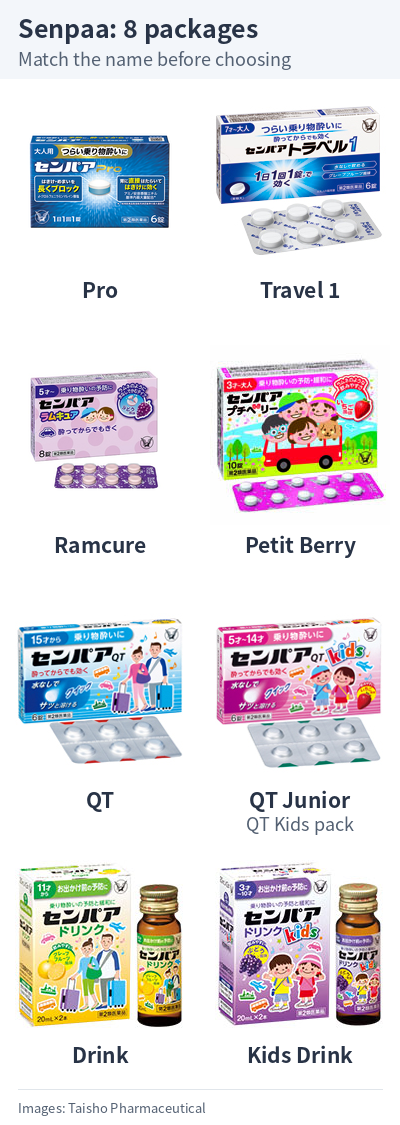
Start with age and how the person can take medicine. For ages 3–4, the labelled choices here are Petit Berry or Kids Drink; from age 5, Ramcure and QT Junior add water-free options. Pro is for ages 15+, once daily with water. Every product below prohibits driving or operating machinery after taking it.

I'm Irene, a Taiwanese-born, Japanese-licensed pharmacist working in a Japanese drugstore. A family ferry trip can mean several different medicine needs in one bag. With Senpaa, choosing the right format is useful, but checking the age and repeat-dose rules comes first.
A quick route through the range
Senpaa (センパア, also romanised as Semper) is Taisho's motion-sickness brand. These Japanese Class 2 OTC medicines prevent and relieve dizziness, nausea and headache caused by motion sickness. They are not a general treatment for unexplained vomiting or dizziness.
- A small child aged 3–4: Petit Berry is a small strawberry-flavoured chewable; Kids Drink is a grape-flavoured 20 mL liquid. An adult must supervise, and the tablet must not lodge in the throat.
- A child aged 5–10: Ramcure offers a grape-flavoured chewable; QT Junior dissolves without chewing. These are alternatives, not medicines to combine.
- Want once-daily dosing: Travel 1 is a chew-or-dissolve option from age 7, with a half-tablet child dose; Pro is a swallow-with-water option from age 15.
- An older child or adult who prefers liquid: the ordinary Drink starts at age 11. Do not confuse it with Kids Drink, which is labelled for ages 3–10.
- An adult who wants a quick-dissolving tablet: adult QT starts at age 15. QT Junior has different age-specific doses.
Flavours are the manufacturer's descriptions, not a taste test. Do not choose by a cartoon or the word “Kids” alone: the formal QT Junior product is pictured in the official catalog with “QT Kids” on its box.
Match the name, age and dose
For prevention, each product's Japanese directions say to take it 30 minutes before travel. They can also be taken after motion-sickness symptoms begin, within the labelled schedule. Pro and Travel 1 are once daily; the others allow no more than two doses daily, at least four hours apart when a further dose is needed.
| Product | Labelled age and amount per dose | Daily limit and method |
|---|---|---|
| Pro | Age 15+: 1 tablet; under 15: do not use | Once daily; swallow with water or lukewarm water |
| Travel 1 | Age 15+: 1 tablet; age 7–14: half a tablet; under 7: do not use | Once daily; chew or dissolve in the mouth |
| Ramcure | Age 11+: 2 tablets; age 5–10: 1 tablet; under 5: do not use | Up to twice daily, at least 4 hours apart; chew or dissolve |
| Petit Berry | Age 11+: 2 tablets; age 3–10: 1 tablet; under 3: do not use | Up to twice daily, at least 4 hours apart; chew or dissolve |
| QT, adult | Age 15+: 1 tablet; under 15: do not use | Up to twice daily, at least 4 hours apart; dissolve in the mouth |
| QT Junior | Age 11–14: 2 tablets; age 5–10: 1 tablet; under 5: do not use | Up to twice daily, at least 4 hours apart; dissolve in the mouth |
| Drink | Age 11+: one 20 mL bottle; under 11: do not use | Up to twice daily, at least 4 hours apart |
| Kids Drink | Age 3–10: one 20 mL bottle; under 3: do not use | Up to twice daily, at least 4 hours apart |
QT Junior and Kids Drink are child-labelled products; do not invent adult doses or extend their stated age ranges. If a product does not cover the person's age, choose another appropriate product with the pharmacist.
Once daily: Pro or Travel 1?
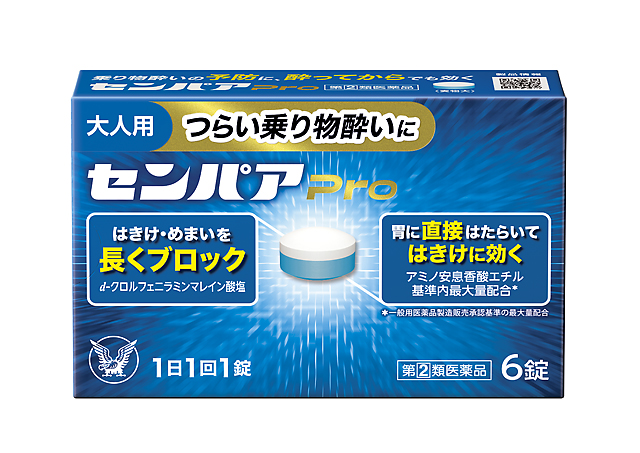
Pro is a two-layer tablet for ages 15 and over. Per tablet it contains benzocaine 100 mg, scopolamine hydrobromide hydrate 0.25 mg, d-chlorpheniramine maleate 2 mg, pyridoxine hydrochloride 10 mg and anhydrous caffeine 20 mg. The benzocaine component acts on excessive stomach movement in the manufacturer's explanation. Its extra ingredients do not establish that Pro is the best choice for everyone, and caffeine does not cancel the driving prohibition.
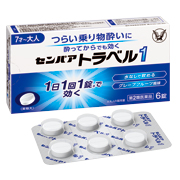
Travel 1 is grapefruit-flavoured and can be chewed or dissolved without water. Each whole tablet contains chlorpheniramine maleate 4 mg and scopolamine hydrobromide hydrate 0.25 mg. Ages 7–14 take only half a tablet, once daily. The name “1” must not be read as one whole tablet for every age.
Chewables: Ramcure or Petit Berry?
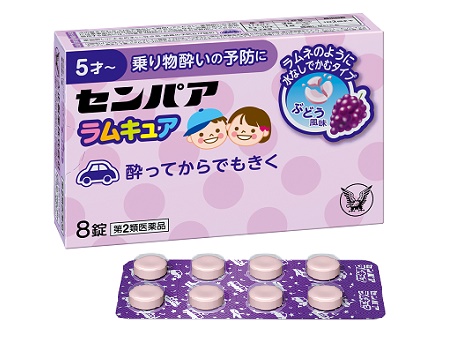
Ramcure's grape-flavoured tablets start at age 5. Two tablets contain d-chlorpheniramine maleate 1.32 mg and scopolamine hydrobromide hydrate 0.16 mg. The younger age band takes one tablet per dose.
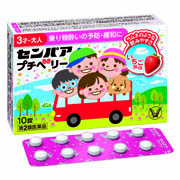
Petit Berry starts at age 3 and is strawberry-flavoured. Two tablets contain chlorpheniramine maleate 2.66 mg and scopolamine hydrobromide hydrate 0.16 mg. Again, ages 3–10 take one tablet per dose. Watch young children closely so the tablet does not catch in the throat.
Chlorpheniramine and d-chlorpheniramine are not the same ingredient name. Do not rank these products by comparing their milligram numbers alone or substitute one product's dose for another's.
QT: let it dissolve, and open it gently
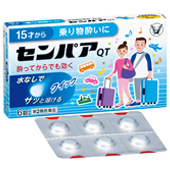
Adult QT contains d-chlorpheniramine maleate 2 mg plus scopolamine hydrobromide hydrate 0.25 mg per tablet.
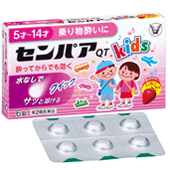
QT Junior contains d-chlorpheniramine maleate 1.32 mg plus scopolamine hydrobromide hydrate 0.16 mg per two tablets. That matches Ramcure's listed active amounts on the same two-tablet basis, but the format and labelled upper age range differ.
- Use dry hands. These tablets dissolve very easily in water and can break.
- Peel back the coloured foil tab: red for adult QT, green for QT Junior. Then gently push the tablet up from below.
- Remove the tablet completely and let it dissolve in the mouth; no water or chewing is needed. Never swallow the packaging.
Do not treat QT like an ordinary push-through blister without first peeling its lid.
Liquid: the two bottles have different strengths
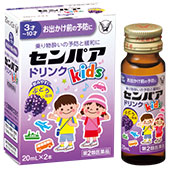
Kids Drink is grape-flavoured. One 20 mL bottle contains chlorpheniramine maleate 1.3 mg and scopolamine hydrobromide hydrate 0.08 mg, for ages 3–10.
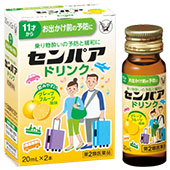
Ordinary Drink is grapefruit-flavoured, for ages 11 and over. One 20 mL bottle contains chlorpheniramine maleate 2.6 mg and scopolamine hydrobromide hydrate 0.16 mg. Same bottle volume does not mean the same dose strength. Follow the whole-bottle instructions for the correct product rather than improvising a child's portion from the adult bottle.
The safety check applies to every format
Do not drive, cycle or operate machinery after taking these medicines. The leaflets warn about sleepiness, blurred vision and unusual sensitivity to light. A child using the medicine also needs this warning explained in an age-appropriate way.
While taking any one of these products, do not also use another motion-sickness medicine, a cold medicine, fever/pain reliever, sedative, cough/expectorant medicine, stomach pain/antispasmodic medicine, or an oral antihistamine-containing product such as an allergy or rhinitis medicine. Have a pharmacist review what is already in the travel bag before starting.
Consult before use if receiving medical treatment, pregnant or possibly pregnant, older, previously allergic to medicines, having trouble urinating, or diagnosed with glaucoma or heart disease. The reviewed leaflets do not provide a separate breastfeeding instruction; breastfeeding users should obtain individual advice rather than assume suitability.
Stop immediately and consult for rash, redness, itching, headache, difficulty urinating, facial flushing or abnormal sensitivity to light. Stop and consult if dry mouth, constipation, sleepiness or blurred vision persists or worsens; Pro also lists diarrhoea in this group. Rare serious blood disorders require immediate medical care: warning symptoms include unusual bruising or bleeding, pallor, breathlessness, or sudden high fever with chills and a sore throat.
The leaflets do not set a “take for several days before consulting” trial period. Do not keep escalating or combining doses if the problem is not controlled; seek advice, especially when symptoms continue beyond travel or are not clearly motion-related.
Pack it so the instructions travel too
Keep medicines in their original containers, away from sunlight and children, in a cool place; keep tablets dry. Do not use expired products. Pro needs protection from light after opening its inner foil bag, and must be used within six months after opening even if the printed expiry is later.
My final check is simple: age, format, one-dose amount, then the next permitted dose. Sleep well before travel and avoid overeating or excessive drinking, as Taisho's leaflets advise. A convenient flavour or water-free tablet helps only when the medicine itself is appropriate.
Sources
- Taisho: current Senpaa catalog and product list
- Pro: official product information and Japanese leaflet
- Travel 1: official product information and Japanese leaflet
- Ramcure: official product information and Japanese leaflet
- Petit Berry: official product information and Japanese leaflet
- Adult QT: official product information and Japanese leaflet
- QT Junior: official product information and Japanese leaflet
- Drink: official product information and Japanese leaflet
- Kids Drink: official product information and Japanese leaflet
Japanese product information checked on 15 October 2026. Read the leaflet in your own pack and ask a pharmacist for personal advice.