Hi, I’m Irene. A small mouthwash bottle can be a concentrate, not a travel-size ready-to-use rinse. With Japan’s アセス液 (Acess Solution), the most useful thing to remember is the measuring cup: 1 mL first, then water up to 15 mL in total.
Identify the blue-and-white Acess Solution pack
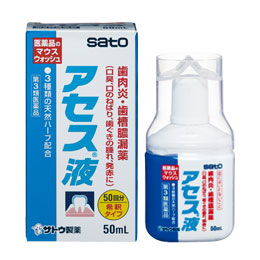
The current Japanese range lists 50 mL and 90 mL. This is a Class 3 OTC medicine for relief of gingivitis and periodontal-disease symptoms such as gum swelling, bleeding, redness, itching, discharge, sticky mouth and associated bad breath. It is not a promise to treat every cause of bad breath or replace dental care.
Do not confuse it with アセスメディクリーン (Acess Mediclean). That is a different, ready-to-use product. This guide’s dilution instructions apply only to アセス液.
The measuring-cup sequence: 1 → 15 → 30
Follow the actual leaflet supplied with your bottle. The visual sequence below restates its instructions; it is not a new dosage.
After brushing the gums, measure 1 mL of the medicine in the supplied cup.
Add water to the 15 mL mark. Do not add 15 mL of water to the medicine. Do not rinse with the concentrate undiluted.
Rinse vigorously around the gums, then spit it out. Do not swallow. You may leave it at that or rinse with water afterwards.
For dental/oral use only. Do not swallow. Use twice daily, morning and evening. Do not borrow the volume or frequency of another mouthwash. If you cannot read the cup markings, ask the pharmacist rather than estimating by a capful.
Check before using, and know when to stop
Ask a doctor, dentist, pharmacist or registered OTC medicine seller first if you are receiving medical or dental treatment, have had medicine allergies, or have severe soreness or erosion inside the mouth.
Stop immediately and seek advice with the leaflet if a skin rash, redness or itching develops. Also stop and seek advice if symptoms worsen, or do not improve after a period of use. Take the leaflet to a doctor, pharmacist or registered OTC medicine seller; a dentist is also an appropriate contact when symptoms have not improved. The leaflet does not give a fixed number of days: do not turn that into a compulsory waiting period.
For children, the leaflet requires parent or guardian supervision but gives no numerical minimum age. Do not interpret that as suitability for every child. Ask before choosing it for a child, especially if rinsing and spitting reliably is uncertain.
Ingredients and keeping the bottle
The labeled active ingredients are chamomile tincture 1.25%, rhatany tincture 1.25% and myrrh tincture 0.62%. “Herbal” does not mean allergy-free. Inactive ingredients include medicinal soap, propylene glycol, peppermint oil, parabens and fragrance.
Keep tightly closed in a cool, low-humidity place away from sunlight and children. Do not transfer to another container or use after expiry.
Irene’s last shelf check
Full name → dilute or ready-to-use → cup markings → stopping rules. Being able to perform those checks matters more than choosing the smallest bottle. Continue proper brushing and dental check-ups; a rinse does not remove tartar for you.
Official sources
- Sato: current Japanese Acess Solution product and pack sizes
- Sato: complete Japanese leaflet, including the measuring-cup diagram
- Acess: dilute-type product and distinction from Mediclean
Checked 14 November 2026. This guide covers the Japanese product, not the labeling or approval of products sold in other countries.