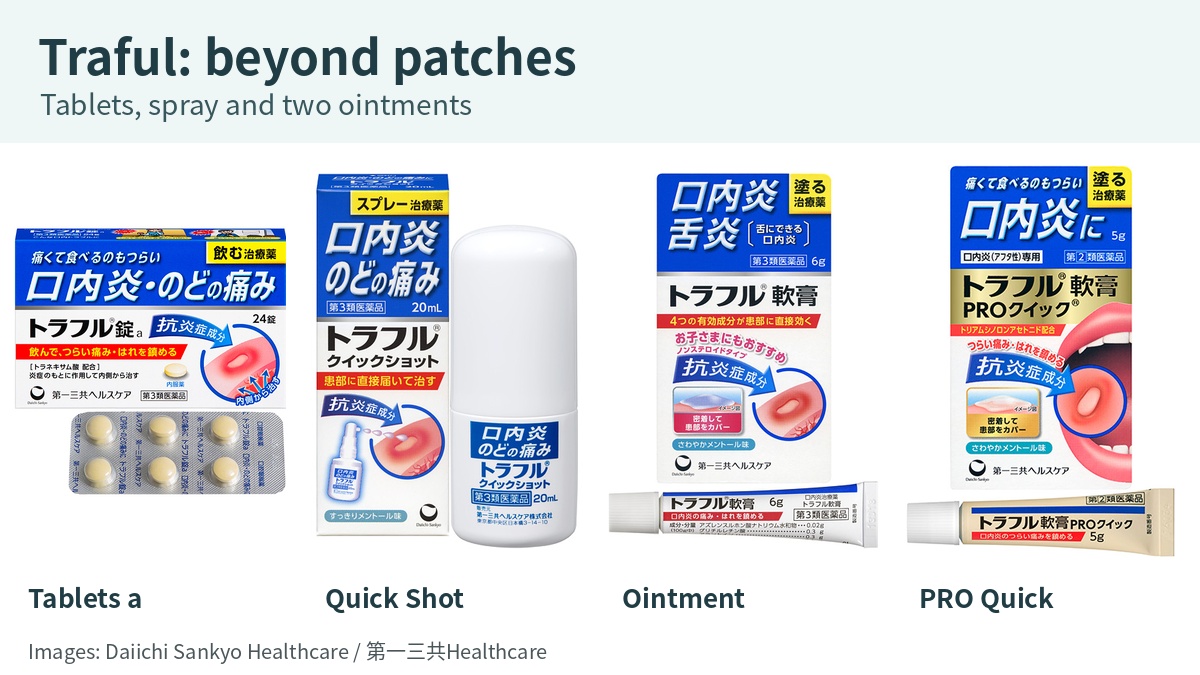
A mouth ulcer is awkward to cover, or you simply dislike having a patch in your mouth. On the Japanese drugstore shelf, Traful also offers tablets, a spray and two ointments. Start with whether self-treatment is appropriate, then choose a form you can use correctly.

I’m Irene, a Taiwan-born, Japan-licensed pharmacist working in a Japanese drugstore. Let’s separate swallowed medicine from products applied to the sore, so the word “Quick” does not have to make the decision for you.
Sources checked: 12 October 2026. This guide covers Japanese-market products; local shop stock is not confirmed.
- Check the sore before choosing the format
- The four boxes solve different practical problems
- Tablets a: swallowed, rather than left on the sore
- Quick Shot: a spray for local application
- Ordinary ointment: non-steroid coverage
- PRO Quick: check the aphthous-ulcer restriction
- Can I combine them? What about pregnancy or breastfeeding?
- Mark the opening date, and keep the treatment limits separate
- Official sources
Check the sore before choosing the format
Yellow pus, widespread white patches that wipe away, numerous small blisters, fever, swollen glands or marked fatigue need assessment by a doctor, dentist or pharmacist. Difficulty placing a patch does not establish the cause of the sore, and suspected infection rules out self-selecting the steroid ointment.
Get medical or dental care for a persistent sore, repeated bleeding, a lump, red or white tissue changes, or difficulty swallowing. A sore still present after about two weeks particularly needs attention. Do not restart the clock by switching products: their own stop-and-consult limits are shorter.
If none of those warning signs applies and you meet the product’s conditions:
- Prefer not to touch the sore? Consider the swallowed “トラフル錠a” tablets from age 7, after checking other oral medicines for tranexamic acid, licorice or glycyrrhizin.
- Want to spray the affected area? Consider “トラフル クイックショット” Quick Shot, provided you can use it without breathing the spray in.
- Want a non-steroid ointment that covers the sore? Consider ordinary “トラフル軟膏”; widespread lesions or ongoing treatment require advice first.
- Considering a local steroid for a suitable aphthous ulcer? Check the infection exclusions and consultation rules before choosing “トラフル軟膏PROクイック”.
The four boxes solve different practical problems
| Product | Route and main ingredients | First check |
|---|---|---|
| Traful Tablets a | Swallowed; tranexamic acid and licorice extract, plus vitamins | Other oral medicines may duplicate ingredients |
| Quick Shot | Sprayed onto the sore; water-soluble azulene | You must be able to spray without inhaling |
| Ordinary Traful Ointment | Applied inside the mouth; four non-steroid actives | Widespread inflammation needs advice |
| Traful Ointment PRO Quick | Applied inside the mouth; triamcinolone acetonide steroid | Aphthous ulcers only; exclude infection |
Pack colour, the name “PRO” and percentages of different drugs do not provide a valid strength ranking.
Tablets a: swallowed, rather than left on the sore
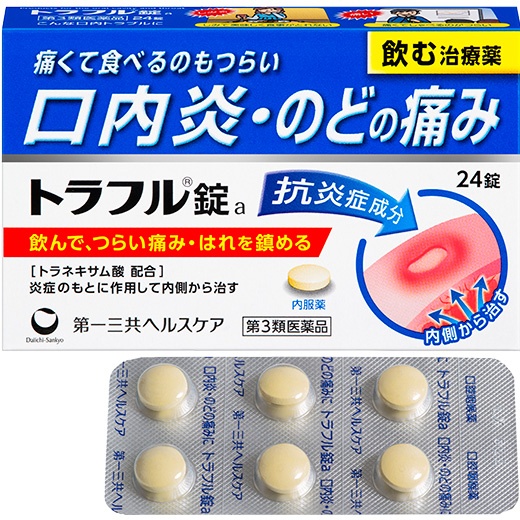
Match the full name “トラフル錠a”, including the final a. This medicine is labelled for mouth inflammation and throat pain or swelling from pharyngitis or tonsillitis. It is not a lozenge to dissolve in the mouth.
The adult daily dose of six tablets contains tranexamic acid 750 mg, crude licorice extract 198 mg (equivalent to 990 mg of crude herb), pyridoxine hydrochloride (vitamin B6) 50 mg, vitamin B2 12 mg and sodium L-ascorbate 500 mg. The vitamins do not make it a supplement for continuous use.
- Ages 15 and over: two tablets per dose, morning, noon and evening.
- Ages 7–14: one tablet per dose, morning, noon and evening, with adult supervision.
- Under 7: do not take.
Swallow with water or warm water, before or after food. Remove each tablet from its blister first; never swallow the packaging.
Check combinations before the first dose. Do not take other oral medicines containing tranexamic acid, licorice or its main constituent glycyrrhizin while taking this product. These may appear in cold, rhinitis, pain, cough or Kampo medicines. Show the pharmacist all the boxes.
Consult first if pregnant or possibly pregnant, older, receiving medical or dental treatment, prone to medicine allergies, or if you have swelling, hypertension, heart or kidney disease, a blood clot or a risk of thrombosis. The manufacturer’s FAQ permits use while breastfeeding, but the other restrictions still apply.
Stop and seek advice immediately for rash, itching, nausea, vomiting, stomach discomfort, appetite changes, dizziness or frequent urination; also stop for persistent or worsening diarrhea. Stop and seek advice if there is no improvement after 5–6 days. Do not use continuously long term; the manufacturer gives roughly one week as a guide when symptoms are improving. Stop and seek medical care immediately for increasing weakness, numbness, stiffness or muscle pain: these may indicate serious licorice-related effects, including pseudoaldosteronism or myopathy.
Quick Shot: a spray for local application
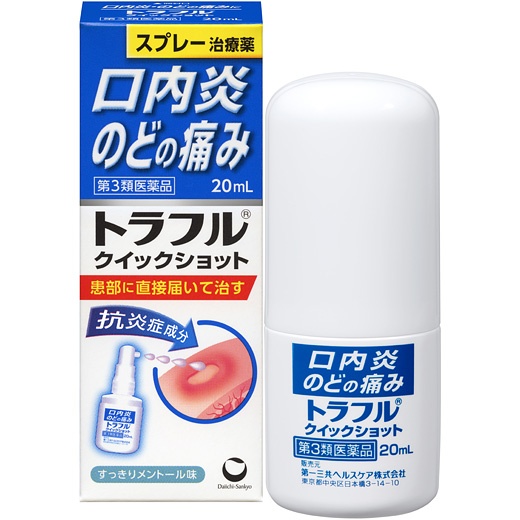
“トラフル クイックショット” contains a menthol-flavoured, gel-like liquid in a 20 mL spray bottle. Its non-steroid active is azulene sulfonate sodium hydrate, 20 mg per 100 g. Labelled uses include mouth inflammation and inflammatory throat symptoms such as soreness, swelling and hoarseness.
Apply an appropriate amount to the affected area several times daily. Before first use, press the pump 4–5 times until liquid appears. That is the initial priming instruction, not a requirement to use 4–5 sprays for every dose.
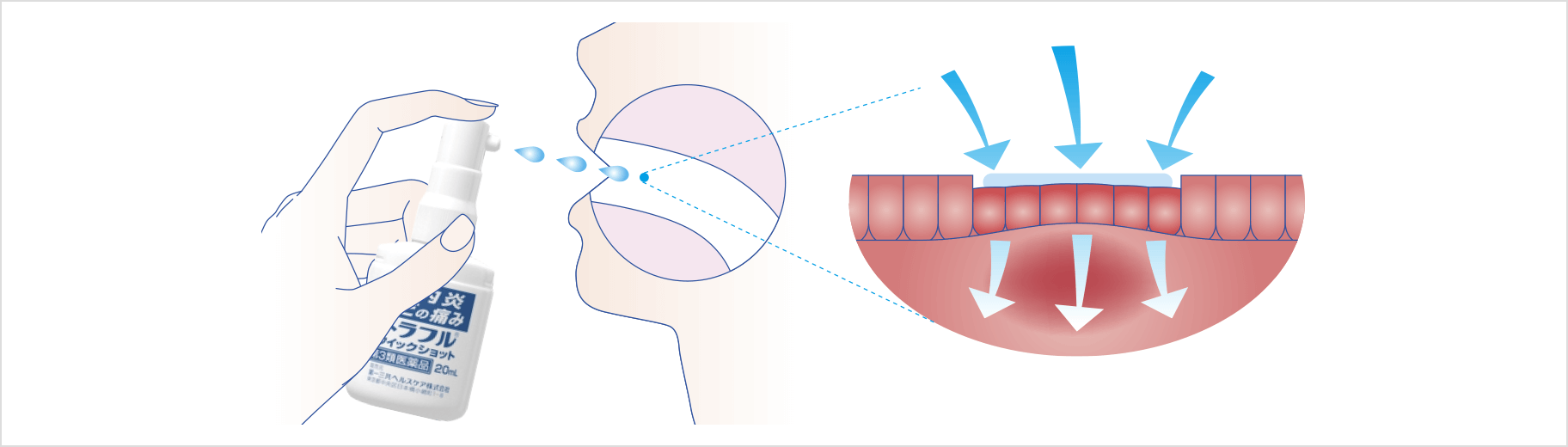
When spraying toward the back of the throat, make a sound while spraying rather than breathing in; inhaling can carry liquid into the airways or lungs. Keep the nozzle from touching your mouth and avoid getting spray in your eyes.
The manufacturer gives no numerical minimum age, but says a child must be able to say “ah” while the spray is used, with adult supervision. That does not establish suitability for babies.
Ask first if you have a history of medicine allergy or severely eroded mouth tissue. Stop and seek advice for irritation, a rash or itching, or if symptoms have not improved after 5–6 days.
Ordinary ointment: non-steroid coverage
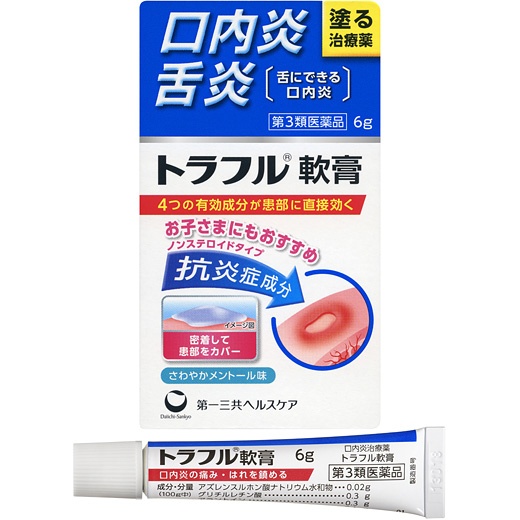
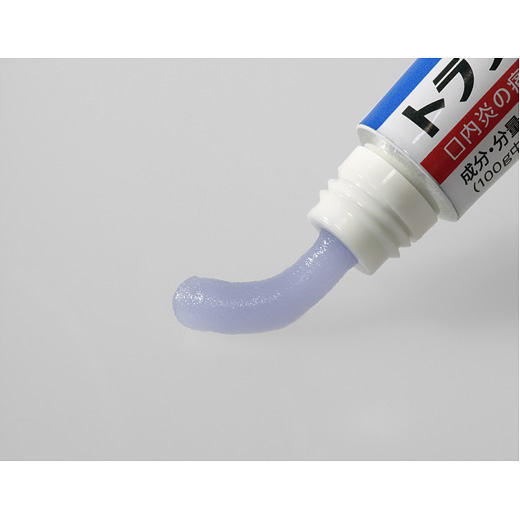
“トラフル軟膏” comes in a 6 g tube. The pale-blue ointment adheres to cover the affected area and is labelled for mouth inflammation and glossitis, or inflammation of the tongue.
Each 100 g contains azulene sulfonate sodium hydrate 0.02 g, glycyrrhetinic acid 0.3 g, allantoin 0.3 g and cetylpyridinium chloride hydrate (CPC) 0.1 g. These provide anti-inflammatory, tissue-repair-supporting and antiseptic actions. An antiseptic ingredient does not make suspected mouth infections appropriate for self-treatment.
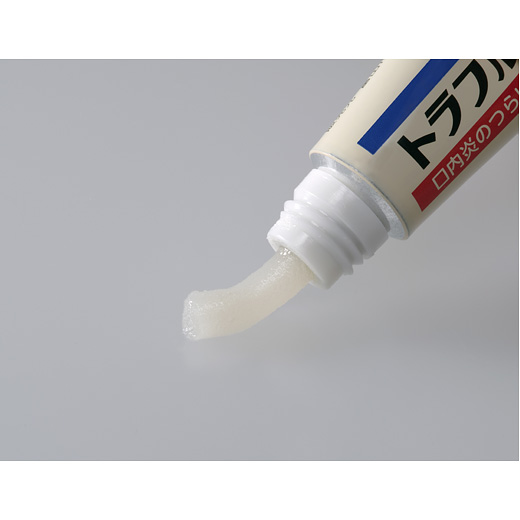
Apply an appropriate amount 2–4 times daily after cleaning the area. Wash your hands, rinse your mouth, cover the sore and avoid touching it afterward; follow your pack’s leaflet for the detailed application technique. Use only inside the mouth. The point inside the reversed cap opens the tube seal.
Consult first if receiving medical or dental treatment, if you have a history of medicine allergy, or if a large area is affected. The manufacturer’s FAQ gives no numerical age limit but requires a child to be able to describe their symptoms, with adult supervision. Its pregnancy and breastfeeding FAQs permit use; assessment of the lesion still matters.
Stop and seek advice for mouth irritation, a rash, redness or itching, or no improvement after 5–6 days.
PRO Quick: check the aphthous-ulcer restriction
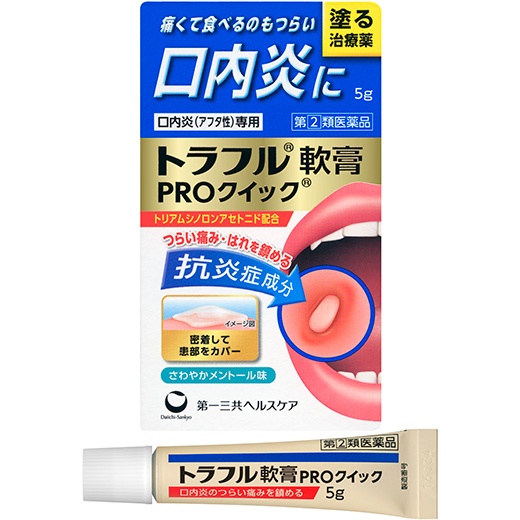
“トラフル軟膏PROクイック” is a 5 g ointment containing triamcinolone acetonide 0.1 g per 100 g, or 0.1%. This is a topical steroid for aphthous mouth ulcers only. The leaflet describes one or a few small, shallow, painful round ulcers, under 10 mm across, with a pale centre and reddish edge, on areas such as the inner cheek, tongue or inner lip. Appearance alone cannot confirm a diagnosis.
Do not use when infection is suspected, or on an area with an oral infection such as gingivitis or periodontal infection. Steroids can worsen infection. Widespread removable white patches, pus, numerous blisters or systemic symptoms need assessment first.
Consult before use if pregnant, possibly pregnant, breastfeeding, older, receiving treatment, prone to medicine allergies, or if the affected area is extensive. Children must be able to describe their symptoms and have adult supervision; the absence of a numerical age restriction is not permission to use it for any young child.
Apply an appropriate amount once to several times daily. Clean your hands and mouth, cover the sore, avoid touching it and avoid eating or drinking for a while afterward. Follow the detailed technique in your pack’s leaflet. Stop once the pain settles. Do not use it outside the mouth or as denture adhesive.
- Worsening after 1–2 days, or no improvement after five days: do not continue; seek advice.
- New white patches, yellow pus, an asthma attack or allergic swelling: stop and get help immediately.
- Fever, spreading lesions, blisters outside the mouth, a rash, eye pain, blurred vision or genital ulcers: stop and seek medical assessment. Breathing difficulty needs emergency care.
Can I combine them? What about pregnancy or breastfeeding?
Do not layer the spray, patches or either ointment on the same sore at the same time. The manufacturer explicitly advises against this. Some oral-plus-topical combinations are permitted, but the tablets’ ingredient-duplication and medical-history restrictions still apply. Adding another product is not automatically useful.
Pregnancy and breastfeeding rules differ: the official FAQs permit ordinary ointment and Quick Shot during both; Tablets a requires consultation in pregnancy, while its breastfeeding FAQ permits use; PRO Quick requires consultation during both pregnancy and breastfeeding. Other medical conditions and ongoing treatment also need consideration.
Mark the opening date, and keep the treatment limits separate
Store all four away from sunlight and children, in a cool place, without transferring them to other containers. Use within six months of opening the tablets’ foil bag, spray bottle or ointment tube, and never beyond the printed expiry date. A six-month storage limit does not mean six months of continuous ulcer treatment.
BB Charge c belongs to a separate vitamin B2/B6 medicine line. The current c version launched on 15 April 2026; the manufacturer says production of the older BB Charge a has ended. It is not the same formula as Tablets a. A mouthwash is also outside this four-product comparison.
If you would consider a patch, see the separate Traful versus Taisho Quick Care mouth-ulcer patch guide. At the shelf, match the complete name and tell the pharmacist your age, other medicines and what the sore looks like. That is more useful than buying all four.
Official sources
- Traful Tablets a: product information and Japanese leaflet
- Quick Shot: product information and Japanese leaflet
- Ordinary ointment: product information and Japanese leaflet
- PRO Quick: product information and Japanese leaflet
- Manufacturer FAQs: children, pregnancy, breastfeeding and combinations
- Current Traful product range
- National Cancer Center Japan: oral warning signs
- National Cancer Center Japan: a mouth sore persisting for two weeks