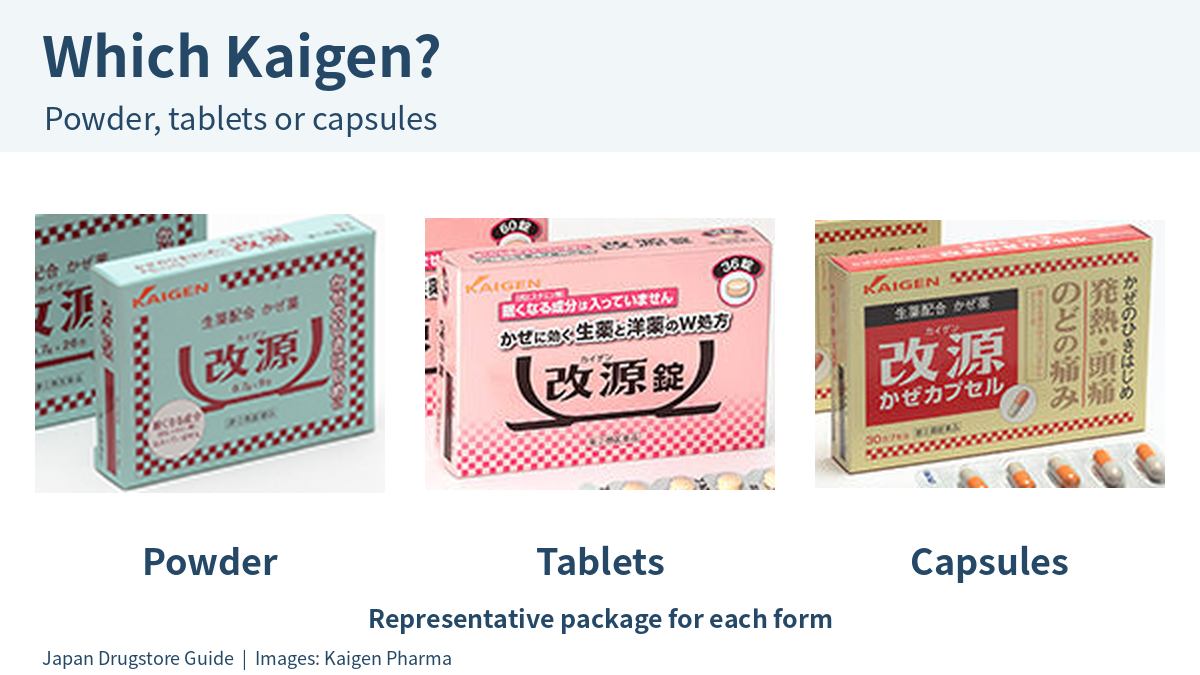
Kaigen’s herbal ingredients can make its powder, tablets and capsules look like one formula in three forms. All three also contain medicines such as acetaminophen, and none contains an antihistamine. But some ingredient amounts, minimum ages and doses differ. First check whether the medicine fits your symptoms, then choose a form you can take correctly.

I’m Irene, a Taiwan-born, Japan-licensed pharmacist working in a Japanese drugstore. This guide compares Kaigen powder (改源), Kaigen tablets (改源錠) and Kaigen cold capsules (改源かぜカプセル), with the Japanese names to help you find the right box.
Checked on 13 October 2026. All three are Designated Class 2 OTC medicines. Do not apply these doses to other Kaigen-branded medicines or throat sweets.
- First, do these medicines fit your symptoms?
- Quick choice: start with a form you can take correctly
- Match the complete name on the box
- Herbal ingredients plus other medicines, with different amounts
- Children’s doses differ substantially
- All three have restrictions on other medicines
- No improvement after 5–6 doses? Stop and seek advice
- Official sources
First, do these medicines fit your symptoms?
All three are labelled for relief of cold-related sore throat, cough, phlegm, chills, fever, headache, joint pain and muscle pain. Runny nose, blocked nose and sneezing are not among their labelled uses. If nasal symptoms are your main problem, ask the pharmacist to help you choose again.
- Seek urgent medical care for difficulty breathing, chest pain, blood in your phlegm, a rapidly worsening cough or feeling very unwell. High fever, pregnancy, breastfeeding, chronic illness or current treatment also needs professional advice; the word “herbal” is not enough to establish suitability.
Quick choice: start with a form you can take correctly
- Comfortable taking powder and its taste? Consider Kaigen powder after checking suitability. It has a distinctive flavour. Children’s doses involve fractions of a sachet, so do not casually estimate a portion.
- Prefer tablets to powder and can swallow them? Consider Kaigen tablets. The adult dose is three tablets three times daily, not the two-capsule dose.
- Prefer capsules? Consider Kaigen cold capsules. Adults take two capsules three times daily; this does not establish that the overall formula or effect is stronger.
| Compare | Kaigen powder | Kaigen tablets | Kaigen cold capsules |
|---|---|---|---|
| Minimum age | 1; under 2 should see a doctor first | 5 | 7 |
| Dose at age 15+ | One sachet | Three tablets | Two capsules |
| Frequency and timing | Three times daily, preferably within 30 minutes after meals | Three times daily, preferably within 30 minutes after meals | Three times daily, preferably within 30 minutes after meals |
| Adult daily acetaminophen | 900 mg | 900 mg | 900 mg |
| Adult daily dl-methylephedrine HCl | 30 mg | 45 mg | 40 mg |
| Adult daily caffeine | 75 mg | 75 mg | 75 mg |
| Runny/blocked nose and sneezing | Not labelled uses | Not labelled uses | Not labelled uses |
| No improvement | Stop and seek advice after 5–6 doses | Stop and seek advice after 5–6 doses | Stop and seek advice after 5–6 doses |
Match the complete name on the box
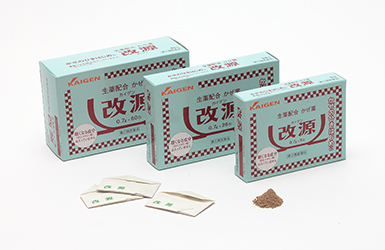
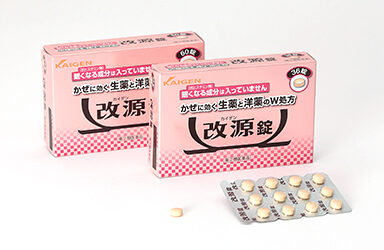
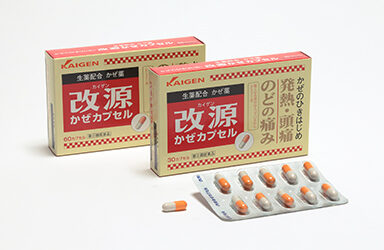
Herbal ingredients plus other medicines, with different amounts
All three contain acetaminophen, dl-methylephedrine hydrochloride, anhydrous caffeine, and powdered liquorice, cinnamon bark and ginger. Their adult daily acetaminophen and caffeine amounts match, but some other amounts differ. Do not swap doses between forms or take them together.
| Herbal ingredients per adult day | Powder: 3 sachets | Tablets: 9 tablets | Capsules: 6 capsules |
|---|---|---|---|
| Powdered liquorice | 200 mg | 225 mg | 200 mg |
| Powdered cinnamon bark | 200 mg | 200 mg | 150 mg |
| Powdered ginger | 100 mg | 150 mg | 135 mg |
The absence of an antihistamine is a feature of these formulas, not a promise of no side effects or fitness to drive while ill. All three leaflets list dizziness among reactions requiring you to stop and seek advice. Do not drive if you feel unwell.
Children’s doses differ substantially
- Kaigen powder per dose: age 15+, one sachet; ages 11–14, two-thirds; 7–10, one-half; 3–6, one-third; 1–2, one-quarter. Do not give to children under 1. For children under 2, medical care takes priority and the leaflet allows use only when unavoidable. A printed dose is not a recommendation to self-treat a toddler.
- Kaigen tablets per dose: age 15+, three tablets; ages 11–14, two; ages 5–10, one. Do not give to children under 5.
- Kaigen cold capsules per dose: age 15+, two capsules; ages 7–14, one. Do not give to children under 7.
Take each product three times daily, preferably within 30 minutes after meals. An adult must supervise children. Do not increase the dose or take it long term. The powder leaflet directs taking it with tea or water; rewrap any remainder from a divided sachet and use within two days. Remove tablets or capsules from the blister before swallowing; never swallow the packaging.
All three have restrictions on other medicines
While taking any of these products, do not take another cold medicine, fever/pain medicine, sedative or cough/expectorant medicine. This includes a familiar painkiller: all three contain acetaminophen, even though the packaging highlights herbal ingredients. Do not drink alcohol before or after taking them.
- Do not take a product if you have had an allergy to it or its ingredients, or asthma triggered by it, another cold medicine or a fever/pain medicine.
- Consult a doctor or pharmacist first if receiving medical or dental treatment, pregnant or possibly pregnant, breastfeeding, older, previously allergic to medicines or experiencing a high fever.
- Consult first if you have a thyroid disorder, diabetes, heart disease, high blood pressure, liver or kidney disease, or a stomach or duodenal ulcer.
No improvement after 5–6 doses? Stop and seek advice
For all three products, stop and take the leaflet to a doctor or pharmacist if symptoms do not improve after 5–6 doses. This is a number of doses, not 5–6 days. Do not wait that long if warning symptoms appear.
Stop and seek advice for a rash, redness, itching, nausea, vomiting, loss of appetite, dizziness or an excessive drop in temperature. Stop and get medical help immediately for breathing difficulty, confusion, a widespread rash with fever or sore/eroded lips, yellow skin or eyes, dark brown urine, reduced urine or swelling throughout the body. Read the leaflet for the full list of serious reactions.
Store away from sunlight in a cool, dry place out of children’s reach. Do not transfer to another container or use after expiry. These are not herbal-only medicines or a direct choice for runny or blocked noses. Check suitability first, then choose by the form you can take correctly and the age-specific dose.
Official sources
Kaigen powder and Japanese leaflet · Kaigen tablets and Japanese leaflet · Kaigen cold capsules and Japanese leaflet