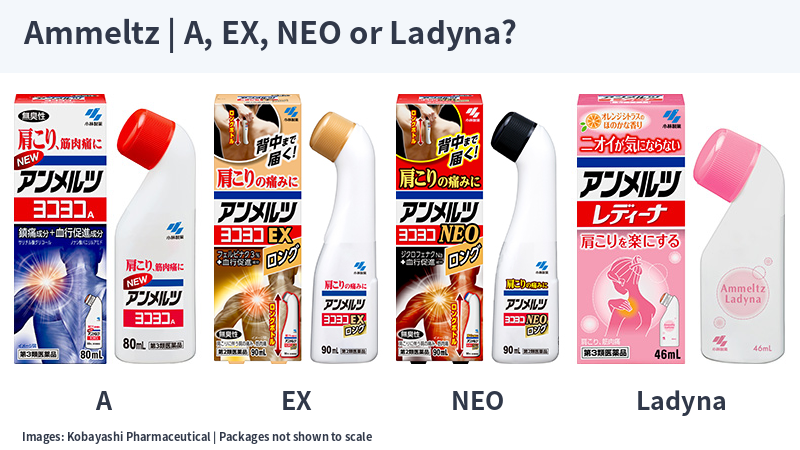
The bent-neck Ammeltz bottle is easy to recognise, but its contents are not all the same. New Yoko Yoko A and Ladyna contain glycol salicylate; EX contains felbinac; NEO contains diclofenac sodium. The restrictions and application schedules differ too. Start with the exact name and whether you can use it, then consider scent and bottle length.

I'm Irene, a Taiwan-born pharmacist licensed in Japan and working in a Japanese drugstore. A familiar bottle shape can make a shelf of pain medicines look simpler than it really is. I'll help you compare these four Japanese-market liquids without using the package colour or cooling sensation as a strength ranking.
Sources checked: 13 October 2026. This guide covers four selected Ammeltz products, not the entire range. Original Yoko Yoko and Gold EX NEO Long Guinuri are separate products outside this comparison. Always check the current leaflet supplied with your exact bottle; overseas versions may differ.
First check whether the product is suitable
Do not use EX or NEO if you are under 15, pregnant or possibly pregnant, have ever had asthma, or have had an allergic reaction to that product or its ingredients. Their leaflets prohibit long-term continuous use. For either, consult a doctor, pharmacist or registered medicine seller first if you are receiving medical treatment or have a history of medicine-related allergy.
A and Ladyna also require consultation before use if you have a history of medicine-related allergy. Their age labelling differs: their current leaflets require adult guidance and supervision when used by children, but do not give a numerical minimum age. That is not a promise of suitability for every child. Ask a pharmacist about the child's age, symptoms and skin before choosing. The absence of EX/NEO's pregnancy prohibition on A or Ladyna is also not proof that either is suitable during pregnancy; ask a healthcare professional rather than substituting it yourself.
Seek prompt medical assessment if shoulder pain occurs with exertion such as climbing stairs, comes with hand numbness or weakness, occurs even when you are not moving the neck or shoulder, or is getting progressively worse. These are not reasons to keep switching bottles.
Match the complete name, then the bottle size
| Product | Main anti-inflammatory/analgesic ingredient | Japanese shelf identifier | Current listed sizes |
|---|---|---|---|
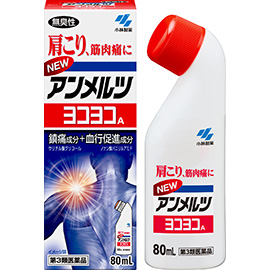
| New Ammeltz Yoko Yoko A | Glycol salicylate | ニューアンメルツヨコヨコA | 46 mL, 80 mL, Long 90 mL |
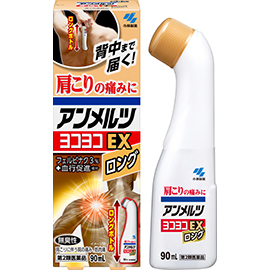
| Ammeltz Yoko Yoko EX | Felbinac | アンメルツヨコヨコEX | 46 mL, Long 90 mL |
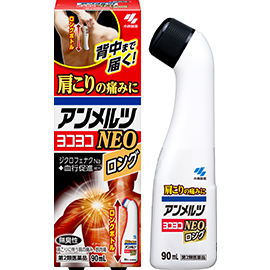
| Ammeltz Yoko Yoko NEO | Diclofenac sodium | アンメルツヨコヨコNEO | 46 mL, Long 90 mL |
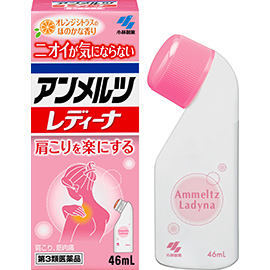
| Ammeltz Ladyna | Glycol salicylate | アンメルツ レディーナ | 46 mL |
A and Ladyna are Japanese Class 3 OTC medicines; EX and NEO are Class 2. These categories are not a numerical ranking of pain relief. A, EX and NEO are described by the maker as low-odour/“odourless”; Ladyna has an orange-citrus fragrance. Fragrance is a preference, not evidence of gentler treatment. Ladyna's feminine packaging does not make it a women-only medicine.
The complete active formulas, with their original unit bases
These are formula concentrations, not amounts to apply. A, EX and Ladyna list ingredients per 100 mL; NEO lists them per 100 g. Mass and volume are not interchangeable. The different ingredients and bases do not support a “3% is three times stronger than 1%” comparison.
| Product and concentration basis | Labelled active ingredients in that quantity |
|---|---|
| New Yoko Yoko A, per 100 mL | Glycol salicylate 2,500 mg; l-menthol 3,000 mg; chlorpheniramine maleate 100 mg; benzyl nicotinate 10 mg; nonivamide 12 mg |
| Yoko Yoko EX, per 100 mL | Felbinac 3 g; l-menthol 6 g; chlorpheniramine maleate 0.1 g; nonivamide 12 mg |
| Yoko Yoko NEO, per 100 g | Diclofenac sodium 1 g; l-menthol 5 g; tocopheryl acetate 0.1 g; nonivamide 12 mg; benzyl nicotinate 10 mg |
| Ladyna, per 100 mL | Glycol salicylate 2,500 mg; l-menthol 3,000 mg; chlorpheniramine maleate 100 mg; tocopheryl acetate 100 mg |
All four contain menthol. A, EX and NEO also contain nonivamide, while Ladyna does not. These are real formulation differences, but stronger cooling, warmth or stinging does not establish better pain relief. Do not add extra applications to chase a sensation. Glycyrrhetinic acid appears among the excipients of EX and NEO; it is not an additional labelled active ingredient in this table.
A and Ladyna are labelled for stiff shoulders, muscle pain or fatigue, lower-back pain, bruises, sprains and joint pain. EX and NEO include shoulder pain associated with stiffness, muscle and joint pain, lower-back pain, bruises, sprains and elbow pain. Their tendon-sheath indications are not identical: EX lists hand, wrist and ankle pain/swelling; NEO lists hand and wrist pain. This comparison does not diagnose the cause of pain.
How often to apply: follow the exact product
All four are external-use liquids. The directions specify an appropriate amount on the affected area, not a fixed number of millilitres or bottle strokes. EX and NEO are for ages 15 and over, subject to the exclusions above. A and Ladyna's child-supervision requirement still applies.
| Product | Labelled application frequency | Important limit |
|---|---|---|
| New Yoko Yoko A | Several times a day | Appropriate amount; adult guidance and supervision for children |
| Yoko Yoko EX | 2–4 times a day | Ages 15+ only; no long-term continuous use |
| Yoko Yoko NEO | 3–4 times a day | Ages 15+ only; no more than 50 g in one week; no long-term continuous use |
| Ladyna | Several times a day | Appropriate amount; adult guidance and supervision for children |
NEO's weekly ceiling is 50 g, not 50 mL. Its bottles are sold by volume, so do not convert that limit into a bottle fraction without reliable product-specific information. Ask a pharmacist if you cannot judge your use. NEO is for relief of existing pain/swelling symptoms, not treatment of the underlying cause or routine preventive application.
NEO also prohibits other topical anti-inflammatory pain medicines during use, including other topical diclofenac products, and other external medicines on the same application site. Consult before use if taking a new-quinolone antibiotic. Bring your medicines or a list to the pharmacist instead of assuming two different brands can be combined.
- Read the full name and supplied leaflet. Check age, allergies, asthma, pregnancy and other medicines before opening.
- Apply only to an appropriate area of intact external skin. Keep all four away from the eyes and mucous membranes, and off eczema, irritated skin and wounds. EX and NEO also exclude fungal or pus-producing lesions; NEO additionally excludes delicate areas such as the face, head and armpits.
- Follow the product's frequency and amount. Do not seal the area under plastic wrap or another poorly ventilated covering. NEO specifically includes support/correction belts in this warning. If your skin is especially sensitive, do not repeatedly apply to the same area.
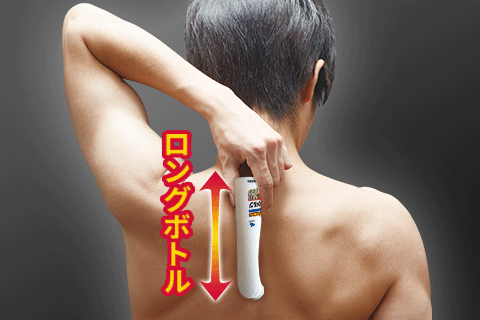
- Close the cap securely after use. Do not use a more forceful rubbing motion or extra medicine to compensate for difficulty reaching the area.
A, EX and NEO specifically warn that application before or after sweating, exercise or bathing can intensify stinging, pain or heat. Their leaflets advise washing off with soap if these sensations are strong; Ladyna also gives soap-washing advice for strong stinging. Do not interpret painful irritation as a sign to keep applying.
Stop rules and storage
For all four, stop and consult a doctor, pharmacist or registered medicine seller if symptoms are not improving after 5–6 days. Stop earlier if a rash, redness, itching, swelling or other suspected adverse skin reaction appears. Bring the package or leaflet. Do not wait for day six if pain is worsening or warning signs appear.
EX and NEO warn about rare anaphylaxis. Trouble breathing, hoarseness, hives, palpitations or confusion soon after use need immediate medical attention. NEO also warns about severe contact dermatitis and photosensitivity: intense itching, redness, swelling, blisters, erosion, pigment changes or white patches may spread or worsen in sunlight. Stop using it and seek immediate medical assessment if these occur.
If any liquid gets into the eyes, rinse immediately with water or lukewarm water. Seek eye-care assessment if symptoms are severe.
Store upright with the cap tightly closed, in a cool, dry place away from direct sunlight and children. NEO should be kept in its box. All contain ethanol: keep away from flames and do not transfer to another container. Follow the expiry date; NEO additionally says to use promptly after opening, without specifying a fixed number of months. A and Ladyna can damage or stain some plastics, synthetic fabrics, finished wood and leather, so avoid accidental contact.
The useful shortcut is exact formula → suitability → directions → bottle preference. If a liquid suits the symptoms and your medical circumstances, a reachable bottle and acceptable scent can help with practical use. Neither “EX,” “NEO,” a long neck nor a pink box replaces those checks.
Official sources
- Kobayashi Pharmaceutical: New Ammeltz Yoko Yoko A product details and current Japanese leaflet.
- Kobayashi Pharmaceutical: Yoko Yoko EX product details and current Japanese leaflet.
- Kobayashi Pharmaceutical: Yoko Yoko NEO product details and current Japanese leaflet.
- Kobayashi Pharmaceutical: Ladyna product details and current Japanese leaflet.
- Kobayashi Pharmaceutical: current lineup, bottle design and ingredient comparison, and reference English/Chinese information. Reference translations do not supersede the supplied Japanese leaflet.
- Japan Physicians Association: Shoulder stiffness patient booklet, third edition, February 2018, printed page 2, for warning signs requiring assessment. This is general symptom guidance, not Japanese product dosing advice.