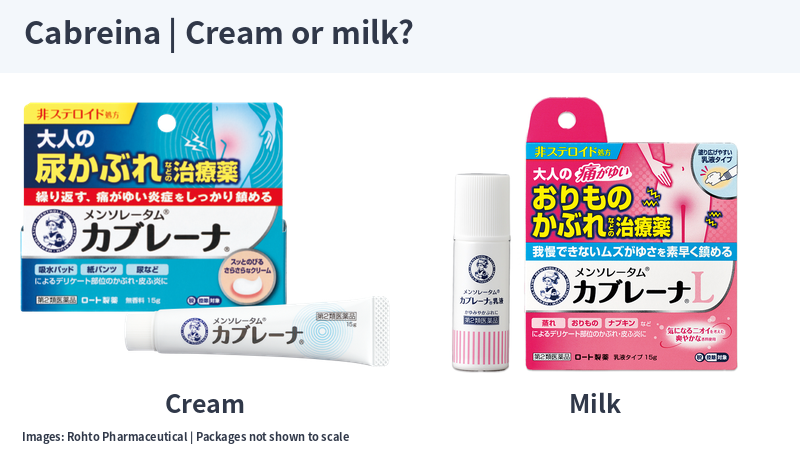
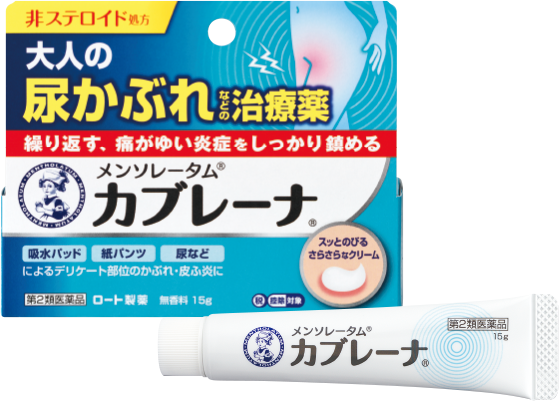
Cabreina cream and Cabreina Milk are non-steroid medicines for irritated, itchy external skin. The cream is fragrance-free; the more fluid milk contains fragrance. Four active ingredients have the same concentrations, while the antibacterial ingredient differs. Before choosing a texture, check that the symptom and application site are suitable.

I'm Irene, a Taiwan-born pharmacist licensed in Japan and working in a Japanese drugstore. Intimate-area itching can be awkward to ask about, but the most useful first question is whether it is skin irritation or something that needs a different assessment. I'll explain the two Cabreina packages without treating every itch as the same problem.
Sources checked: 13 October 2026. This guide covers the Japanese-market Mentholatum Cabreina cream and Cabreina Milk, both 15 g Class 2 OTC medicines. Read the complete current leaflet or carton supplied with the product.
External skin only: when to get advice first
Do not apply either product to the eyes, around the eyes, or mucous membranes such as the lips. Do not put it inside the vagina. The fact that a product is sold for the “delicate area” does not make every surface in that area an appropriate application site.
If intimate itching is new and unexplained, very strong or widespread, or comes with blisters, ulcers or a change in your usual vaginal discharge, seek medical assessment rather than choosing by fragrance or package colour. These medicines are labelled for skin inflammation and itching; they are not vaginal yeast-infection treatments. An antibacterial ingredient does not establish that an infection has been identified or treated.
For both products, consult a doctor, pharmacist or registered medicine seller before use if you are receiving medical treatment, have previously had an allergic reaction to medicines or similar substances, or the affected skin is severely wet, weeping or eroded.
Cream or milk: the useful differences
| Comparison | Cabreina cream | Cabreina Milk |
|---|---|---|
| Japanese sales name | メンソレータム カブレーナ | メンソレータム カブレーナ乳液 |
| Texture | Cream | More fluid, spreadable emulsion |
| Fragrance | Fragrance-free | Contains fragrance |
| Antibacterial ingredient | Benzethonium chloride | Isopropyl methylphenol |
| Manufacturer's main positioning | External skin irritation associated with urine or absorbent pads | External skin irritation associated with discharge, moisture or sanitary pads |
Both have the same labelled indications: contact irritation, diaper rash, dermatitis, itching, eczema, skin erosion and heat rash. Their different package positioning is not a diagnostic test, and severe weeping or erosion still requires consultation. The milk's fragrance is not treatment for the cause of unusual discharge or odour.
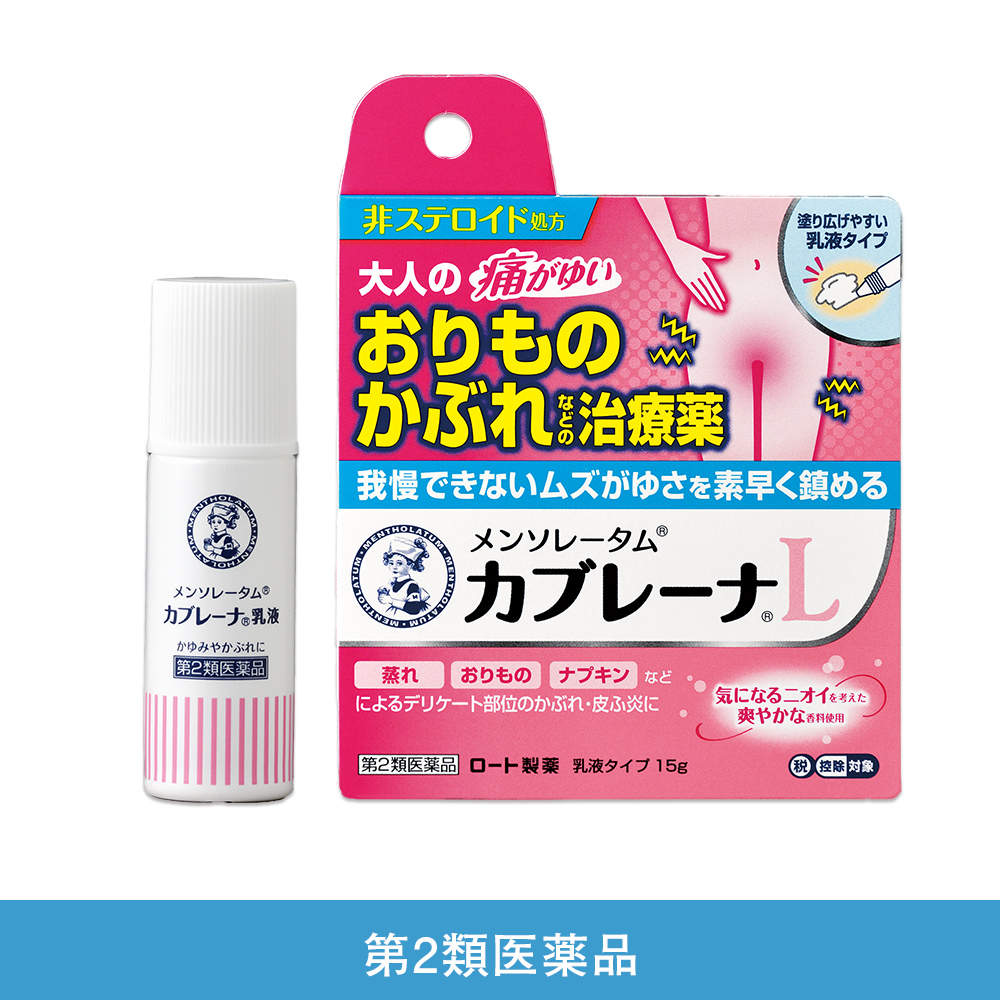
Four shared concentrations, one different antibacterial ingredient
The following quantities are per 1 g of medicine. They describe concentration, not the amount to apply or a daily dose. The milk's official table is per 100 g; its values have been divided by 100 here.
| Active ingredient | Cream, per 1 g | Milk, per 1 g |
|---|---|---|
| Ufenamate | 50 mg (5%) | 50 mg (5%) |
| Diphenhydramine | 10 mg (1%) | 10 mg (1%) |
| Glycyrrhetinic acid | 3 mg (0.3%) | 3 mg (0.3%) |
| Tocopheryl acetate | 5 mg (0.5%) | 5 mg (0.5%) |
| Benzethonium chloride | 1 mg (0.1%) | Not listed |
| Isopropyl methylphenol | Not listed | 2 mg (0.2%) |
Ufenamate and glycyrrhetinic acid address inflammation; diphenhydramine reduces itching. The antibacterial ingredients are different substances, so 0.2% versus 0.1% is not proof that the milk is twice as strong. Neither product contains a steroid. Non-steroid does not mean free of irritation, allergy or application-site restrictions.
If a pharmacist confirms that one of these medicines fits the skin problem, fragrance-free cream may suit someone who wishes to avoid fragrance; the milk offers a more fluid application texture. Neither choice overrides a known ingredient allergy. Do not layer both on the same area just to obtain both antibacterial ingredients.
How to apply them
Both labels say to apply an appropriate amount to the affected area several times a day. They do not specify a fixed gram amount or an exact number of daily applications.
- Confirm that the area is suitable external skin and that the symptom has been assessed when needed.
- Clean the affected skin gently before use. Avoid rubbing it hard.
- Apply an appropriate amount of the chosen medicine to that area. Keep it away from the eyes and mucous membranes; use externally only.
- Close the container after use and monitor the skin. Stop if irritation or the other adverse symptoms below appear.
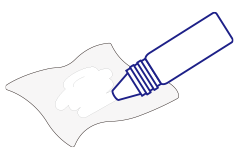
For Cabreina Milk, Rohto says it can be placed on a tissue for application when hygiene is a concern. This remains an external-skin application method, not a vaginal insertion method.
Does the adult-focused packaging mean adults only?
The current leaflets do not set a numerical minimum age and both require parental guidance and supervision when used in children. Rohto's cream FAQ says it can be used for children's diaper rash, while the milk's brand FAQ says it is not restricted by age. These statements do not diagnose a baby's rash or make every genital symptom suitable for self-treatment. Ask a pharmacist or clinician about the actual child and affected skin before choosing.
Stop if the skin reacts, or if it does not improve
Stop immediately and consult with the leaflet or carton if a rash, redness, itching, swelling, stinging, heat sensation or dryness develops. If symptoms have not improved after about one to two weeks, stop and consult. Do not wait that long with worsening symptoms or the assessment signs described above.
If the medicine enters an eye, immediately rinse with water or lukewarm water. Seek ophthalmic care if symptoms are severe.
Also reduce the trigger where possible: change pads regularly, avoid materials that irritate your skin and avoid tight clothing that traps moisture. Gentle cleaning is enough; vigorous scrubbing can add irritation. Repeatedly returning symptoms deserve review even if an itch medicine temporarily helps.
Keep the container tightly closed, out of children's reach and away from direct sunlight. The cream leaflet specifies a cool place; the milk additionally specifies low humidity. Do not transfer either to another container. Use promptly after opening and never after the printed expiry date; the labels do not give a fixed number of months after opening.
Official sources and image credits
- Rohto: Cabreina cream product information and current Japanese leaflet.
- Rohto: Cabreina Milk product information and current Japanese carton-label document.
- Rohto: cream brand page, milk texture and application FAQ and cream children's-use FAQ.
- Rohto: causes of intimate-area itching and when to seek assessment.
- Package photographs and milk-application illustration: Rohto Pharmaceutical, from its official brand pages and store.