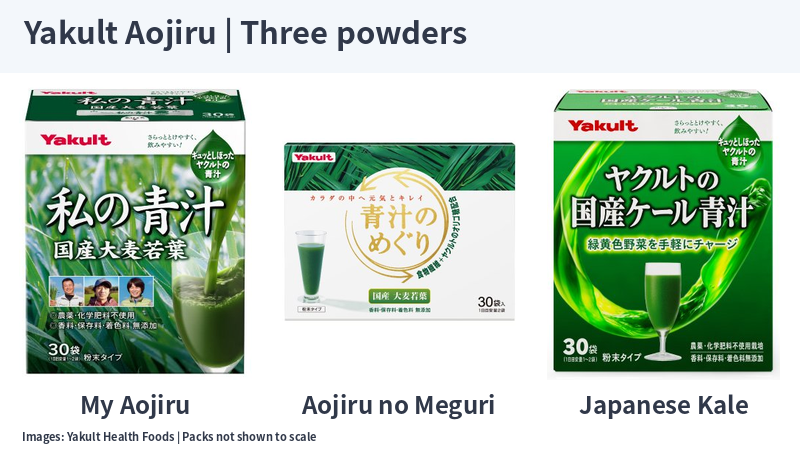
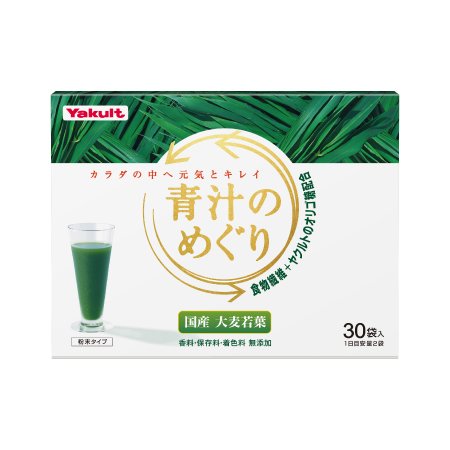
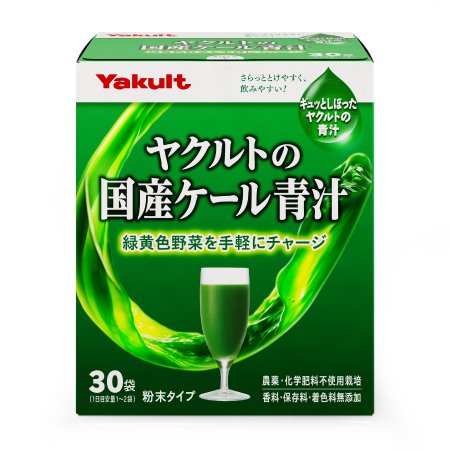
Start with the plant and the added ingredients. My Aojiru is a barley-grass blend; Aojiru no Meguri adds galactooligosaccharides to its barley-grass formula; Japanese Kale Aojiru uses kale extract powder. None should be assumed to contain live bacteria simply because the box says Yakult.

I’m Irene, a Taiwan-born, Japan-licensed pharmacist working in a Japanese drugstore. For green powders, I would check the sachet weight and the daily guide before counting how long a box will last. Thirty sachets can mean 15 days rather than a month.
Sources checked October 14, 2026, Japan time. This comparison covers the three specified Japanese-market products and uses their 30-sachet boxes for pack-duration examples. Other Yakult powders, including similarly named functional or prebiotic versions, have separate labels.
- Which formula should you look at first?
- Read the name, not just the green box
- Nutrition for two sachets, with the daily guide kept separate
- Added oligosaccharides are not live bacteria
- One sachet is mixed with about 100 ml
- Check medicines and allergies before choosing
- Where to look in Japan
- My shopping takeaway
- Official sources and image credits
Which formula should you look at first?
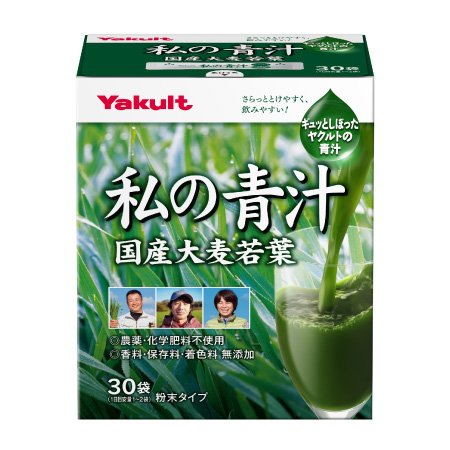
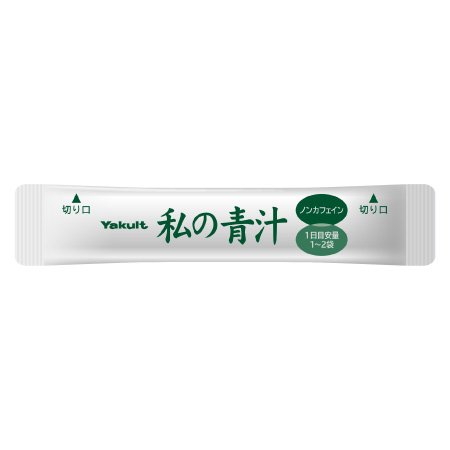
- My Aojiru, 私の青汁: barley grass with soluble dietary fiber and dextrin. The maker’s daily guide is one to two 4 g sachets.
- Aojiru no Meguri, 青汁のめぐり: barley grass, dextrin, galactooligosaccharide powder and soluble fiber. Its guide is two 7.5 g sachets a day.
- Japanese Kale Aojiru, ヤクルトの国産ケール青汁: kale extract powder, including dextrin, plus soluble fiber. Its guide is one to two 4 g sachets a day.
Read the name, not just the green box
Nutrition for two sachets, with the daily guide kept separate
The maker publishes nutrition per two sachets for all three: 8 g My Aojiru, 15 g Aojiru no Meguri and 8 g Japanese Kale. Two sachets are Meguri’s daily guide and the upper end of the one-to-two-sachet guide for the others. Figures cover powder only, excluding milk or other mixing ingredients.
| Exact powder, 2 sachets | Energy | Fiber | Vitamin K | Other distinction |
|---|---|---|---|---|
| My Aojiru, 8 g | 24 kcal | 2.6 g | 90 micrograms | Barley grass, soluble fiber, dextrin |
| Aojiru no Meguri, 15 g | 48 kcal | 3.0 g | 86 micrograms | Galactooligosaccharides 2.5 g |
| Japanese Kale Aojiru, 8 g | 25 kcal | 1.6 g | 45 micrograms | Kale extract powder and soluble fiber |
For a 30-sachet box, My Aojiru and Japanese Kale provide 15–30 days at their one-to-two-sachet guide. Meguri provides 15 days at two sachets a day. The larger weight of a Meguri sachet does not mean it is simply a stronger version of My Aojiru: its recipe also differs.
Added oligosaccharides are not live bacteria
The ingredient lists for these three powders do not list lactic acid bacteria. Meguri’s additional ingredient is galactooligosaccharide powder. Do not transfer the ingredients or expectations of Yakult’s fermented drinks to an aojiru powder. “Aojiru” means a green plant drink category, not one fixed recipe.
These are dietary supplements in the form of food powders, not medicines for constipation or products that replace vegetables. A scoop of powder cannot reproduce the variety and texture of an ordinary mixed diet. Choose it as an addition if it fits your meals, rather than a reason to skip vegetables.
One sachet is mixed with about 100 ml
- Check the full product name and how many sachets its daily guide specifies.
- Dissolve one sachet in about 100 ml water, milk or another suitable drink, following the product directions. Mixing with milk changes both nutrition and allergens.
- Prepare it when you want to drink it. Yakult advises against making aojiru in advance and asks you to drink it promptly.
- Store unopened powder away from heat, humidity and direct sunlight; check the package’s best-before date and opening instructions.
Check medicines and allergies before choosing
All three contain vitamin K. Yakult specifically asks people taking warfarin, or other prescription medicines, to consult their doctor or pharmacist before drinking aojiru. If you have been told to restrict vitamin K, show the product and planned amount to your care professional first. A lower number in the table does not make one product automatically suitable.
The maker states that none of the 28 allergens covered by its declaration is contained in these three powders. That is not a guarantee against every possible allergy; check the actual ingredients and any drink you add. My Aojiru and Meguri warn that large amounts at once may cause loose stools. Stop if a powder does not agree with you.
Yakult’s general aojiru FAQ gives elementary-school age as its starting point and emphasizes balanced meals. For a younger child, ask a health professional before use rather than scaling down the adult portion. During pregnancy or breastfeeding, the maker recommends consulting a doctor as a precaution.
Where to look in Japan
The official pages list drugstores, pharmacies and supermarkets as sales channels for My Aojiru and Japanese Kale. Aojiru no Meguri’s page currently lists Amazon.co.jp. Check availability before planning a shopping stop; the three products should not be assumed to sit together in every drugstore.
My shopping takeaway
Choose between barley grass, a barley-grass blend with oligosaccharides, and kale first. Then compare the amount you will actually drink and how many days the box supplies. If medicines or a vitamin K restriction are involved, that suitability check comes before flavor or value for money.
Official sources and image credits
- Yakult My Aojiru: ingredients, portions, nutrition and sales channels
- Yakult Aojiru no Meguri: ingredients, two-sachet guide and sales channel
- Yakult Japanese Kale Aojiru: ingredients and nutrition
- Yakult Health Foods FAQ: medicines, children, preparation and storage
Product and sachet photographs: Yakult Health Foods.