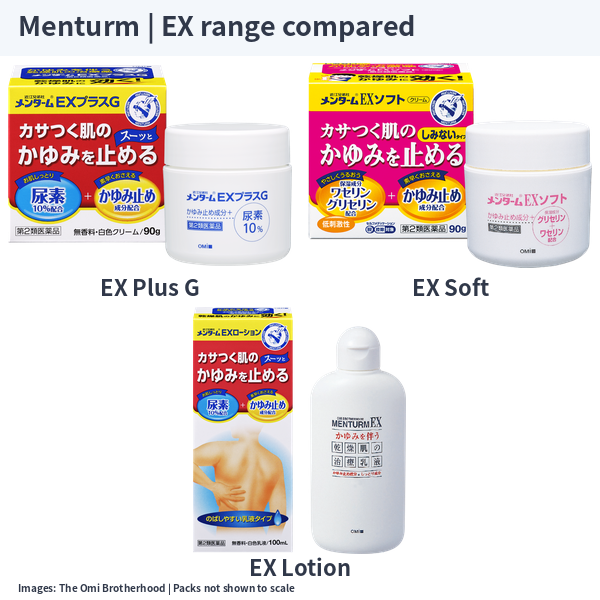
For itchy dry skin, Menturm EX Plus G and EX Lotion share the same five active ingredients, including 10% urea. EX Soft is a different formula without urea, with different labelled uses and a shorter non-improvement deadline. Choose by the skin problem and application restrictions before deciding whether you prefer a jar or a lotion bottle.

I'm Irene, a Taiwan-born pharmacist licensed in Japan, currently working in a Japanese drugstore. With the EX range, I want to help you separate a texture preference from a change in medicine, especially when shopping for a child or skin that stings easily.
Sources checked on 14 October 2026 (Japan time). This guide covers the current Japanese EX Plus G cream (90 g and 150 g), EX Lotion (100 mL) and EX Soft cream (90 g), all Class 2 OTC medicines. It uses the current G label, not an older EX Plus formulation.
First, match the kind of itch
- Itchy dry skin with no prohibited application-site problem: Plus G and Lotion are the same active-formula options in different formats.
- Prefer to avoid urea: Soft contains none, but it still contains itch medicines and has its own precautions.
- Red, swollen, wounded, severely eroded or deeply cracked skin: do not simply put the urea versions on it; their labels exclude these sites.
- A rash whose cause is unclear, or one that keeps worsening: ask for assessment rather than treating every itch as dryness.
The three versions at a glance
This table compares pack sizes and daily application frequency, not a measured gram dose. All three require adult supervision for children. Age notes are manufacturer FAQ guidance: approximately 6+ for Plus G and 1+ for Soft, starting with a small amount; the reviewed Lotion sources do not establish a numerical age guideline.
| Product / Japanese shelf name | Pack and formula distinction | Labelled application | If not improving, stop and consult |
|---|---|---|---|
| EX Plus G / メンタームEXプラスG | Cream, 90 or 150 g; 10% urea | Appropriate amount, 1 to several times daily | After about 2 weeks |
| EX Lotion / メンタームEXローション | Lotion, 100 mL; same active formula as G | Appropriate amount, 1 to several times daily | After about 2 weeks |
| EX Soft / メンタームEXソフト | Cream, 90 g; no urea | Appropriate amount, several times daily | After 5–6 days |
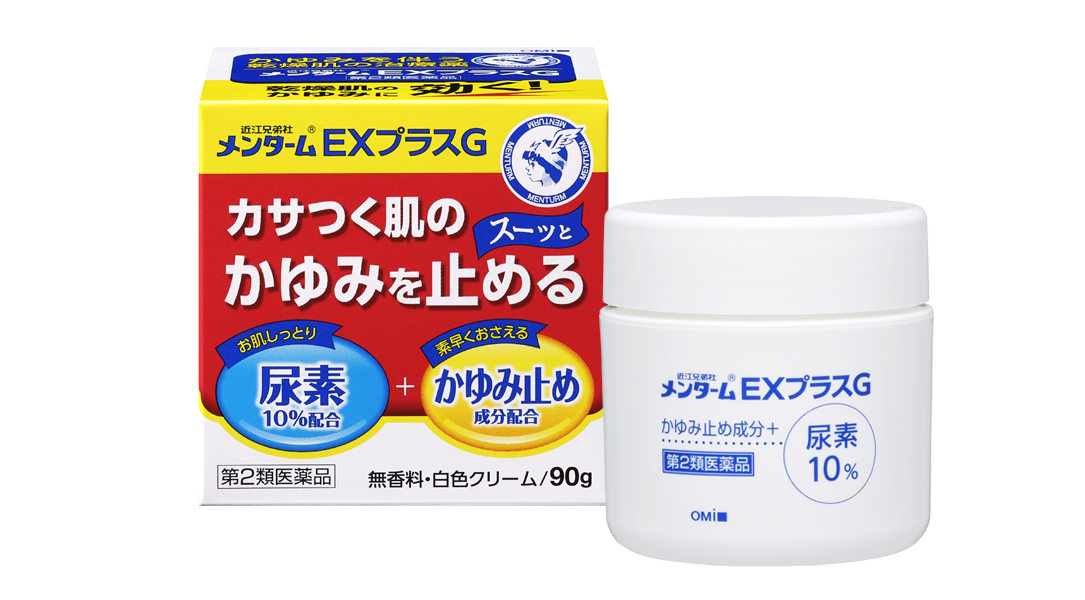
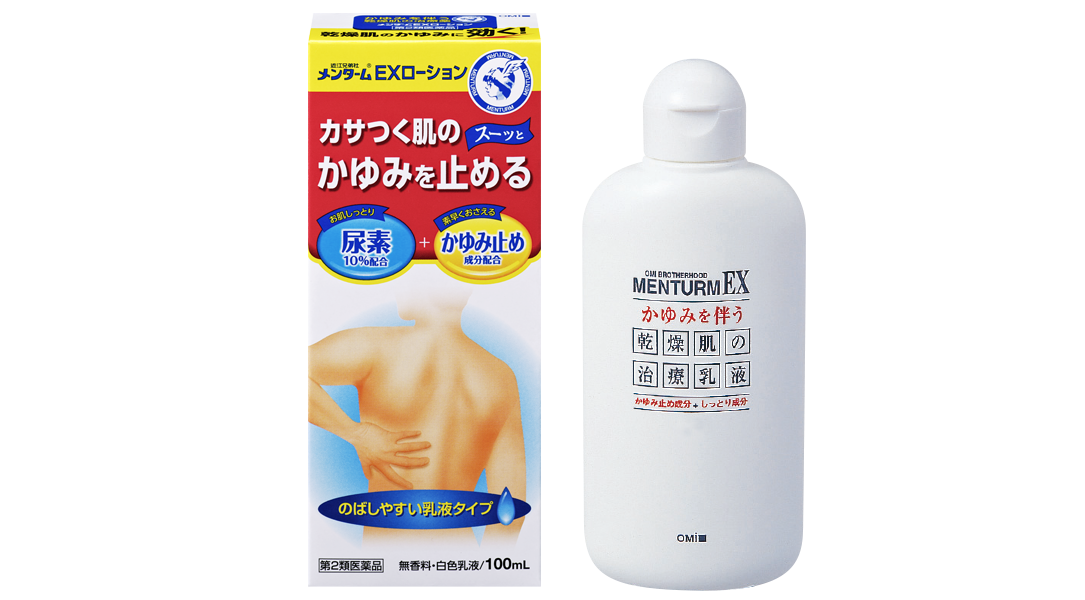
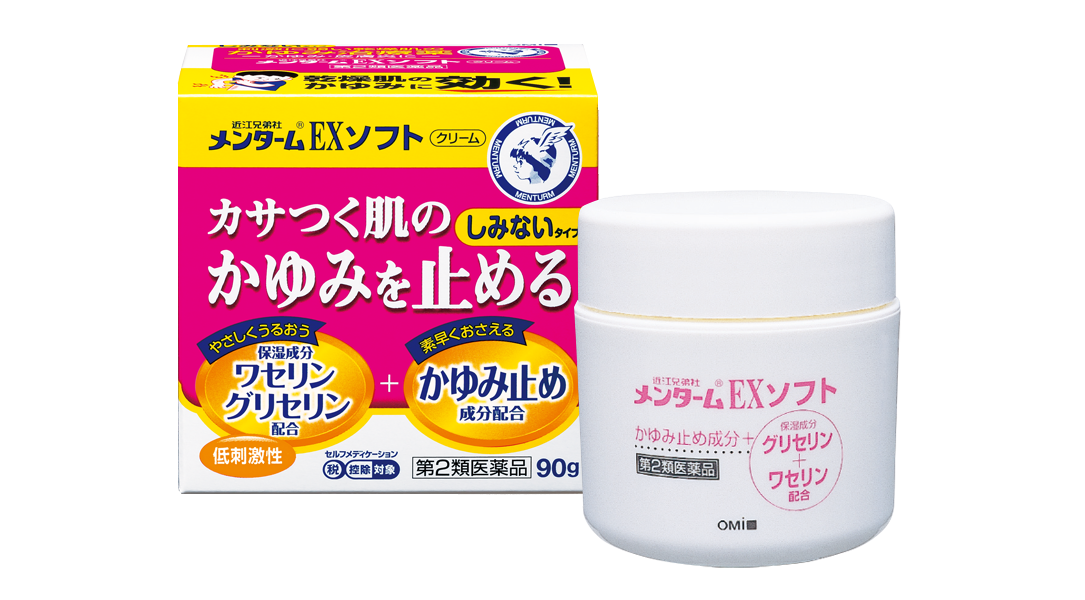
Same actives in G and Lotion; a different formula in Soft
Every amount below is grams per 100 g of product, the manufacturer’s concentration basis. This is true even though Lotion is sold in a 100 mL bottle: 100 mL must not be substituted for 100 g. The comparison is not a single application or daily dose; use follows the age-qualified directions above.
| Active ingredient | Plus G and Lotion, per 100 g | Soft, per 100 g |
|---|---|---|
| Urea | 10 g | Not included |
| Diphenhydramine hydrochloride | 1 g | 2 g |
| Lidocaine | 2 g | 2 g |
| d-Camphor | 1 g | Not included |
| Tocopherol acetate (vitamin E) | 0.3 g | 0.5 g |
| Glycyrrhetinic acid | Not included | 0.2 g |
| Panthenol | Not included | 1 g |
G and Lotion combine urea for moisture retention with itch-relieving medicines. Lotion is described by the maker as easy to spread over a wider affected area; this is a format advantage, not evidence of better treatment. Soft contains more diphenhydramine hydrochloride per 100 g than G/Lotion, but that alone does not prove greater overall effectiveness. All three are steroid-free; Soft also excludes urea, menthol, fragrance and colourants. “Soft” is not a guarantee against allergy or irritation.
G and Lotion are specifically indicated for itchy dry skin, including dry-skin conditions in older adults, adults and children. Soft’s label covers itching, dermatitis, contact irritation, eczema, hives, heat rash, chilblains, insect bites and skin erosion. A wider list of indications does not make it the right medicine for every rash; severe weeping or erosion needs consultation before Soft is used.
What do the age recommendations actually mean?
The leaflets do not print a numerical minimum age. The maker’s FAQ gives a practical starting-age guide of 6 years and older for Plus G, and 1 year and older for Soft, with a small amount first. These are product-specific guidance, not proof that every child at that age is suitable. Do not transfer G’s six-year guide to Lotion just because its actives match. For a younger child, an extensive rash or uncertain symptoms, ask a pharmacist or doctor with the exact product and age.
Avoid the wrong application site
- G and Lotion: do not apply around the eyes or to mucous membranes, wounds, red swollen areas, or severely eroded or cracked skin. Their leaflets explicitly say not to use them on the face for routine cosmetic skin care.
- Soft: do not apply to wounds, around the eyes or to mucous membranes. Severe weeping or erosion requires advice first.
- All three: consult before use if under medical treatment or with a medicine-allergy history. G/Lotion also mention a history of irritation. These are medicines for labelled symptoms, not replacements for ordinary everyday moisturisers.
A simple use-and-review routine
- Check the exact name and affected skin area. For a child, use only under adult supervision and follow the product-specific suitability advice.
- Apply an appropriate amount at the labelled frequency: G/Lotion 1 to several times a day; Soft several times a day. Do not swallow.
- Avoid transferring the medicine from your fingers into your eyes or onto mucous membranes. If it gets into the eye, rinse immediately with water or lukewarm water and obtain eye care for severe symptoms.
- Close the container after use and store away from heat, direct sunlight and children, preferably in a dry, cool place. Keep the original container and note when you opened it.
Stop immediately and consult for rash, redness, itching or swelling after use. G and Lotion additionally list irritation with pain, heat or tingling, and skin peeling like a scab. Do not persist through these symptoms because the product is steroid-free. If there is no improvement, G/Lotion say to stop and consult after about two weeks; Soft says after 5–6 days. Seek advice sooner if the condition worsens.
All leaflets say to use promptly after opening and never after expiry. The FAQ gives approximately six months after opening as a storage-dependent guide for Plus G and Soft. It is not a guarantee that a poorly stored product remains usable, and this FAQ number should not automatically be assigned to Lotion.
If the urea formula suits your skin, G versus Lotion is largely a format choice between the same actives. Soft changes the active formula and label scope, so check it as a separate medicine. Skin condition, age guidance and the stop date are more useful than treating the three names as a strength ladder.