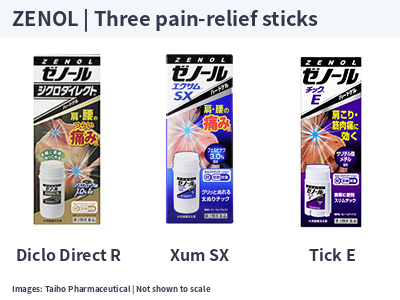
The twist-up format is similar, but the medicines are different. ZENOL Diclo Direct R contains diclofenac; Xum SX contains felbinac; Tick E uses methyl salicylate with three other actives. Check age, asthma and pregnancy restrictions before choosing a stick. Do not choose by the largest percentage or the strongest cooling sensation.

I'm Irene, a Taiwan-born pharmacist licensed in Japan, currently working in a Japanese drugstore. A stick can be convenient when you do not want cream on your fingers, but I still start with the ingredient and the person's situation, not the shape of the container.
Sources checked on 14 October 2026 (Japan time). This guide compares the three currently listed sticks: Diclo Direct R 42 g, Xum SX 43 g and Tick E 33 g. Taiho’s current product index explicitly marks Xum FX and Xum liquid gel as manufacturing ended. Older four-product comparisons can therefore describe a different lineup; manufacturing ended does not establish whether a particular shop still has stock.
- Choose by restrictions and symptoms first
- The practical differences
- Percentages compare concentration, not clinical strength
- R and SX: the restrictions to check before purchase
- Tick E has its own precautions
- Use the stick without scraping the skin
- Stop sooner for a reaction
- Official sources and image credits
Choose by restrictions and symptoms first
- If you are 15 or older and considering an anti-inflammatory pain medicine: compare R and SX by their actual ingredients and directions with a pharmacist. Neither label supports a universal “stronger” winner.
- If you have ever had asthma, or are pregnant or possibly pregnant: do not use R or SX. Ask about a suitable option instead of automatically switching to Tick E.
- For a child: R and SX are prohibited under 15. Tick E gives an adult-supervision instruction but no numerical minimum age, so ask a pharmacist about the specific child.
- Seek medical assessment if injury pain is severe, worsening or not improving; do not keep covering it up with a pain-relief stick.
The practical differences
The table lists the amount in one container and the labelled frequency of applying an appropriate amount to the affected area. It is not a gram-per-application prescription. R and SX are for ages 15+; Tick E has no numerical minimum in the reviewed Japanese label and requires adult supervision when used by children.
| Product / Japanese shelf name | One container / category | Labelled daily application | Stop and consult if not improving |
|---|---|---|---|
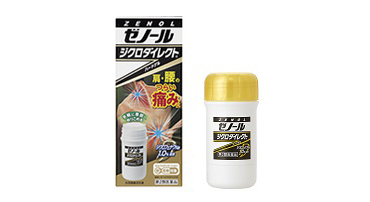
| Diclo Direct R / ゼノールジクロダイレクトR | 42 g; Class 2 | 3–4 times; no more than 50 g per week | After 5–6 days |
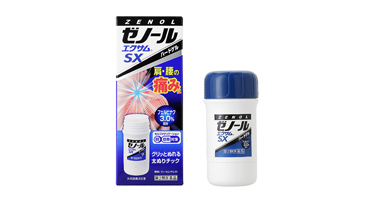
| Xum SX / ゼノールエクサムSX | 43 g; Class 2 | 2–4 times | After about 1 week |
| Tick E / ゼノールチックE | 33 g; Class 3 | Usually 1 to several times | After about 5–6 days |
Percentages compare concentration, not clinical strength
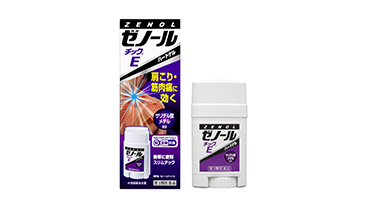
All quantities below are grams of active ingredient per 100 g of the product, equivalent to weight percentages, not the amount in one stick or one application. These are the full active formulas for the age-qualified uses above. Comparing 1% diclofenac with 3% felbinac or 17.5% methyl salicylate does not establish relative effectiveness.
| Product | All active ingredients per 100 g |
|---|---|
| R | Diclofenac sodium 1 g; l-menthol 3 g |
| SX | Felbinac 3 g; l-menthol 3 g |
| Tick E | Methyl salicylate 17.5 g; l-menthol 6 g; dl-camphor 5 g; glycyrrhetinic acid 0.02 g |
R and SX list joint pain, muscle pain, shoulder pain associated with stiffness, lower-back pain, bruises, sprains, tendon-sheath inflammation and elbow pain. The wording is not identical: R specifies hand/wrist pain for tendon-sheath inflammation; SX includes hand, wrist and ankle pain and swelling. Tick E lists shoulder stiffness, muscle fatigue, muscle pain, lower-back pain, joint pain, bruises, sprains and chilblains. This comparison explains Japanese label scope; it does not diagnose the cause of your pain.
R and SX: the restrictions to check before purchase
Both prohibit use after an allergy to the product or its ingredients, with any history of asthma, during pregnancy or possible pregnancy, and under age 15. Do not apply around the eyes or to mucous membranes, eczema, irritated skin, wounds, fungal infections or pus-producing lesions. R also explicitly excludes delicate skin such as the face, scalp and armpits. Consult before use if receiving medical treatment or with a medicine-allergy history; R additionally requires consultation when receiving fluoroquinolone antibiotics.
R must not be combined with other topical pain-relief/anti-inflammatory medicines, and its instructions also prohibit other topical products on the application site. Do not use it continuously long term; use only when symptoms are present, and do not exceed 50 g in a week. Both R and SX prohibit sealing the treated area with poorly breathable material such as plastic wrap. A patch over a stick application is not a shortcut to stronger relief.
Tick E has its own precautions
Do not apply Tick E around the eyes, to mucous membranes, eczema, irritated skin or wounds. Ask before use if you have had an allergic reaction to medicines. Its child-supervision wording does not make it an automatic choice for infants, pregnancy or someone excluded from R/SX. Tell the pharmacist the age, medical history and other medicines so suitability can be checked individually.
Use the stick without scraping the skin
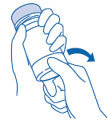
- Check that the skin area is appropriate and wipe off sweat. These products are for external use only; never swallow them.
- Turn the base to expose about 4–5 mm of medicine, so the container edge does not contact the affected skin. Apply an appropriate amount at the frequency for your exact product.
- Stop using R or SX once the support tray becomes visible and its upper surface is exposed. For Tick E, stop when the support tray is visible and becomes unstable. Do not force out or scrape up the remnants.
- Close the cap properly after use. Keep cool, away from sunlight, children and flame; do not throw the container into fire. The medicine can damage certain coatings, fabrics and leather. Use promptly after opening and never past expiry.
Stop sooner for a reaction
Stop and seek advice for new rash, redness or itching with any of the three. R and SX also list other local reactions such as swelling and irritation; R lists pain, heat, rough or peeling skin, blisters and pigmentation changes. Severe itchy inflammation, blistering, pale or dark patches, or a reaction triggered or worsened by sunlight requires medical assessment with R. R and SX warn about rare anaphylaxis: sudden hives, hoarseness, breathing difficulty, palpitations or altered consciousness require urgent care. If medicine enters the eye, rinse immediately with water or lukewarm water and seek eye care if symptoms are severe.
Keep the exact suffix in mind: R, SX and Tick E are separate medicines. Choose one that fits your symptoms and safety limits, follow its application frequency, and use the non-improvement deadline as a reason to reassess rather than simply buying another stick.
Official sources and image credits
- Taiho current ZENOL lineup and manufacturing-ended notices
- Diclo Direct R: official information and photographs; Japanese package label; Explanatory leaflet
- Xum SX: official information and photographs; Japanese package label; Explanatory leaflet
- Tick E: official information and photographs; Japanese package label; Explanatory leaflet
- NHS: sprains and strains, when to seek medical advice