
Hi, I’m Irene, a Taiwan-born, Japan-licensed pharmacist working in a Japanese drugstore. Stona’s red and silver boxes highlight different cold symptoms, but both contain several medicines in each capsule. I would compare the ingredients and safety restrictions before deciding which symptom on the front best matches yours.
- The quick choice
- Recognize these exact two products
- Ingredient differences, using the same daily basis
- The “do not take” checks
- Other medicines, alcohol and breastfeeding
- Conditions that need advice before use
- How to take it and when to stop
- Adverse reactions: do not wait for the next dose
- Irene’s takeaway
- Official sources and image credits
The quick choice
- Stona IB Gel EX: the throat-pain/fever-focused formula, containing ibuprofen and tranexamic acid. It has additional stomach, medical-treatment and pregnancy restrictions that matter before purchase.
- Stona Gel Sinus EX: the runny/blocked-nose-focused formula, containing belladonna alkaloids and diphenylpyraline, plus acetaminophen for fever and pain. It is still a combination cold medicine, not a stand-alone nasal medicine.
- Planning to drive or operate machinery: neither is suitable after taking it. Caffeine in the formula does not cancel that warning.
- Already taking a cold, pain, cough or oral allergy medicine: do not add either box without checking the combination. Do not take these two together.
Both are Japanese Designated Category 2 OTC medicines for ages 15 and over. Their labelled uses cover the same set of cold symptoms: runny or blocked nose, sneezing, sore throat, cough, phlegm, chills with fever, fever, headache, joint pain and muscle pain. The highlighted symptom is not their only effect, and it does not make one universally stronger.
If you have difficulty breathing, chest pain, are coughing up blood, feel very unwell or have a rapidly worsening cough, seek urgent medical assessment instead of trying another box. These are general warning signs, separate from the products’ dosing instructions.
Recognize these exact two products
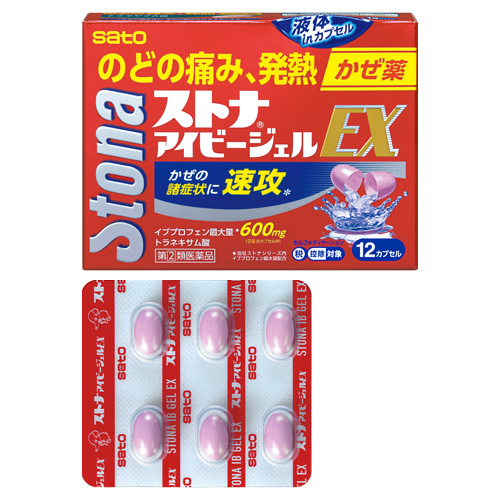
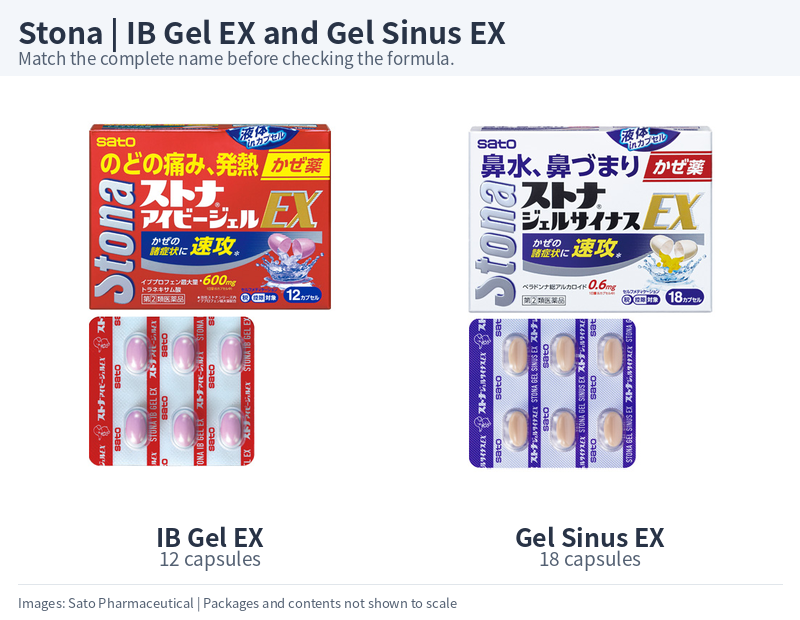
The red box says ストナアイビージェルEX. Its current pack sizes are 12 or 24 liquid-filled soft capsules. The large “600 mg” refers to ibuprofen in the six-capsule daily dose, not one capsule or one administration.
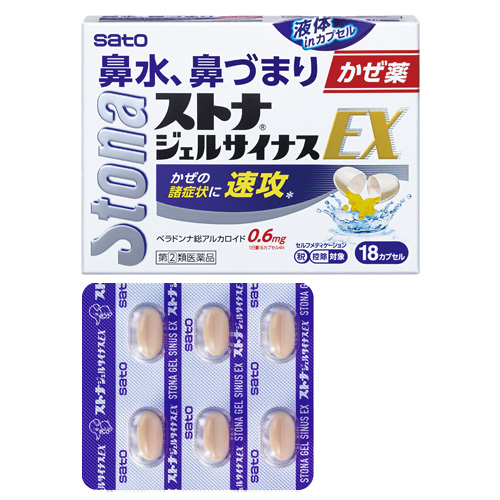
The silver/white box says ストナジェルサイナスEX. Its current pack sizes are 18 or 30 liquid-filled soft capsules. “Sinus” in the name does not add a labelled indication for treating diagnosed sinusitis or allergic rhinitis.
Stona Kyotan Capsules and Stona Plus Gel EX are different products, covered in the separate Stona phlegm-medicine comparison. Do not transfer their age limits to the two products here.
Ingredient differences, using the same daily basis
Every quantity in this table is per six capsules, the labelled daily dose at age 15+. A single administration is two capsules.
| Ingredient group | IB Gel EX per 6 capsules/day | Gel Sinus EX per 6 capsules/day |
|---|---|---|
| Fever and pain | Ibuprofen 600 mg | Acetaminophen/paracetamol 900 mg |
| Additional anti-inflammatory ingredient | Tranexamic acid 750 mg | No tranexamic acid listed |
| Nasal-symptom ingredients | d-Chlorpheniramine maleate 3.5 mg | Belladonna total alkaloids 0.6 mg; diphenylpyraline hydrochloride 4 mg |
| Cough-related ingredients | Dihydrocodeine phosphate 24 mg; dl-methylephedrine hydrochloride 60 mg | Dihydrocodeine phosphate 24 mg; dl-methylephedrine hydrochloride 60 mg; noscapine 48 mg |
| Phlegm-clearing ingredient | Bromhexine hydrochloride 12 mg | Ambroxol hydrochloride 45 mg |
| Anhydrous caffeine | 75 mg | 75 mg |
| Riboflavin, vitamin B2 | Not listed as an active | 12 mg |
IB Gel EX pairs ibuprofen for fever/pain with tranexamic acid’s anti-inflammatory action. Gel Sinus EX uses a different nasal-symptom combination and acetaminophen for fever/pain. They also use different phlegm-clearing medicines. Milligrams of different ingredients cannot be compared as a strength score.
Both already contain cough medicines and an antihistamine. The appropriate question is whether you need and can safely take the whole combination. If only one symptom is troublesome, ask a pharmacist whether a more focused option would fit better.
The “do not take” checks
Neither product may be used by anyone under 15, anyone who has had an allergic reaction to that product or its ingredients, or anyone who has developed asthma after taking that product, another cold medicine or a fever/pain medicine.
IB Gel EX has these additional prohibitions:
- Do not take it within the final 12 weeks before the expected delivery date.
- Do not take it if you are receiving medical treatment for a stomach/duodenal ulcer, blood disorder, liver disease, kidney disease, heart disease or high blood pressure.
- Do not take it if you are receiving zidovudine.
An exclusion from IB Gel EX does not automatically make Gel Sinus EX a safe substitute. The other formula has its own consultation requirements.
Other medicines, alcohol and breastfeeding
While taking either product, do not use other cold medicines, fever/pain medicines, sedatives, cough/expectorant medicines, or oral medicines containing antihistamines, including certain rhinitis, motion-sickness and allergy products. Gel Sinus EX additionally prohibits gastrointestinal pain-relief/antispasmodic medicines. Bring the actual packages, including medicines bought outside Japan, for checking.
After taking either, do not drive or operate machinery. Drowsiness can occur; Gel Sinus EX also warns of blurred vision and unusual glare. Do not drink alcohol before or after taking either medicine.
For breastfeeding, both labels say to avoid the medicine, or to avoid breastfeeding if taking it. Discuss an appropriate option with a doctor or pharmacist rather than taking it while continuing to breastfeed.
Conditions that need advice before use
For either product, consult a doctor, pharmacist or registered salesperson first if you are receiving medical or dental treatment, pregnant or possibly pregnant, older, have a history of medicine/other allergies, have a high fever or have difficulty urinating. IB Gel EX’s outright prohibitions above still apply.
Gel Sinus EX: consultation is required for diagnosed thyroid dysfunction, diabetes, heart disease, high blood pressure, liver or kidney disease, stomach/duodenal ulcers, glaucoma, impaired respiratory function, obstructive sleep apnea or obesity.
IB Gel EX: its consultation list covers a diagnosis or history of stomach/duodenal ulcers, blood disorders, liver/kidney/heart disease, high blood pressure, bronchial asthma, systemic lupus erythematosus, mixed connective tissue disease, ulcerative colitis, Crohn’s disease, thyroid dysfunction, diabetes, glaucoma, blood clots or a risk of thrombosis, impaired respiratory function, obstructive sleep apnea or obesity. Examples of clots on its label include cerebral thrombosis, myocardial infarction and thrombophlebitis. If you are currently being treated for one of the conditions in its prohibition list, do not use it.
How to take it and when to stop
- Check the exact box and all medicines you already take. Both products here are for age 15+. Never adapt them into a child’s dose.
- Take two capsules per administration, three times daily, preferably within 30 minutes after meals. Push the capsules out of the blister first; never swallow a capsule with its blister packaging.
- Stop if there is no improvement after 5–6 administrations. This means doses, not days. IB Gel EX particularly highlights fever lasting three days or more, or fever that returns.
- Do not exceed the duration limit. IB Gel EX must not be taken for more than five days. Gel Sinus EX prohibits long-term continuous use. Neither instruction overrides the earlier 5–6-dose review point or an adverse reaction.
- Store properly. Keep in a cool, dry place away from sunlight and children; do not transfer to another container or use after expiry.
Gel Sinus EX’s vitamin B2 can turn urine yellow. That label note does not explain away dark brown urine with jaundice or other illness symptoms.
Adverse reactions: do not wait for the next dose
Stop and seek professional advice for new reactions such as rash/redness/itching, nausea or vomiting, loss of appetite, stomach pain, diarrhea, dizziness, difficulty urinating or unusual swelling. Read the enclosed leaflet for the complete list. IB Gel EX also lists unusual bruising/bleeding, palpitations, insomnia, low mood, blurred vision and ringing in the ears; Gel Sinus EX lists headache, numbness, facial flushing and unusual glare, among other reactions.
Constipation, dry mouth or drowsiness that persists or worsens means stopping and consulting with either product. Gel Sinus EX includes persistent/worsening blurred vision in this instruction; IB Gel EX lists blurred vision among reactions requiring immediate stopping and advice.
Stop and get medical help immediately for breathing difficulty, faintness/confusion, a widespread worsening rash with fever or eye/lip inflammation, yellow skin/eyes or dark brown urine, or reduced urination with swelling. IB Gel EX additionally warns about serious gastrointestinal bleeding, blood disorders, aseptic meningitis, heart attack and stroke. Black stools, vomiting blood, severe headache with a stiff neck, chest pressure with cold sweats, or sudden one-sided weakness/speech difficulty need immediate care. Do not wait for paired or accompanying symptoms to appear before seeking help, or wait through the usual trial period.
Irene’s takeaway
IB Gel EX and Gel Sinus EX give you different ingredient combinations for overlapping cold symptoms. Start with medical suitability and duplication checks, then consider which formula matches your symptoms. Both are 15+, both prohibit driving after use, and both require stopping for lack of improvement after 5–6 doses.
Official sources and image credits
Checked on 14 October 2026 against the current Japanese leaflets, both revised February 2026. Follow the leaflet in the package you buy. Package and blister images: Sato Pharmaceutical Co., Ltd.