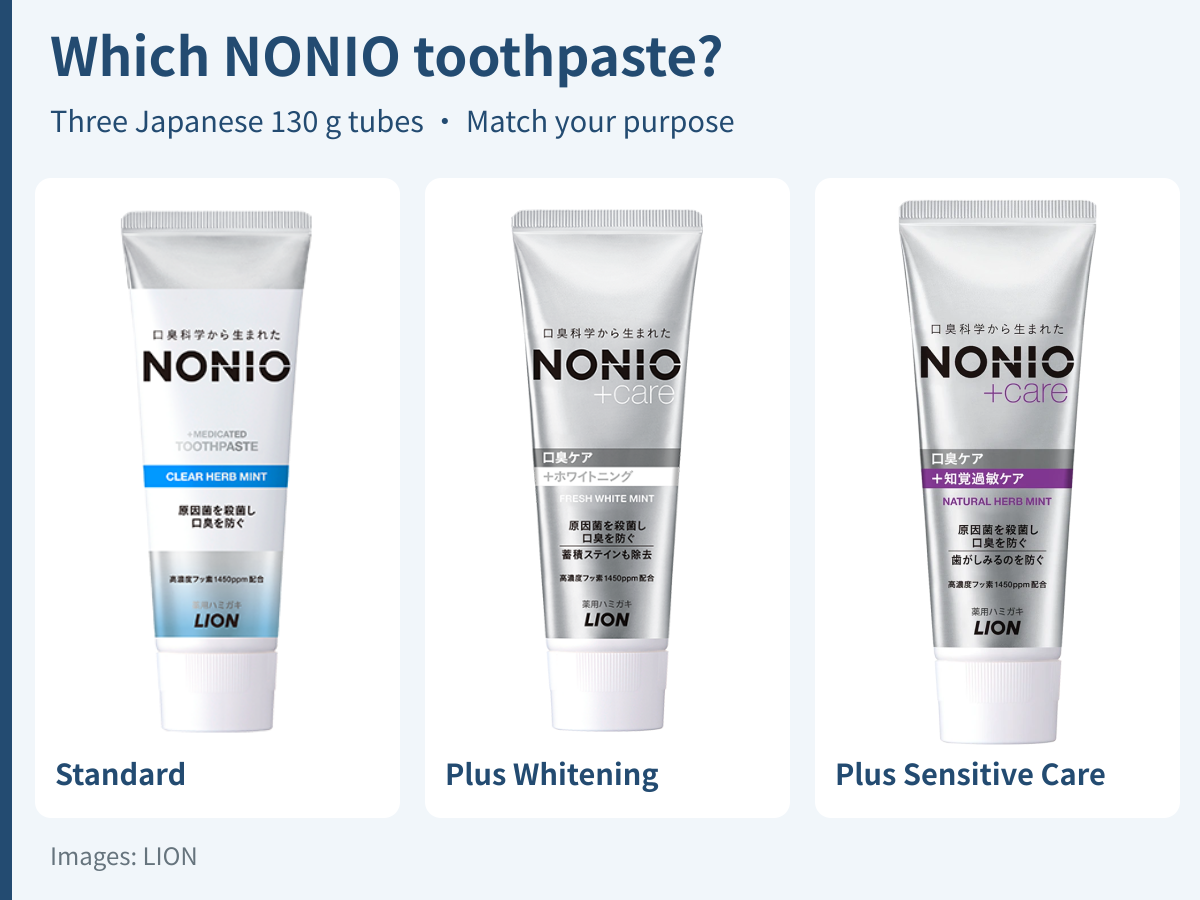
Choose NONIO by what you want alongside breath care: standard Clear Herb Mint for the basic option, Plus Whitening for added surface-stain care, or Plus Sensitive Care for sensitivity prevention. All three include fluoride and bad-breath prevention. “Plus” is a purpose cue, not an overall strength ranking.

I’m Irene, a Taiwan-born, Japan-licensed pharmacist working in a Japanese drugstore. If you’re buying toothpaste for someone else, one extra question helps: do they want their usual tube, or a different purpose? Let’s match the full name before choosing.
Information checked: 19 October 2026. This guide compares three current Japanese 130 g toothpastes. All are Japanese quasi-drugs, a regulated preventive oral-care category, not OTC medicines. Versions sold in other countries may differ.
Start with the purpose and match the label
Basic breath care: standard NONIO
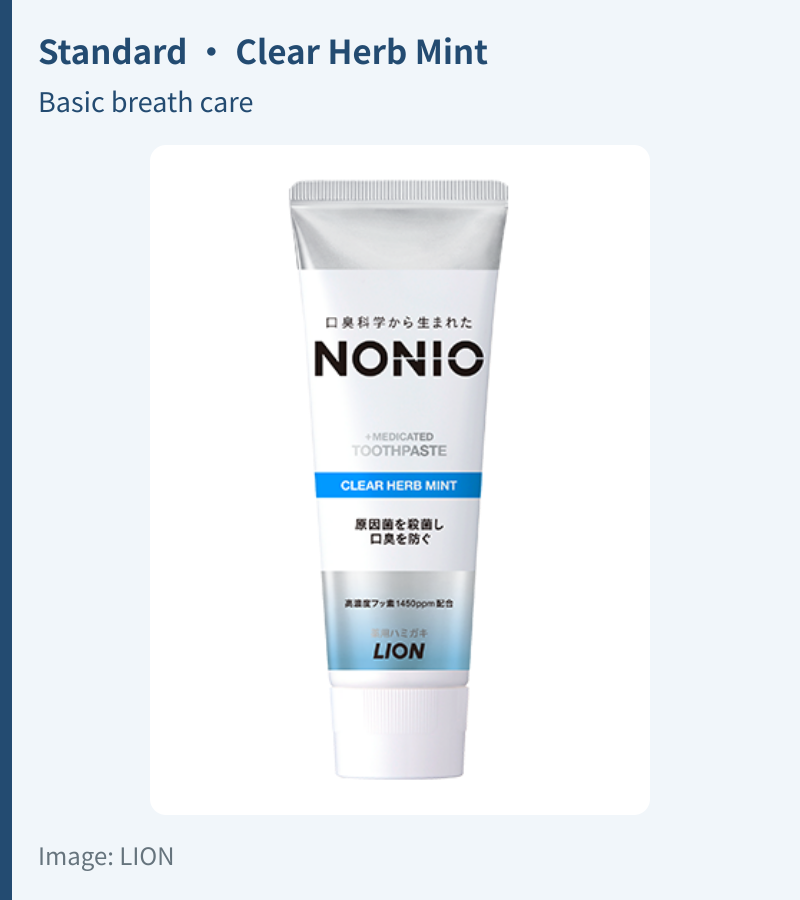
Look for NONIOハミガキ クリアハーブミント, 130 g. The flavour is Clear Herb Mint. If someone asks for their usual NONIO without requesting an extra feature, check this full name first. The standard range has other flavours; this comparison fixes one flavour rather than presenting each as a different treatment.
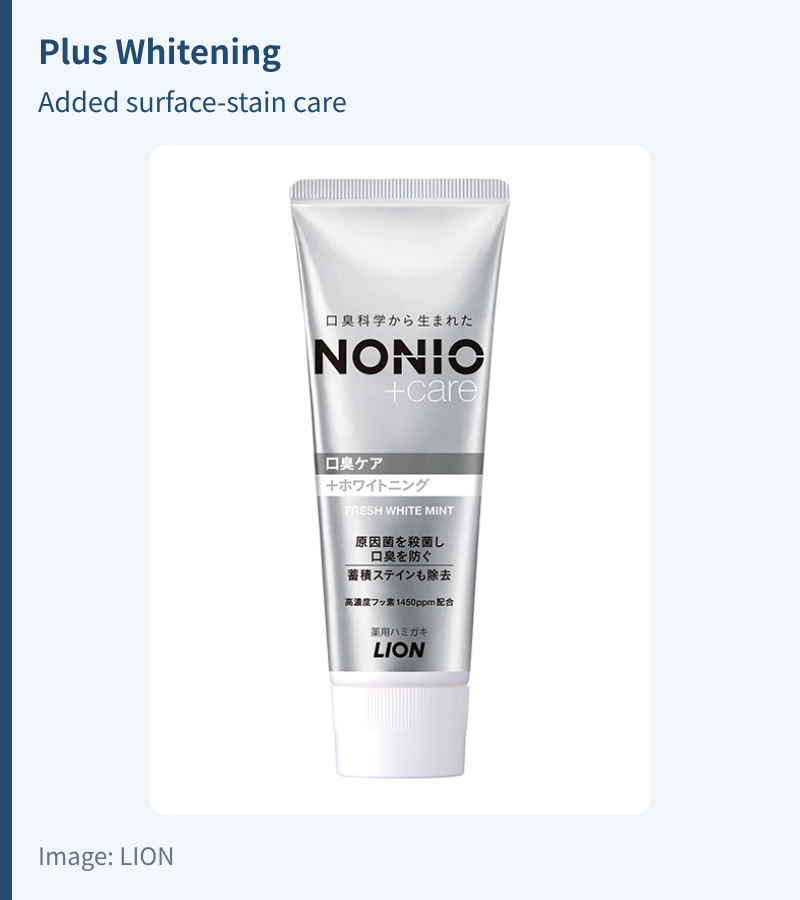
Breath care plus surface stains: Plus Whitening
Look for NONIOプラスホワイトニングハミガキ, 130 g. Its flavour is Fresh White Mint. The useful package clue is ホワイトニング, meaning whitening. The added reason to consider it is its stain-removal formulation; it is not a tooth-bleaching treatment.
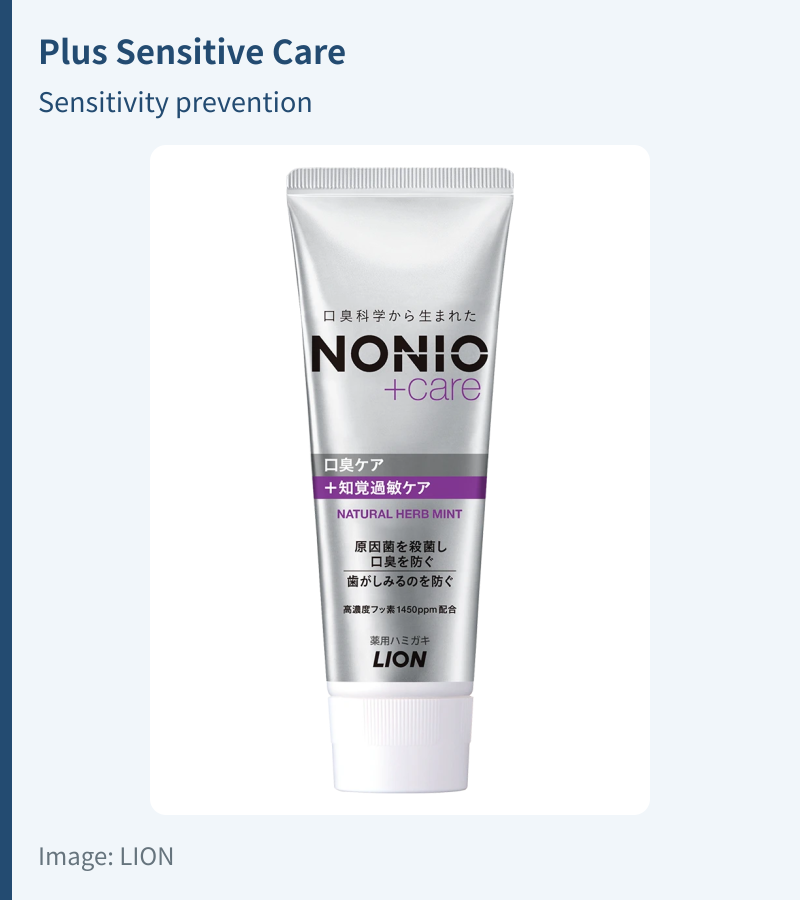
Breath care plus sensitivity prevention: Plus Sensitive Care
Look for NONIOプラス知覚過敏ケアハミガキ, 130 g. Its flavour is Natural Herb Mint. 知覚過敏 identifies tooth sensitivity. This version contains potassium nitrate. Unexplained tooth pain needs a dental assessment before assuming sensitivity is the cause.
What changes between the three?
The standard tube already includes stain care
The standard toothpaste contains the active ingredients sodium lauroyl sarcosinate (LSS), sodium polyphosphate and sodium fluoride. Its labelled purposes include preventing bad breath, whitening teeth, cleaning the mouth and preventing the development and progression of tooth decay. Choosing the basic option does not mean giving up every stain-care benefit.
Lion describes Clear Herb Mint as a refreshing herbal-mint flavour. That is the manufacturer’s description, not my personal taste test. A stronger mint sensation would not establish stronger antibacterial action.
Plus Whitening adds a polishing ingredient
Alongside the same three named active ingredients, this formula lists aluminium oxide as a polishing agent. Lion describes its “Shiny Powder” design as helping remove stains in microscopic surface irregularities. It is an option to compare when surface discolouration is your additional priority within NONIO.
Whitening here means surface-stain removal, not changing your teeth’s natural colour through bleaching. Ask a dentist about stains that do not brush away rather than scrubbing harder. Lion does not provide an abrasivity ranking for these three products, so the name alone cannot establish which is gentlest or harshest.
Fresh White Mint is described by Lion as a mint flavour with grapefruit and lychee notes. It is not mint-free or fragrance-free.
Plus Sensitive Care adds potassium nitrate
This version adds potassium nitrate to the three active ingredients listed above, for preventing sensitivity-related pain. It also has a labelled whitening purpose. You do not have to assume sensitivity care means no stain care at all.
Lion describes Natural Herb Mint as a gentle herbal-mint flavour. A mild-sounding flavour does not guarantee an irritation-free product. It does not mean abrasive-free either: all three ingredient lists include silica as a cleaning agent.
When to get dental care: toothache lasting more than two days, pain on biting, fever or cheek/jaw swelling needs a dentist. Persistent bad breath despite a few weeks of improved cleaning, or painful, bleeding or swollen gums, also warrants assessment. Seek emergency help if mouth or neck swelling makes breathing, swallowing or speaking difficult. Sensitivity toothpaste cannot rule out decay, a cracked tooth or infection.
All three contain 1,450 ppm fluoride
Each individual Japanese product page confirms 1,450 ppm fluoride and says to avoid use in children under six and store out of children’s reach. The standard version is not a low-fluoride children’s toothpaste. The herbal flavour of Sensitive Care does not make it suitable for younger children.
For children aged six or older, make sure they can spit reliably and use an amount appropriate to their age and dental advice. If you already follow an individual cavity-prevention plan, show your dentist your existing toothpaste and rinses before changing it.
How to use these toothpastes
- Put toothpaste on a toothbrush and brush gently and thoroughly. The Lion toothpaste FAQ linked from all three pages gives a general reference of about 1 g, or approximately 1–2 cm. Tube openings and paste density affect that length. This is a general guide, not a fixed dose for every child.
- Spit out, then rinse lightly. Lion’s FAQ advises water or lukewarm water after spitting: approximately 5–15 mL depending on age, for about five seconds, with roughly one rinse recommended. Do not deliberately swallow the paste. If your dentist has given individual instructions, check how these products fit that plan.
- Stop if an abnormal reaction occurs. Each product’s official caution says to stop for a rash or other unusual symptoms and consult a doctor, taking the product along.
Keep cleaning between your teeth and attending regular dental check-ups. You do not need to use the three tubes as successive steps. Pick a suitable toothpaste you are comfortable using regularly.
A final shelf check
- Name: Clear Herb Mint in the standard range, Plus Whitening, or Plus Sensitive Care.
- Format: this article covers 130 g tubes. A bottle labelled デンタルリンス or 液体歯磨 is liquid toothpaste; マウスウォッシュ or 洗口液 identifies a different mouthwash product. Sharing the NONIO name does not make their directions interchangeable.
- Version and user: read the Japanese package’s complete directions, ingredients and age restriction. Check actual shop stock and price; neither pack size nor price is an effectiveness ranking.
Irene’s reminder: ask for clear photos of the old tube’s front and back, then confirm whether the person actually wants to change purpose. If they say their teeth hurt, encourage a dental assessment instead of simply buying a sensitivity toothpaste.
For another brand, see the separate APAGARD five-product guide or Clean Dental comparison. An extra medicinal fluoride rinse after brushing has different directions: see Clinica Fluoride Medical Coat.
Official sources and full ingredients
Open each Japanese product page for its complete ingredient list and cautions, and follow the label on your own tube. This guide does not replace individual dental advice.