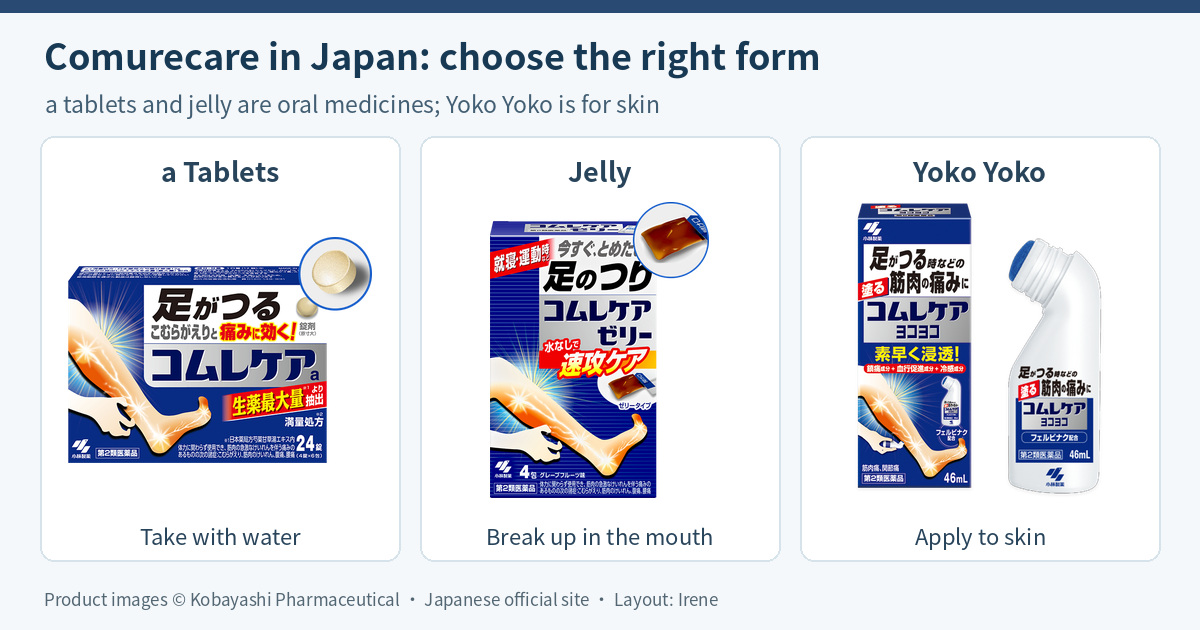
Start with how the medicine is used: Comurecare a tablets and Comurecare Jelly are oral Shakuyakukanzoto medicines; Comurecare Yoko Yoko is a skin-applied liquid containing felbinac and other ingredients. Similar blue boxes and calf illustrations hide an important difference in formula, directions and safety limits. Check the full Japanese name before choosing.

I’m Irene, a Taiwan-born pharmacist licensed in Japan, currently working in a Japanese drugstore. Let’s make this shelf easier to read: first recognise a, ゼリー and ヨコヨコ, then check what you actually do with each product.
- Comparing oral medicines for painful muscle cramps? Look at a tablets and Jelly. Once the age, health and medicine checks are satisfied, the practical choice is tablets taken with water or a jelly that needs no water.
- Looking for a muscle-pain medicine to apply to the skin? Look at Yoko Yoko, with a separate check for asthma, pregnancy, allergies and skin condition. Its formula differs from the oral products.
- Only want your feet to feel cool after walking? Take a rest and assess how you feel before buying a medicine. New pain and swelling in one leg should not be assumed to be ordinary walking fatigue.
Checked 18 October 2026. This guide covers the current Japanese コムレケアa, コムレケアゼリー and コムレケア ヨコヨコ, all Class 2 OTC medicines in Japan. Comurecare plus “tablets”, “jelly” or “topical liquid” is used here to help identify the Japanese products. Formulas, availability and import rules in other countries need separate checking.
Read the whole name: a, ゼリー or ヨコヨコ
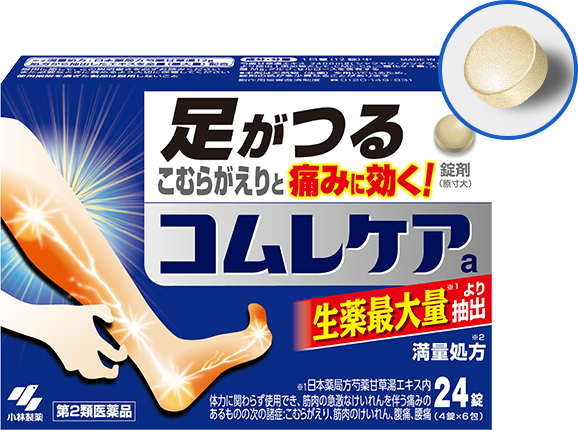
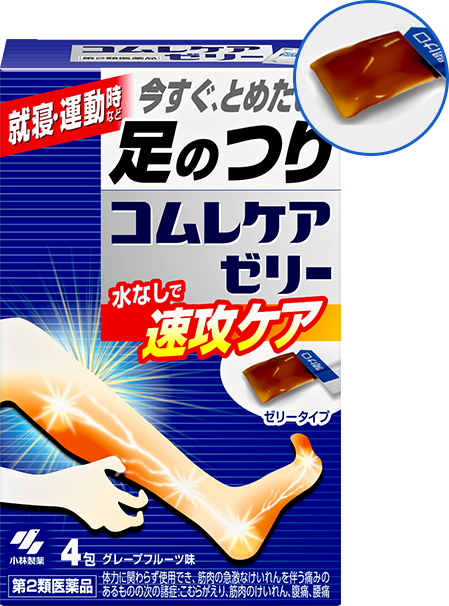
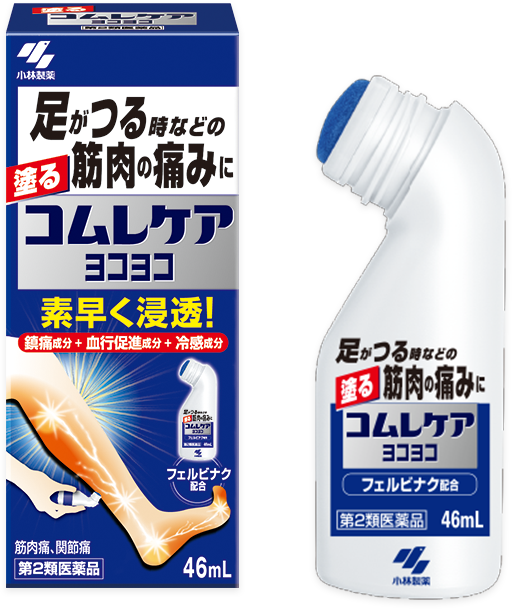
足がつる and こむら返り refer to cramps; 筋肉痛 means muscle pain. A cramp often involves sudden muscle tightening and sharp pain, which is a different description from lingering soreness after a long walk. These words help you read a label; they cannot diagnose the reason for your pain.
Compare the formula and purpose before the format
| Japanese product | Formula and labelled uses | Practical distinction |
|---|---|---|
| コムレケアa Comurecare a | Shakuyakukanzoto, a Kampo herbal formula. The indication requires pain associated with sudden muscle spasm: calf cramps, muscle spasms, and abdominal or lower-back pain meeting that condition. | Oral tablets. Labelled doses start at age 7 and change at age 15. |
| コムレケアゼリー Comurecare Jelly | Also Shakuyakukanzoto, with the same labelled indications as a tablets. | Oral jelly, for ages 15 and over only. Grapefruit flavour; no water needed, but break it up in the mouth before swallowing. |
| コムレケア ヨコヨコ Comurecare Yoko Yoko | Per 100 g: felbinac 3 g, tocopherol acetate 0.5 g and l-menthol 6 g. A topical anti-inflammatory pain reliever for muscle pain, sprains, joint or lower-back pain, tenosynovitis (pain and swelling in the hands, wrists or ankles), elbow pain, bruises and shoulder pain associated with stiffness. | For ages 15 and over. Apply to the affected skin. It is a different medicine from the two oral products and must not be swallowed. |
At the labelled adult daily amount, both oral products use extract made from 6 g of peony root and 6 g of licorice root. The tablet label lists 2,400 mg of extract in 12 tablets; the jelly lists 27 g of extract in three sachets weighing 33 g in total. Those extract weights across different dosage forms are not a potency comparison. They do not show that Jelly is more than ten times stronger, or establish that it works faster than the tablets.
Felbinac in Yoko Yoko is a non-steroidal anti-inflammatory drug (NSAID); menthol adds a cooling sensation. The manufacturer also describes its use for muscle pain occurring during cramps. That does not give it the same action as the oral medicines or make it a cramp-prevention treatment. More cooling or stinging is not a reason to apply extra.
Check these restrictions before buying
- a tablets and Jelly: do not take them if you have been diagnosed with heart disease. Consult a doctor, pharmacist or registered OTC seller before use if you are receiving medical treatment, pregnant or possibly pregnant, an older adult, or have swelling, high blood pressure or kidney disease. Kidney disease is a consult-first condition; heart disease is a do-not-use condition.
- Yoko Yoko: do not use if under 15, pregnant or possibly pregnant, if you have ever had asthma, or if you have had an allergy to this product or its ingredients. The asthma restriction is not limited to asthma triggered by painkillers. Consult first if receiving medical treatment or if medicines or other substances have caused allergic symptoms.
- Other medicines or supplements: show the pharmacist the full names, especially anything containing licorice, glycyrrhizin or another Shakuyakukanzoto formula. Do not add a full tablet schedule to a full jelly schedule. This is a duplicate-ingredient check, not a claim that every other medicine is prohibited.
The three current Japanese leaflets do not contain a separate breastfeeding-specific restriction. That omission does not establish that self-treatment is suitable while breastfeeding; ask a health professional about the exact product and your circumstances.
Exact directions: the tablet and jelly age limits differ
| Product and age | Labelled dose or frequency | How to use |
|---|---|---|
| a tablets: age 15+ | 4 tablets per dose, 3 times daily; this schedule allows no more than 12 tablets a day. | Before meals or between meals, with water or warm water. |
| a tablets: ages 7–14 | 2 tablets per dose, 3 times daily; no more than 6 tablets a day. Do not give to children under 7. | Before or between meals with water or warm water, under a parent or guardian’s supervision. |
| Jelly: age 15+ | 1 whole sachet per dose, 3 times daily; no more than 3 sachets a day. Do not use under 15. | Before or between meals. Break up the jelly in your mouth before swallowing. Use the whole sachet for one dose; do not divide it. |
| Yoko Yoko: age 15+ | A suitable amount 2–4 times daily; no more than 4 applications a day. | Apply only to the affected skin. The leaflet does not specify mL per application or a number of strokes. |
“Between meals” means about 2–3 hours after a meal, not while eating. These are the labelled directions and daily limits calculated from them, not targets you must finish. Both oral leaflets say to take the medicine only while symptoms are present and not to take it continuously. Do not start taking it without symptoms simply because tomorrow involves lots of walking, or use it as a long-term daily preventive.
How to take the jelly
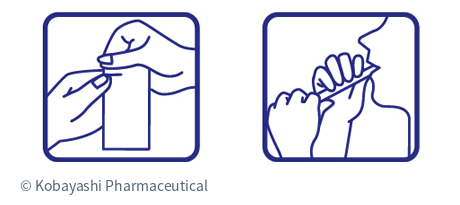
- Hold the sachet upright and tear along the notch.
- Bring the opening to your lips, squeeze the jelly out with your fingers and break it up in your mouth before swallowing.
- Use one entire sachet for the dose. Do not save part for later. Some liquid may separate from the jelly; take care with splashes and the torn edge against your lips.
For a tablets, count the correct number for the person’s age and take them with water or warm water. If a child’s dose leaves tablets in an opened sachet, fold its opening at least twice and use or discard the remainder that day. A sachet is not automatically the correct dose for every age.
How to use the topical liquid
Remove the cap and use the sponge applicator to spread a suitable amount on appropriate affected skin. Do not apply around the eyes or on mucous membranes; keep the liquid out of the eyes. Do not use on eczema, irritated skin, wounds, fungal infections such as athlete’s foot or ringworm, or pus-producing lesions. Do not cover the area with cling film or other poorly breathable material. People with particularly sensitive skin should not keep applying it repeatedly to the same spot.
If it stings strongly, wash it off with soap. Stop and consult with the box if you develop rash, redness, itching, swelling, stinging or dermatitis. If it gets into an eye, rinse immediately with water or lukewarm water; seek eye care for severe symptoms. Close the cap tightly and store upright, away from flames, direct sunlight and heat, out of children’s reach. Do not decant it, and avoid spills on plastics, leather or painted surfaces that it could damage. Follow the expiry date and package storage instructions for all three products. Use the topical liquid promptly after opening; its leaflet does not set a fixed number of months.
When to stop: 5–6 doses is different from 5–6 days
- a tablets and Jelly: stop and consult a doctor, pharmacist or registered OTC seller if symptoms have not improved after 5–6 doses. Take the box or leaflet with you.
- Yoko Yoko: stop and consult if there is no improvement after 5–6 days. Do not use continuously for a prolonged period. Worsening symptoms or side effects require action sooner.
The oral medicines contain licorice and carry warnings about rare serious effects including pseudoaldosteronism and muscle disease. Stop and obtain medical care immediately if new or worsening limb heaviness, numbness or tightness is accompanied by weakness or muscle pain. Do not assume this is simply another cramp and take extra. Also stop and get immediate medical care for new or persistent breathlessness, dry cough or fever, or for palpitations, chest pain, fainting, yellow skin or eyes, or dark urine. These are other serious warning signs in the leaflets. Symptoms alone cannot identify the cause at home.
With the topical liquid, hives, hoarseness, an itchy throat, breathing difficulty, palpitations or confusion soon after use can signal a serious allergic reaction. Stop using it and get immediate medical help.
New pain and swelling in one leg, or a change in skin colour, warrants prompt medical assessment. If accompanied by chest pain or shortness of breath, seek emergency help immediately. Get medical advice for cramps lasting more than 10 minutes, cramps with numbness or swelling, or episodes that repeatedly disturb sleep. Persistent or worsening leg pain should not be repeatedly dismissed as “too much walking”.
Where Ammeltz and cooling sheets fit
For a different comparison of topical pain medicines, see Ammeltz A, EX, NEO and Ladyna in Japan. Even when a bottle says Yoko Yoko, the brand and full product name still matter. For cooling comfort at the hotel, see Kyusoku Jikan cooling sheets and how to place them. Those non-medicinal sheets do not replace assessment of cramps or persistent pain.
A useful shopping order is check the symptoms and restrictions, identify a / ゼリー / ヨコヨコ, then check age and directions. A photo of the full product name is more useful than remembering “the blue box”.
Sources
- Kobayashi Pharmaceutical: a tablets product information and current Japanese leaflet.
- Kobayashi Pharmaceutical: Jelly product information and current Japanese leaflet.
- Kobayashi Pharmaceutical: Yoko Yoko topical liquid product information and current Japanese leaflet.
- Kobayashi Pharmaceutical: Japanese Comurecare range and packaging.
- Japan Ministry of Health, Labour and Welfare: patient information on pseudoaldosteronism, for licorice/glycyrrhizin and combined-medicine risk.
- NHS: leg cramps and when to get medical advice; warning signs of deep vein thrombosis. General safety information; Japanese product doses come from the Japanese leaflets.
This is a guide to identifying Japanese products and understanding their labels, not an individual diagnosis. Read the current leaflet supplied with your own product before use.